When royal crusaders marched into Bohemia during the 1420s to suppress the Hussite religious reform movement, they faced field fortifications built from heavy farm wagons. Standing atop these wooden ramparts were former agricultural laborers armed with their primary working tool: the two-handed grain flail. Modified with iron bands, forged studs, and reinforced joints, these long-hafted implements bypassed the traditional swordplay of knightly cavalry and delivered devastating kinetic shock through plate armor, mail, and iron helmets.
The Anatomy of the Threshing Floor
In rural Bohemia during the early fifteenth century, the agricultural flail (cep) was ubiquitous. Designed for threshing grain to separate kernel from husk, the tool relied on an efficient mechanical transfer of human motion. Its construction required no specialized sword-smithing: a long, light wooden pole (násada) served as the haft, connected via a flexible leather loop or swivel to a heavy, shorter piece of seasoned hardwood known as the striker (biják).
The mechanics of threshing demanded hours of continuous rhythmic swinging against wheat stacks on barn floors. Farm laborers developed muscle memory for generating smooth, powerful downward arcs that accelerated the free-swinging striker. When religious crisis engulfed the Kingdom of Bohemia following the execution of Jan Hus in 1415, thousands of peasants joined the radical Hussite factions without formal military equipment or sword training, bringing their personal farming implements into field camps.
Reinforcing the Striker for War
While a standard wooden threshing flail could bruise an unarmored opponent, it lacked the density and durability to breach late medieval armor. Blacksmiths in radical Hussite strongholds such as Tábor quickly established standardization routines to transform these agricultural implements into war weapons (válečné cepy).
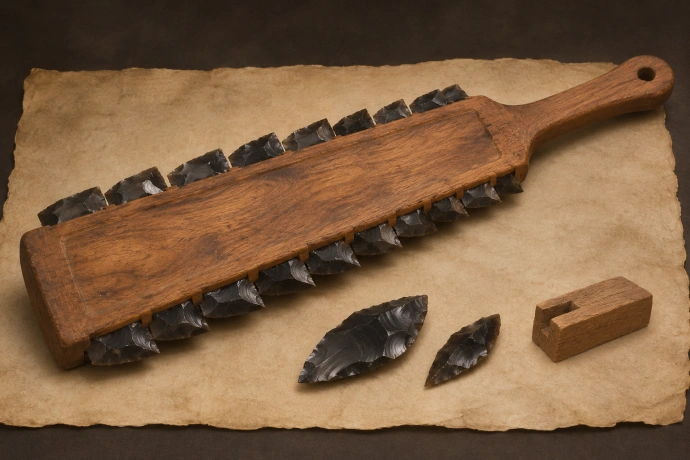
The conversion focused primarily on reinforcing the striking head and its vulnerable point of connection. Blacksmiths fitted thick iron hoops or longitudinal iron straps along the hardwood body of the striker to prevent the wood from splitting upon hard impact. To concentrate kinetic force onto a minimal surface area, forged iron studs or short pyramidal spikes were driven into the wood. Finally, the traditional leather binding at the joint was replaced with forged iron eyelets or short, thick chain links to ensure the head could not be severed by a blade.
Key structural modifications converted the farm tool into a battlefield weapon:
- Iron Banding: Longitudinal and transverse iron straps nailed to the wood to prevent splitting against armor.
- Forged Spikes and Studs: Prominent metal teeth driven into the striker head to puncture padded defenses and bite into steel plate.
- Chained Joint Links: Heavy iron ring connections replacing organic leather swivels to resist sword cuts and shear forces.
Tactical Crucible: Jan Žižka and the Hussite Levies
The sudden deployment of militarized agricultural implements was not an act of disorganized desperate resistance. Under the command of Jan Žižka of Trocnov, a veteran nobleman and brilliant tactician, the Hussite forces were organized into a disciplined, professionalized militia. Žižka recognized that his infantry, largely drawn from townsfolk and rural agricultural workers, could not withstand a direct mounted charge by heavy feudal knights in open country.
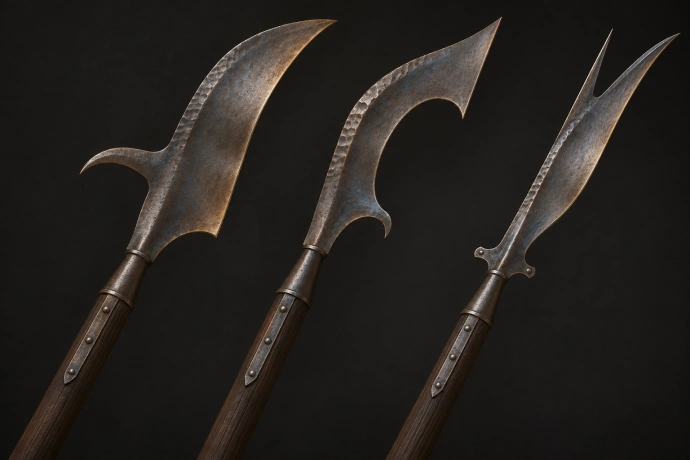
To offset this disadvantage, Žižka structured his forces into specialized tactical teams centered around heavily modified farm wagons. Within this organized doctrine, the war flail was integrated alongside crossbows, early hand firearms (píšťaly and hákovnice), and long polearms like hooks and halberds. The flailmen (cepníci) formed a crucial frontline component of this defense, trained to act in coordinated swinging ranks rather than as isolated skirmishers.
The Wagon Fort as a Fighting Platform
The operational heart of Hussite military success was the vozová hradba or wagon fort (wagenburg). Heavy timber wagons, fortified with thick wooden plank breastworks, were chained wheel-to-wheel in precise geometric enclosures, often atop elevated ground. Each wagon carried a assigned crew of 18 to 21 soldiers with specific duties.
Positioned atop or immediately behind the raised wooden ramparts, flailmen operated with a distinct height advantage. When mounted crusaders or armored infantry attempted to scale the wagons or bridge the narrow gaps between them, the flailmen struck downward from behind timber cover. The elevated position amplified the downward speed of the heavy iron-bound strikers, turning the timber barricades into formidable defensive platforms.
Kinematics and Physics of Jointed Percussion
The jointed flail functions under physical principles fundamentally distinct from rigid percussive weapons like maces, war hammers, or axes. In a rigid weapon, the kinetic energy of the swing transfers directly back into the user's hands and arms upon impact, creating handle shock and requiring strong wrist control to recover from a blocked strike.
In contrast, the flexible hinge of a war flail acts as a mechanical velocity multiplier. As the user pulls the long haft through its arc and decelerates the handle near the apex of the swing, centrifugal force causes the independent wooden striker to accelerate rapidly around the joint. This secondary rotation dramatically increases the impact velocity at the point of contact. Furthermore, because the momentum resides in the jointed head, the energy is discharged into the target rather than bouncing back into the wielder's hands.
Bypassing Parries and Shield Defenses
In addition to high impact force, the jointed construction provided a unique geometric advantage against standard medieval defensive gear. When a rigid weapon strikes the rim of a shield or an opponent's sword blade in a parry, the weapon's trajectory is halted.
When a two-handed flail strikes the upper edge of a knight's shield or a raised arm, the flexible iron link allows the heavy striker to whip over the obstruction. The head continues its arc unimpeded, striking the defender's helmet, collarbone, or shoulder behind their guard. This unpredictable path made traditional parrying techniques ineffective, forcing heavily armored crusaders to keep their distance or risk sudden concussive trauma.
Armour Response: Concussion, Deformation, and Mail Failure
During the 15th century, European plate armor reached high levels of metallurgical and structural protection. While sharp blades glanced off rounded steel breastplates and high-quality kettle hats, rigid plate armor remained susceptible to heavy blunt trauma.
A strike from a two-handed war flail delivered immense kinetic force distributed over the iron bands and studs of the striker. Against mail shirts and padded gambesons, the heavy blunt blow fractured bones and ruptured internal organs without needing to pierce the mail links. Against plate armor, the studs could dent outer plates, bending the steel inward to restrict joint movement, crush limbs, or deliver fatal concussive force through helmet liners.
Archaeological Evidence and Museum Holdings
Physical evidence of authentic 15th-century war flails survives in several Central European collections, notably the National Museum in Prague, the Military History Institute (VHÚ Praha), and the Hussite Museum in Tábor. These artifacts provide concrete proof of how simple agricultural tools were structurally reinforced.
Surviving 15th-century specimens feature heavy, ash or oak strikers measuring between 30 and 50 centimeters in length. The iron work typically shows clear signs of local smithing, including hand-forged square studs driven deep into the timber and heavy iron bands held by flush rivets. The wooden hafts, where preserved, show straight-grained hardwood handles spanning 120 to 140 centimeters, often fitted with iron ferrules at the butt end to prevent splitting under heavy tension.
Iconography in Contemporary Chronicles
The war flail became an iconic visual symbol of the Hussite armies in 15th-century art and literature. Contemporary and near-contemporary illuminated manuscripts, such as the Jena Codex (Jenský kodex) and the chronicle of Ulrich von Richental (Chronik des Konstanzer Konzils), prominently depict Hussite infantry bearing iron-studded flails.
In these period illustrations, flailmen are consistently depicted operating alongside handgunners atop fortified wagons or forming defensive squares. Catholic chroniclers often emphasized the flail in artwork to frame the Hussites as coarse, uncivilized rebels wielding rustic tools. Conversely, Hussite iconography embraced the flail as a proud symbol of righteous peasant resistance and divine justice breaking the power of earthly nobility.
The War Flail Across Central Europe
The tactical effectiveness of the Bohemian war flail did not remain isolated to the Hussite Wars. As veteran Hussite mercenaries later served across Central Europe, and as peasant revolts flared throughout the German-speaking lands during the late 15th and early 16th centuries, the modified two-handed flail was adopted widely.
In Germany, the weapon became known as the Kriegsflegel. German martial arts manuals of the 16th century, most notably the illustrated compendiums of Paulus Hector Mair, formally documented techniques for two-handed flail combat. Mair’s treatises detail specific guards, parries, footwork, and disarming techniques designed specifically for peasant staff implements, demonstrating that the weapon had transitioned from an improvised tool into a recognized martial discipline.
Distinguishing Authentic War Flails from Modern Myths
Popular culture and modern media frequently misrepresent late medieval flails, depicting single-handed weapons with long, swinging chains attached to spiked metal balls. Historical and metallurgical evidence demonstrates that such long-chained single-handed flails were rare, impractically dangerous to the user, and largely exaggerated by 19th-century Romantic artists.
The authentic, historically documented military flail was overwhelmingly a two-handed weapon with a short linkage. The joint consisted of only two or three heavy iron rings or an eyelet pivot, ensuring the striker could not swing back far enough to strike the wielder's hands. Recognizing this distinction separates the practical, battlefield-proven weapon of the Bohemian wagon forts from later Victorian fabrications and modern fantasy imagery.
Further reading
Follow the sources to examine the object and its historical context.
Hussite Museum in TáborExternal reference · Opens in a new tab Military History Institute Prague (VHÚ Praha)External reference · Opens in a new tab