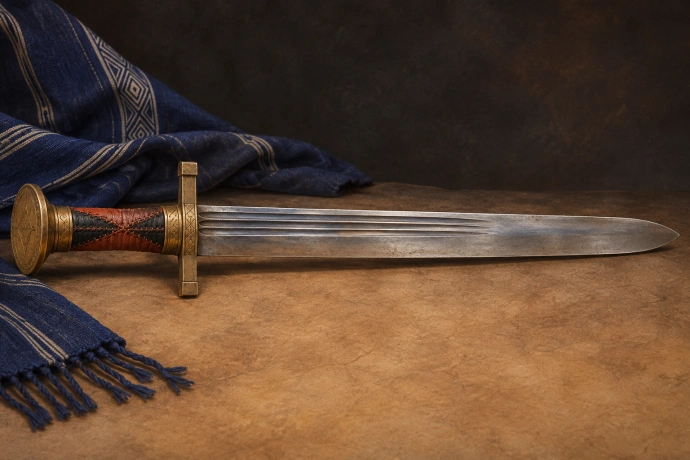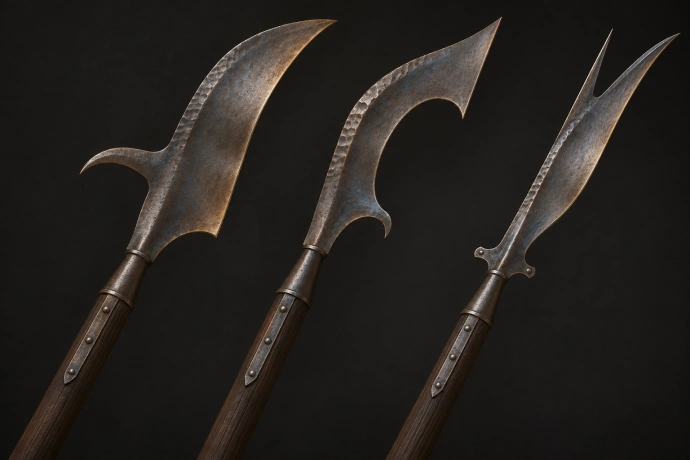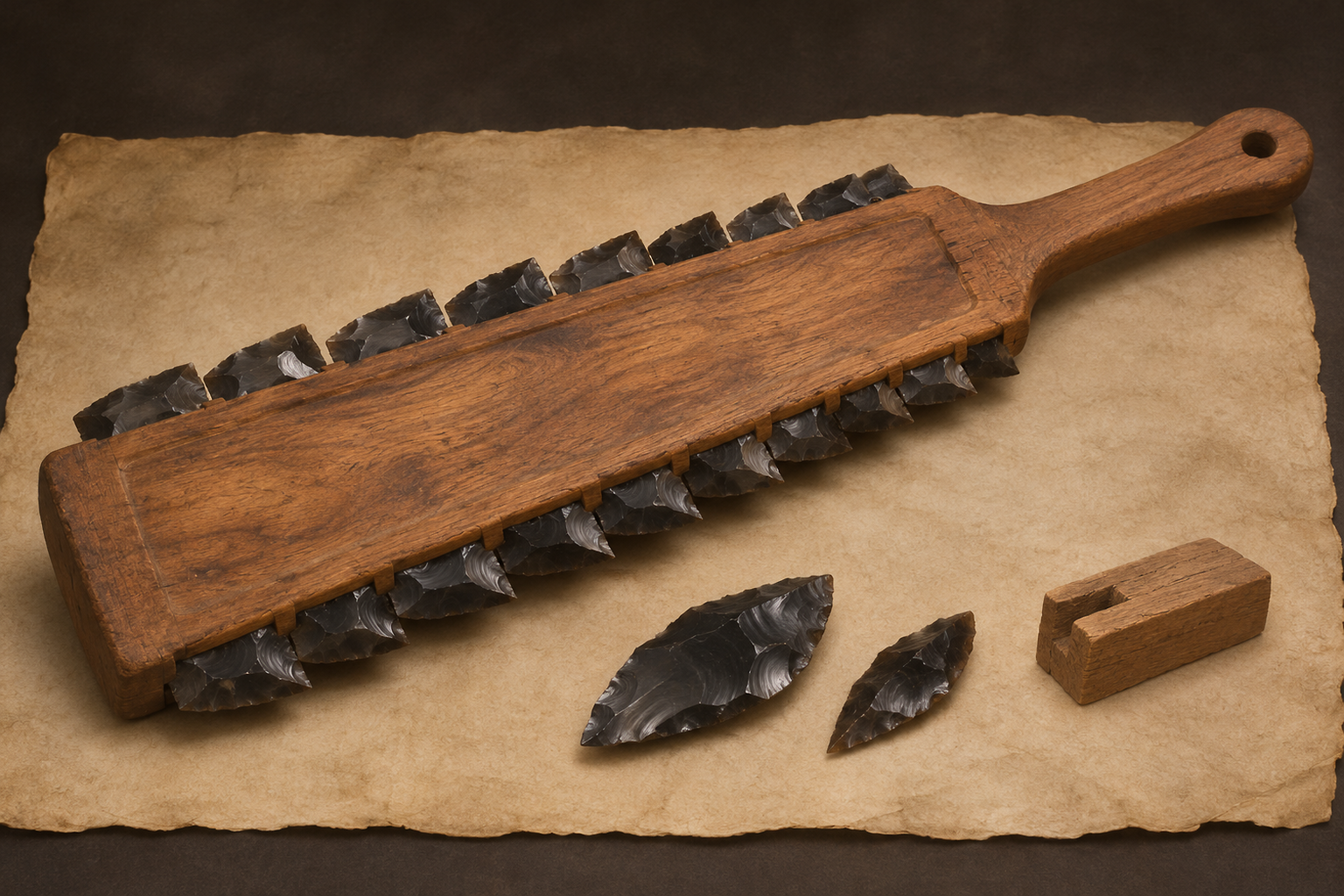
The macuahuitl survives mainly through descriptions, images and fragments rather than a large archaeological series of complete weapons. Its basic design is nevertheless clear: a wooden body carried sharp inserts along one or both edges. Obsidian supplied a very keen but brittle cutting material, while wood provided the grip, mass and support. The important historical question is not whether the weapon possessed an impossible edge, but how makers balanced these different materials and how confidently modern observers can reconstruct the result.
What the Name and Form Tell Us
The word macuahuitl is commonly associated with a wooden weapon fitted with sharp stone elements. Colonial Nahuatl-language and Spanish accounts, together with central Mexican images, establish the broad form: a club-like body with cutting material set along its sides. The surviving evidence does not support one universal design. Illustrations and descriptions vary in the number, placement and apparent size of the inserts.
The category also needs careful limits. A representation in a manuscript is not a surviving weapon, and a modern reproduction is not an archaeological specimen. Nor should every edged club from Mesoamerica be treated as an identical Aztec pattern. Regional traditions, local woods, workshop practice and the intended use of an individual weapon could all affect its construction.
The Wooden Body
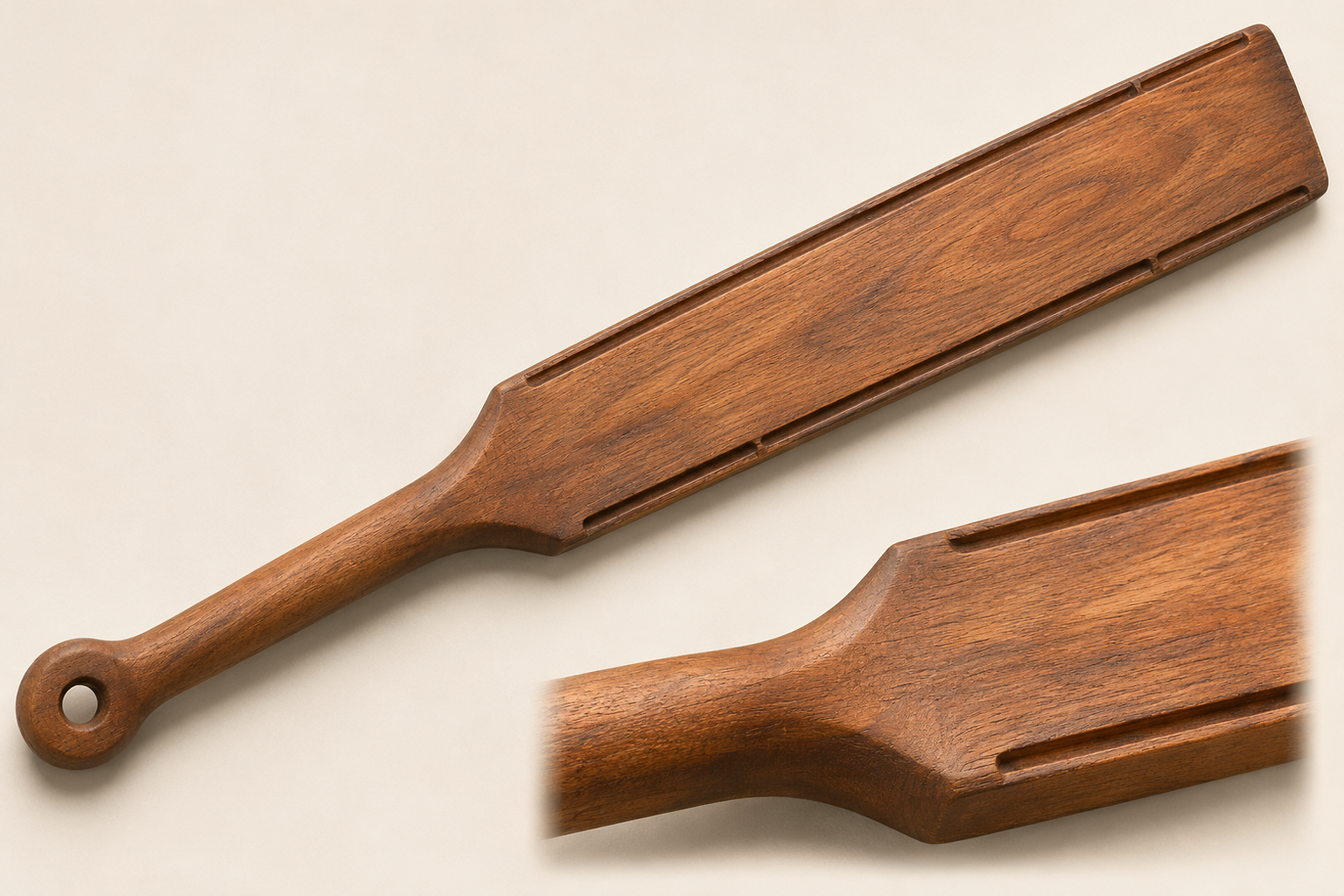
The wooden body carried the stresses that obsidian could not safely absorb. It had to hold the inserts, provide a secure handgrip and survive bending during a strike. Colonial descriptions and images suggest a broadly flat or paddle-like form in at least some examples, but they do not give enough evidence to establish one standard cross-section or a fixed set of dimensions.
Wood identification is difficult when an object has lost its original surface or has been heavily restored. Claims that all macuahuitls used a particular oak, mahogany or other named hardwood go beyond the evidence unless supported by a documented specimen and laboratory study. The safest conclusion is that makers selected workable local timber with enough strength for the intended form.
The handle and blade-bearing section were not interchangeable parts in a simple modern sense. A transition between them had to resist bending, and its shape would influence balance and control. Images can suggest this relationship, but they rarely reveal whether a particular grip was wrapped, carved, painted or fitted with a separate covering.
From Obsidian Core to Cutting Insert
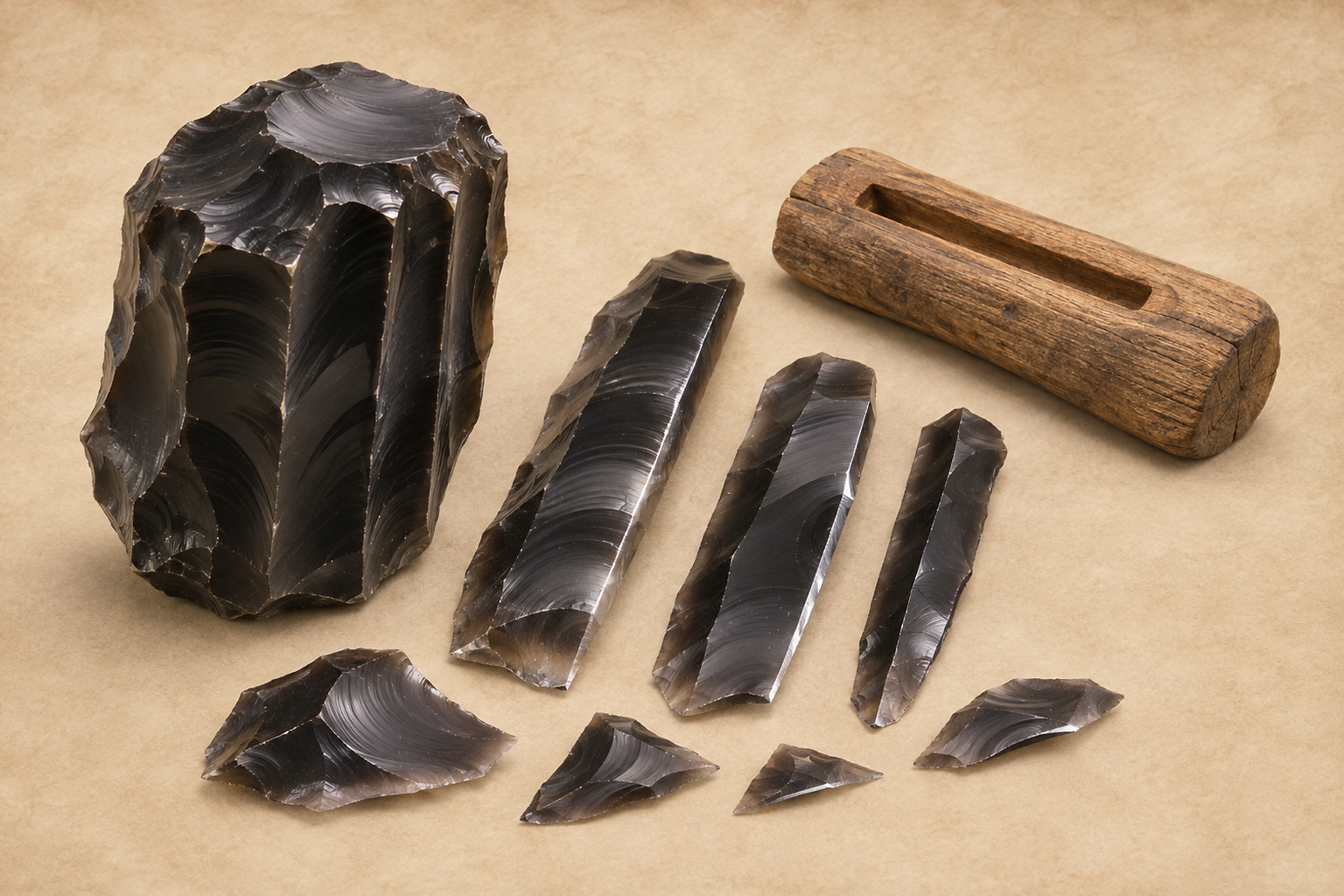
Mesoamerican obsidian technology included the production of prismatic blades from prepared cores. These long flakes offered repeated sharp edges and could be made in standardized forms, although standardization does not mean that every insert for a macuahuitl had the same length or profile. The archaeological presence of prismatic-blade technology demonstrates available expertise; it does not prove the exact manufacturing sequence for a particular weapon.
Obsidian breaks by conchoidal fracture and can produce an exceptionally fine edge. That edge is also vulnerable to chipping when the material receives hard lateral or compressive impact. The useful distinction is between initial keenness and resistance to damage. A sharp insert could cut effectively in suitable contact, while a strike against bone, stone, metal or another hard target could damage it.
The phrase “prismatic core” describes a production method, not a finished weapon part. A core was the prepared mass from which blades were removed. The macuahuitl carried blades or flakes selected from such production, and the exact choice may have depended on the slot, the desired appearance and the maker’s available stock.
How the Inserts May Have Been Set
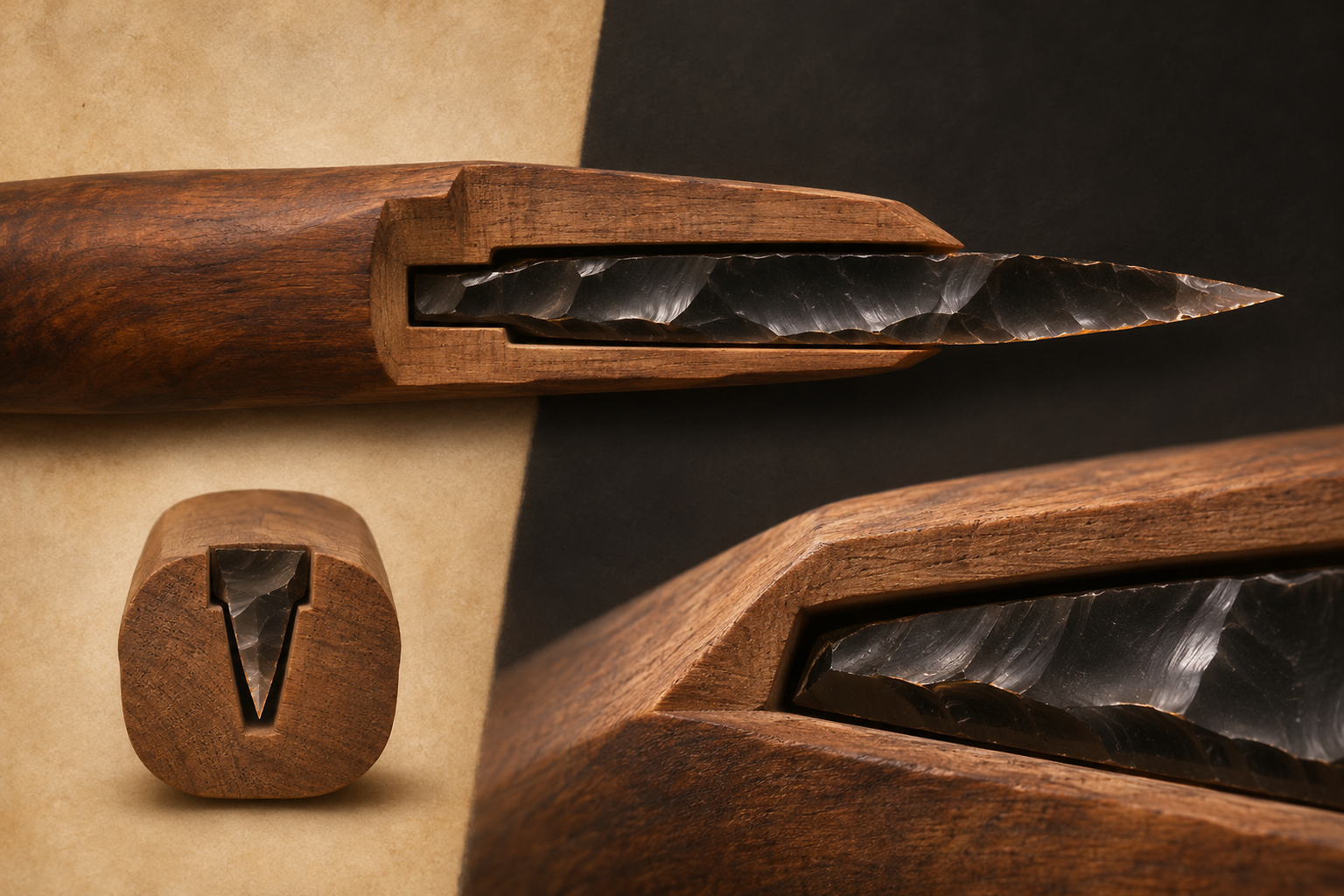
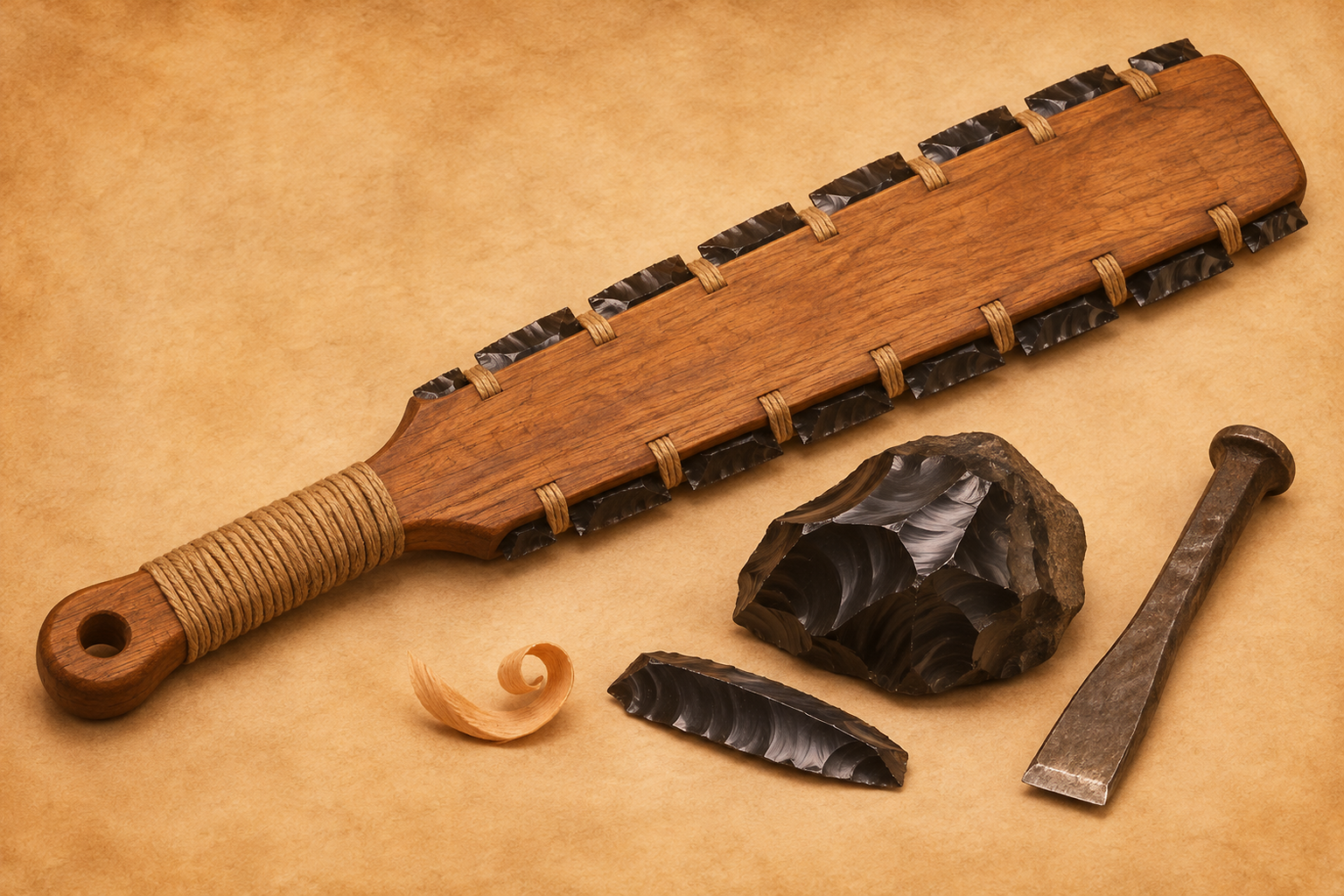
The central construction problem was to hold brittle stone firmly without crushing it. A wooden edge could have been cut or formed to receive the inserts, but the exact cross-section of those settings is not securely documented for every reported specimen. Descriptions and surviving images support the general idea of stone placed along a wooden body; they do not establish a single universal slot profile.
A close fit would reduce movement, but excessive pressure could fracture an insert during assembly. A looser fit would need some other means of retention. This is an engineering inference from the materials, not a directly observed ancient procedure. Modern replicas can test whether a proposed arrangement is workable, yet the result belongs to the replica unless archaeological traces confirm it.
The spacing between inserts also involved a compromise. Closely arranged edges would increase the cutting surface but leave less wood between settings. Wider spacing would preserve more timber while creating interruptions along the edge. Published illustrations may show regular intervals, but apparent spacing can be distorted by scale, artistic convention and later restoration.
Adhesive, Binding and the Limits of Evidence
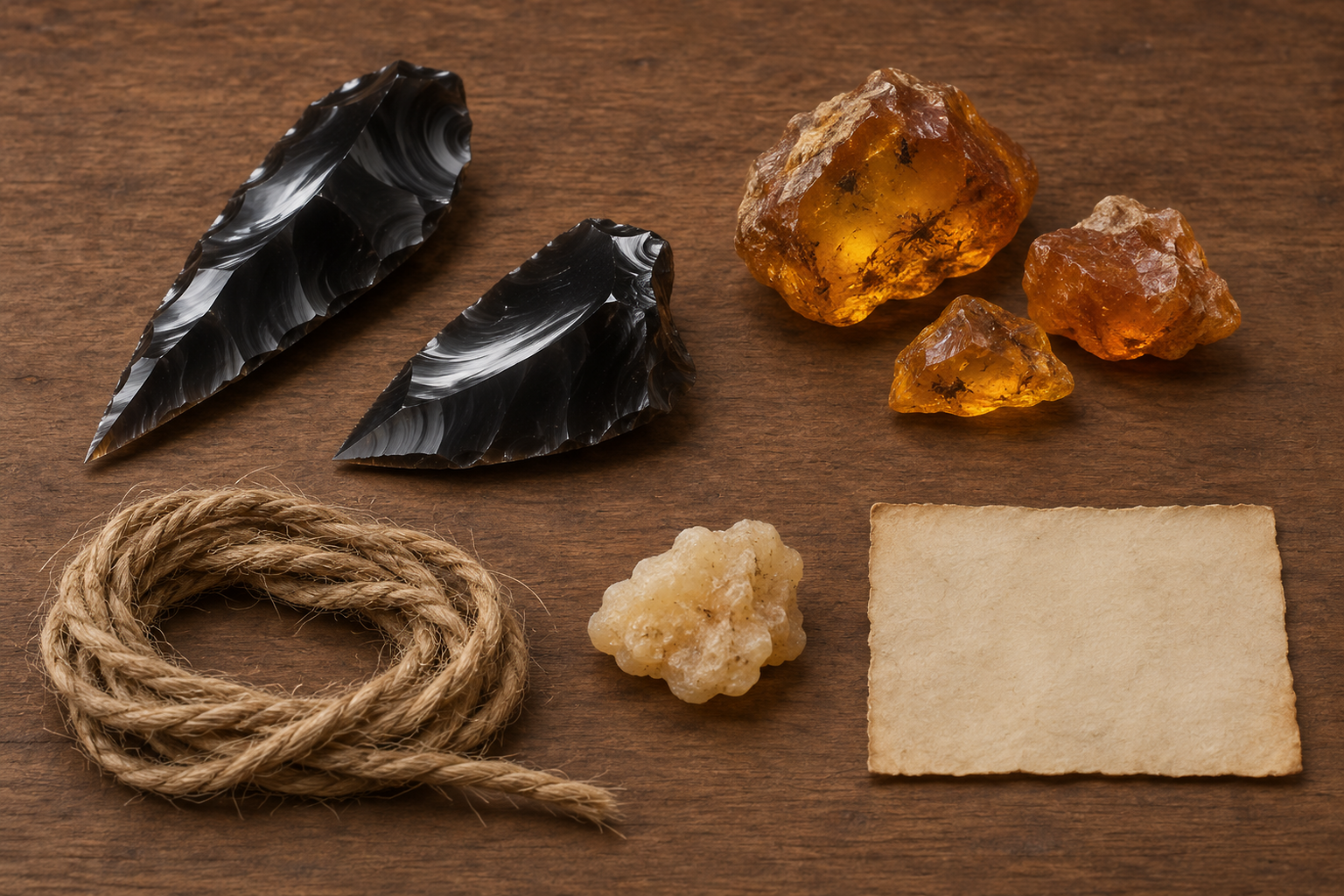
Organic adhesives or bindings are plausible in a composite wooden weapon, but the exact materials used in ancient macuahuitls should not be stated as settled fact without residue or construction evidence. Resin, gum, fiber or another binding substance might have served different roles, yet a plausible material is not the same as a documented one. The tropical and highland environments of Mesoamerica also created different preservation conditions.
Colonial texts may mention gums or other substances in broader technological contexts, but a reference to an adhesive elsewhere does not prove that it secured macuahuitl inserts. Nor does comparative ethnography establish an ancient recipe. Any reconstruction should label its adhesive as experimental or provisional unless a specific object preserves identifiable residue.
The same caution applies to claims about heating, mixing or field replacement. Such actions may be mechanically sensible, but the surviving record does not provide a complete workshop manual. Historical engineering can be discussed without turning a modern hypothesis into a recovered instruction.
What Colonial Accounts Actually Record
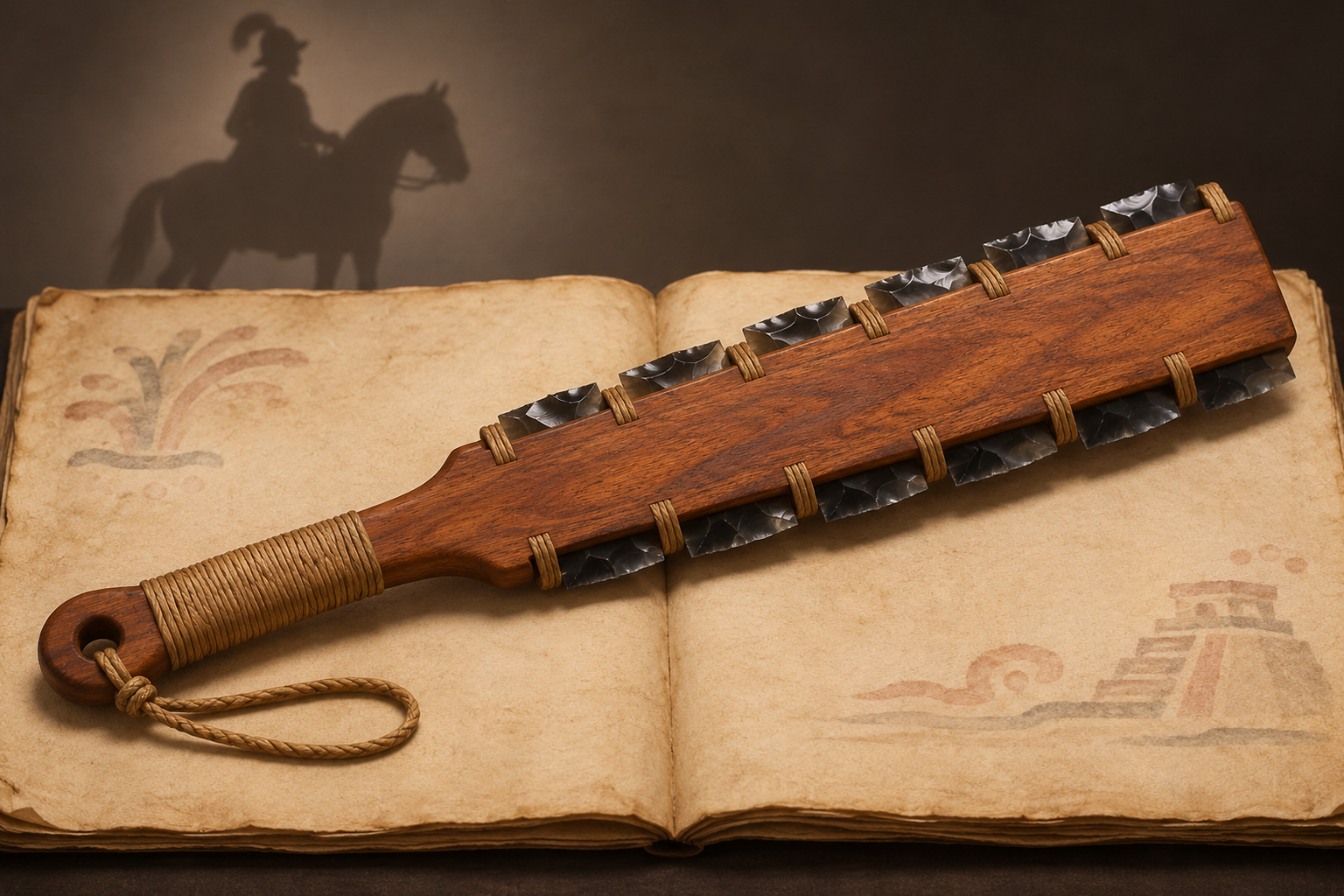
Spanish accounts and Indigenous-authored or Indigenous-informed colonial texts are important evidence, but they were written in contexts shaped by conquest, translation and political argument. They describe weapons, fighters and encounters from particular viewpoints. Their dramatic passages should therefore be compared with images, archaeological remains and the physical behavior of obsidian rather than repeated as transparent measurements of performance.
Reports of macuahuitls killing or disabling horses are part of this contested record. Such accounts may preserve memories of real attacks, but they do not demonstrate that a weapon routinely severed a horse’s neck or defeated armor in a single stroke. The target, angle, number of blows and condition of the animal are generally not available for controlled assessment.
The broader testimony remains valuable even when a detail is uncertain. It indicates that Europeans recognized the weapon as a serious battlefield implement and that Indigenous forces used more than one type of weapon in organized conflict. It does not justify the later image of an invincible “sword” with unlimited cutting power.
A careful reading keeps three kinds of evidence separate:
- contemporary or near-contemporary written description
- pictorial representation and its artistic conventions
- modern reconstruction or performance experiment
Function in Combat Without a Superweapon Claim
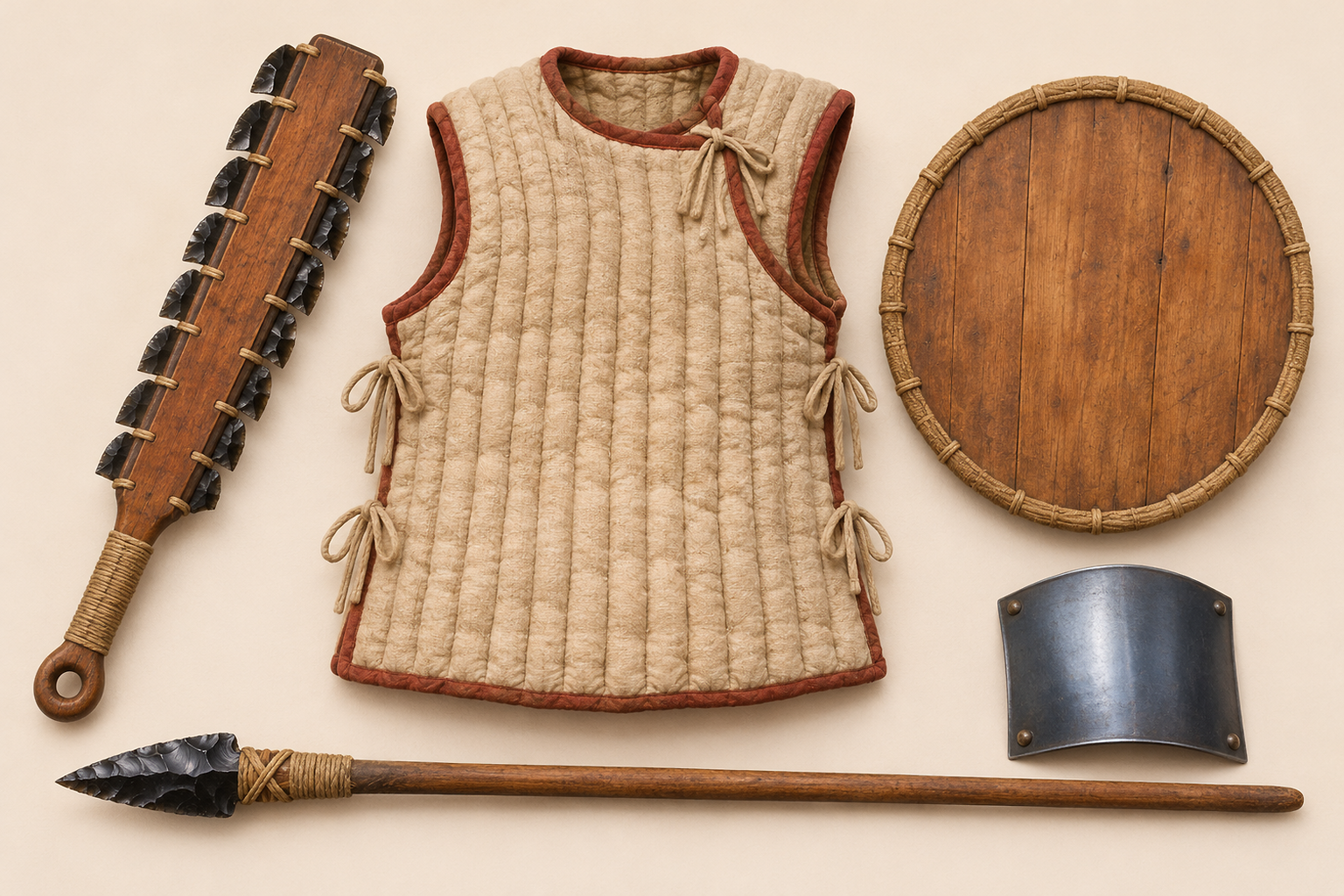
The macuahuitl’s likely battlefield role depended on its edge, reach, mass and the protection available to its user. It could deliver a damaging cut, but its composite edge was not equivalent to a European steel sword. The weapon’s use must also be considered alongside shields, spears, dart weapons and formations rather than in isolation.
Claims that it was designed only for nonlethal capture are also too simple. A sharp edged weapon can injure severely, and warfare in Mesoamerica included killing as well as capture and ritualized violence. At the same time, a weapon’s social or military use cannot be inferred from a single dramatic colonial episode.
Against metal armor, the cutting inserts faced a material problem: steel could resist or deflect a cut that would damage softer tissue or clothing. This does not mean the weapon was useless against every protected opponent. Gaps, exposed areas, force, angle and the rest of the engagement mattered. The evidence is insufficient for a universal claim about its effectiveness against armor.
Regional and Social Variation
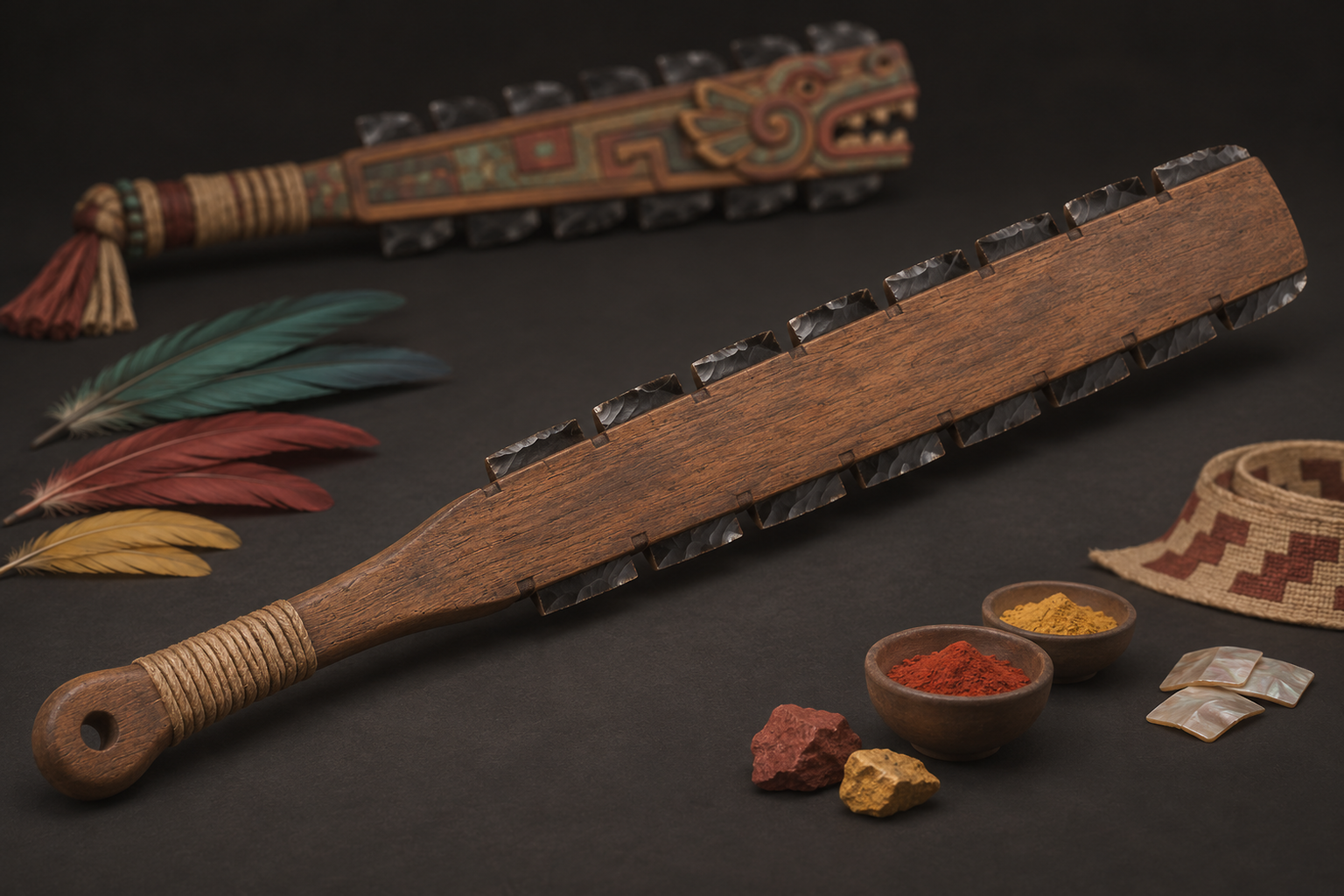
“Mesoamerican weapon” is a broad label, not a description of one uniform military system. Central Mexican evidence is especially prominent because of the written record surrounding the Spanish invasion, but neighboring societies had their own technologies, materials and political histories. Similar-looking forms do not automatically prove direct copying or identical use.
The macuahuitl could occupy different social settings. A practical weapon, an elite object and a ceremonial representation might share a basic silhouette while differing in decoration, care and construction. Feathers, paint or valuable inlay would signal a different purpose from an undecorated implement, but an image alone cannot always tell us whether an object was used in combat.
Preservation further distorts the picture. Organic weapons may disappear, while stone flakes and images remain. Museum collections can also privilege objects acquired by colonial officials, collectors or later institutions. The absence of an ordinary example from a display case is not evidence that ordinary examples never existed.
What Replicas Can and Cannot Demonstrate
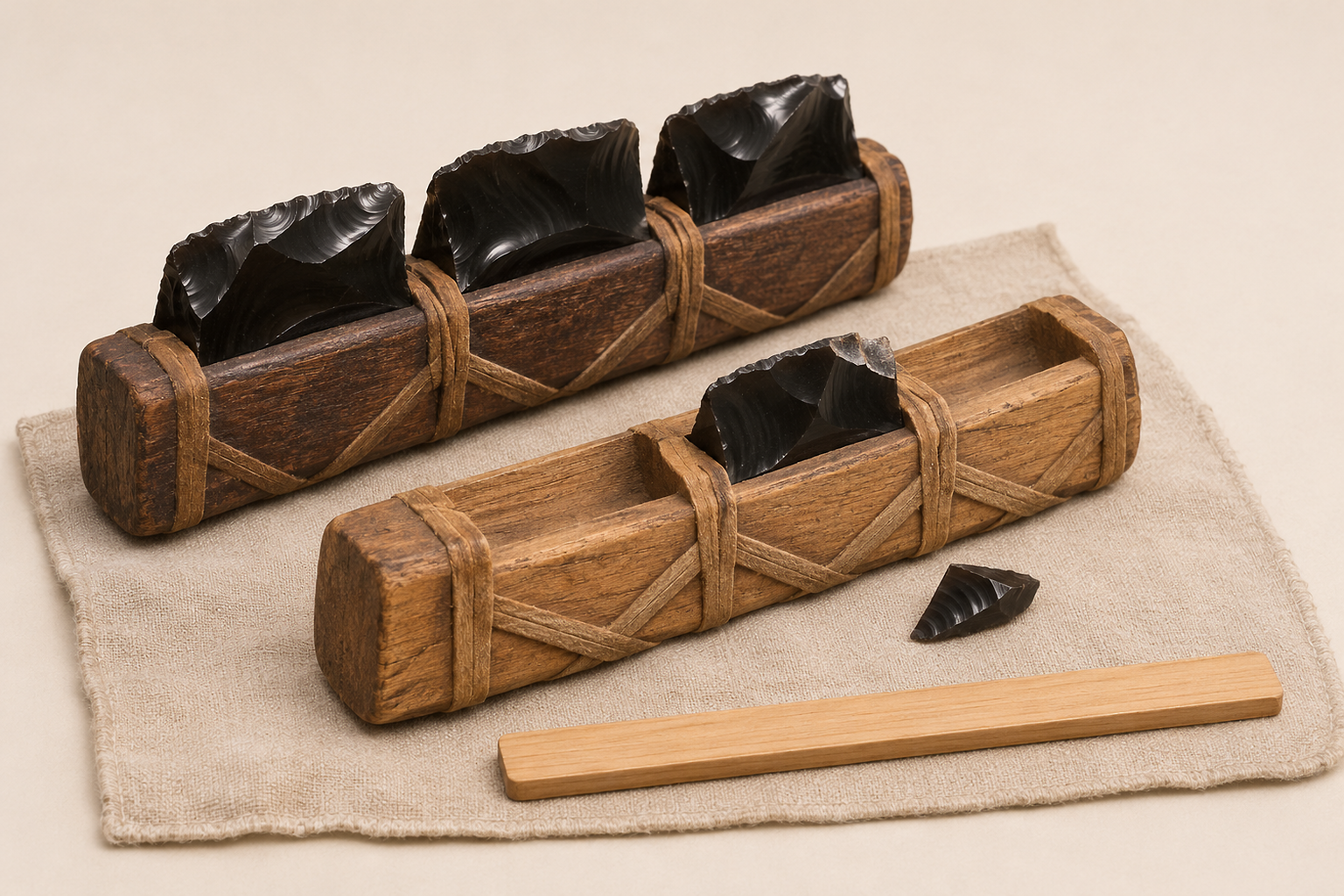
Experimental archaeology has a legitimate role in studying the macuahuitl. A carefully documented replica can test whether a proposed blade-setting arrangement is stable, how a wooden body handles repeated loading or how quickly inserts chip under specified conditions. These observations make a reconstruction more or less plausible.
They do not prove that ancient makers used the same wood, adhesive, insert shape or technique. A modern replica may differ in moisture content, tool marks, dimensions, surface finish and assembly quality. It may also be tested by a modern user whose technique is unlike that of a historical fighter. Results should therefore identify the replica and the test conditions rather than announce a timeless performance figure.
The strongest experiments begin with a clear archaeological question. They compare more than one plausible construction and record failure without treating failure as evidence of ancient incompetence. A replica that breaks may reveal a poor reconstruction, an unsuitable material combination or a real limitation of the original design; the experiment alone cannot choose among those explanations.
The Problem of the “Complete” Museum Macuahuitl
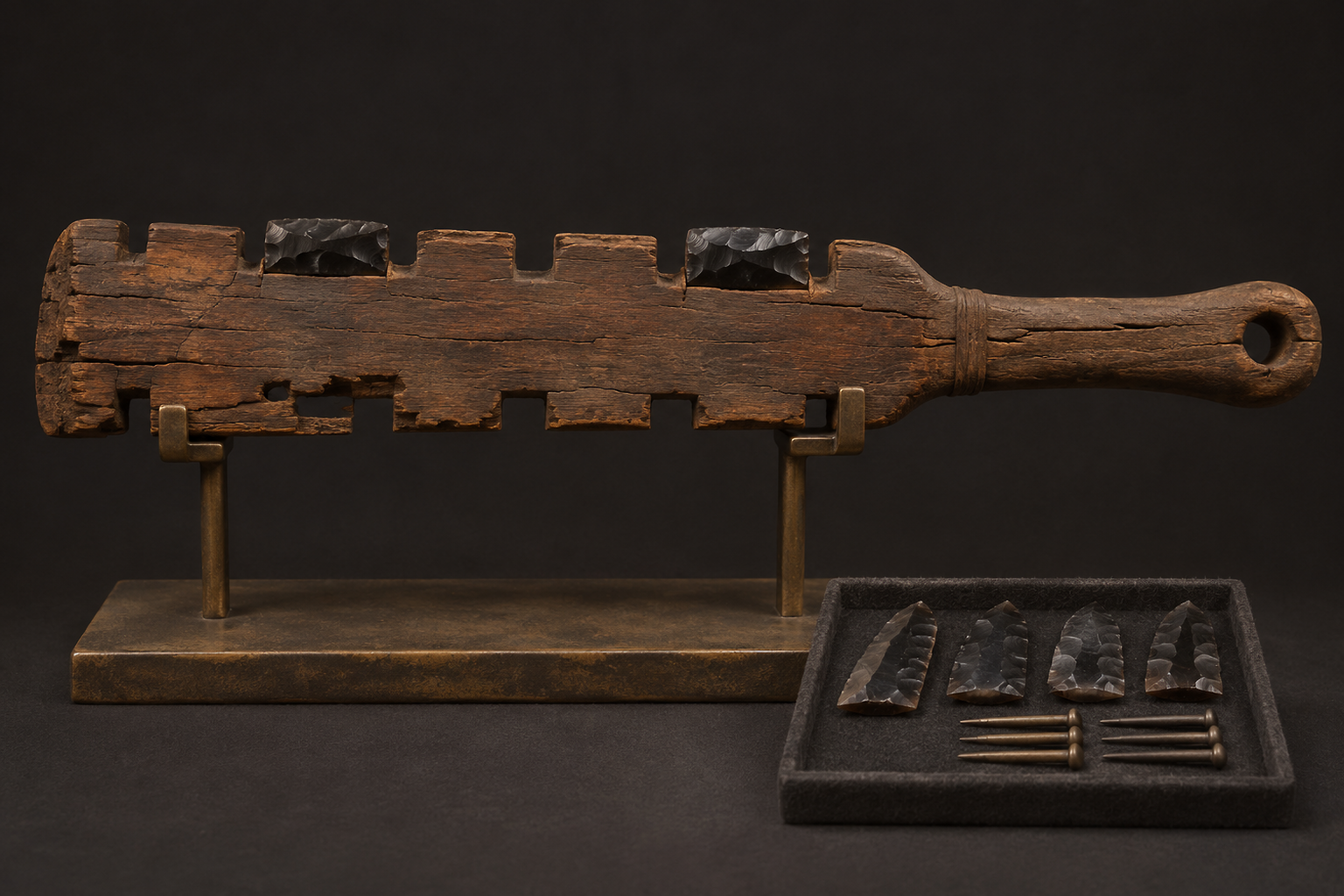
Complete macuahuitls are rare, and their histories are not always transparent. A displayed object may combine surviving wood with replacement pieces, missing inserts, old restoration or a later reconstruction. The label and collection record matter as much as the silhouette visible in a case.
A famous object can acquire authority through repetition. Once a catalogue, illustration or online post calls it an Aztec macuahuitl, later accounts may copy the identification without reexamining its materials and provenance. The responsible question is narrower: which parts survive, which parts were restored, when was the identification made, and what evidence supports the date?
Conservation should favor stability and clear distinction between original and added material. Digital models and labeled replicas can show a possible complete form without disguising the gaps in the physical object. This is especially important for wood, whose cracks, losses and repairs may be more historically informative than a visually perfect reconstruction.
Reading the Macuahuitl in Popular Culture
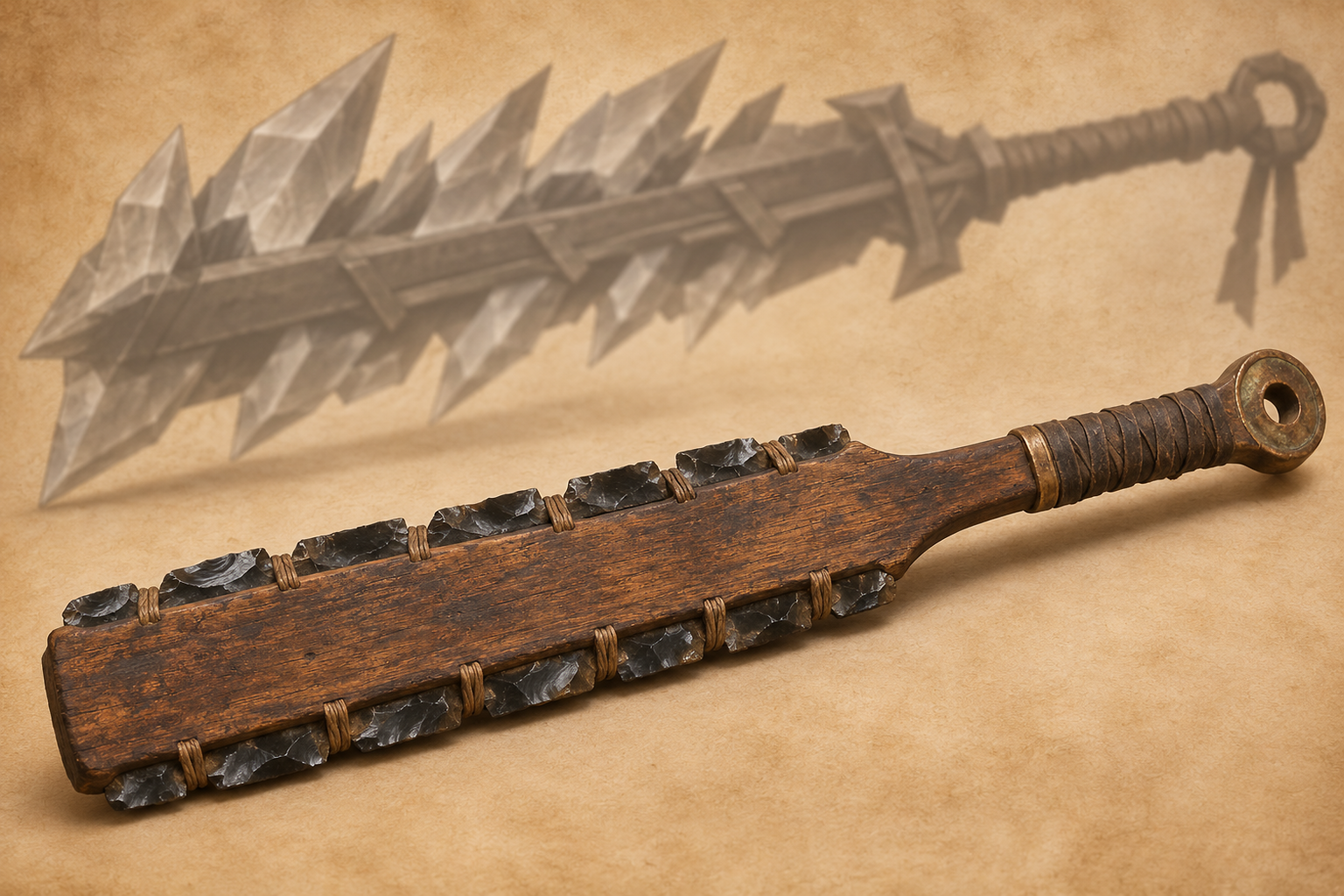
Games, films and illustrations often give the macuahuitl a continuous row of oversized crystal blades. This creates a clear visual language, but it may not represent a documented specimen. Enlarged inserts and exaggerated effects also encourage the false idea that obsidian’s sharpness made it immune to breakage.
The opposite error is to treat the weapon as a primitive failed sword. Its makers solved a real materials problem with resources and techniques suited to their world. A composite edge could be repaired or renewed in ways unlike a forged blade, while its limitations followed directly from the properties of stone and wood.
Historical interpretation works best when it leaves both facts visible: the macuahuitl was a sophisticated composite weapon, and its cutting material was brittle. Neither statement requires a superweapon story or a dismissive comparison with European steel.
Afterlife of a Composite Weapon
After the Spanish invasion, metal tools and weapons entered new systems of production and supply, but technological change was not an instant replacement of every Indigenous practice. People adopted, adapted and abandoned materials under changing political and economic conditions. The surviving record does not support a single timetable for the disappearance of macuahuitl manufacture.
The weapon’s later reputation has often been shaped by conquest narratives. European observers used descriptions of Indigenous arms to characterize the people they encountered, while later writers amplified the most dramatic passages. Modern popular culture then translated those accounts into a weapon of legendary cutting power.
Studying the blade-setting problem offers a better legacy. It directs attention to the maker, the woodworker, the knapper, the supply of obsidian and the limits imposed by each material. The macuahuitl becomes neither a fantasy sword nor a curiosity, but evidence of a particular technological tradition whose surviving traces must be read with care.
Further reading
Follow the sources to examine the object and its historical context.
Bibliographic references are being reviewed by the editors.