Surviving Scottish Highland dirks from the sixteenth and seventeenth centuries present a striking balance between functional simplicity and ornate regional identity. Unlike European main-gauche parrying daggers or long Italian stilettos, the Highland dirk arose from the late medieval ballock dagger, retaining a single-piece wooden hilt and stout blade profile while developing an artistic and martial vernacular entirely its own. Across three centuries, it shifted from an everyday utility knife and deadly backup sidearm to an emblem of clan status, survived the severe weapon proscriptions following the Jacobite defeat at Culloden, and ultimately settled into the ceremonial kit of Highland regiments and Victorian civilian formalwear.
The Ballock Dagger Heritage
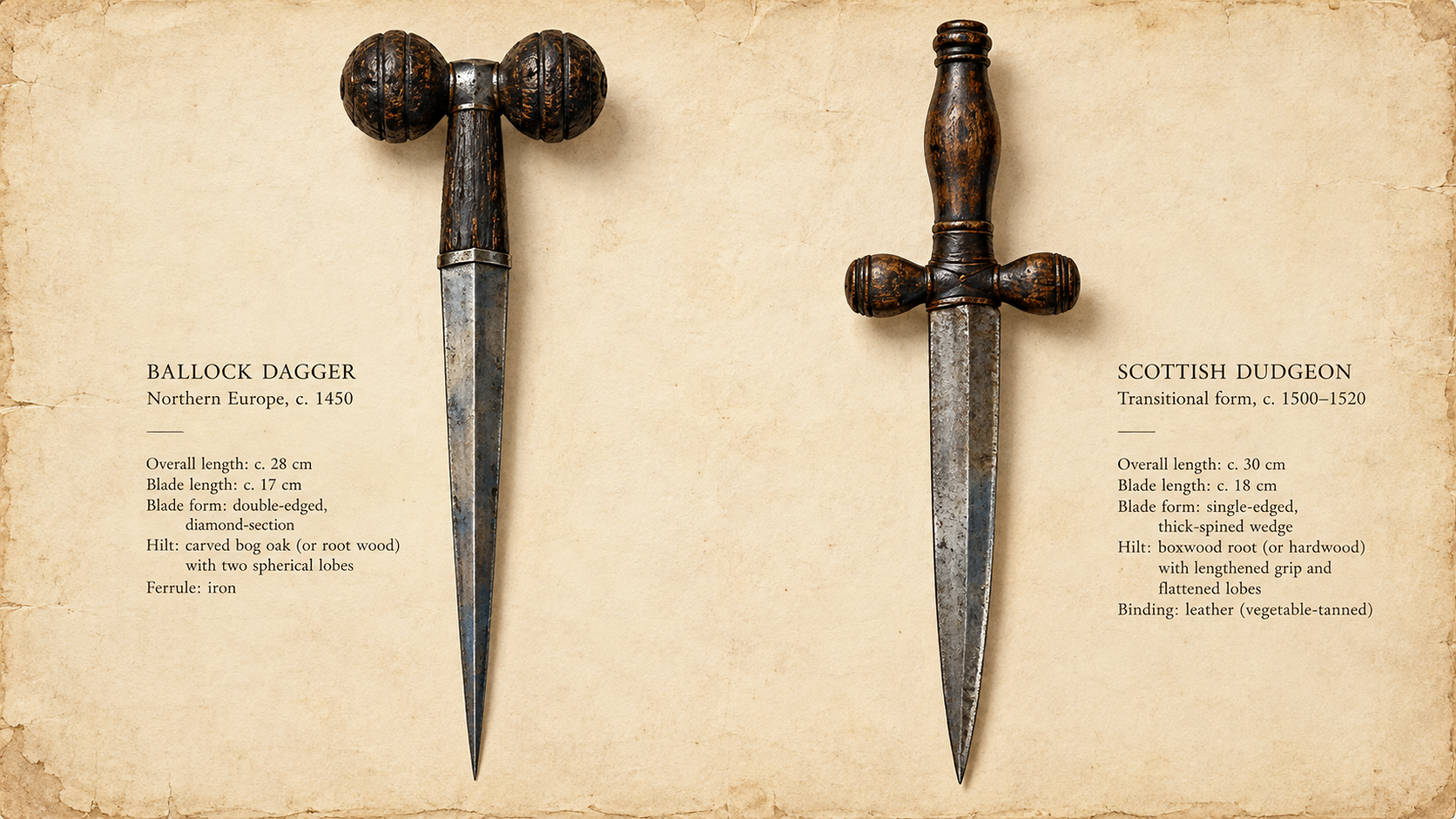
The Highland dirk did not develop in complete isolation from European trends. Instead, it represents the sustained evolution of the northern European ballock dagger, a sidearm ubiquitous across the Low Countries, England, and Scandinavia from the fourteenth century onward. Characterized by a hilt with two distinct lobes at the guard, the ballock dagger provided an exceptionally firm stop for the hand during thrusting blows, transferring the full momentum of the arm into the target without risking the hand slipping onto the steel.
While the fashion for ballock daggers waned across western Europe by the early sixteenth century in favor of quillon daggers and rapiers, Highland artisans retained the foundational layout. The Scottish terrain, hunting requirements, and tactical environment prioritized weapons that could survive hard outdoor living and harsh weather. The organic wooden grip of the ballock dagger avoided the hand-numbing cold of bare iron hilts, offering dependable traction in wet conditions.
Earliest Scottish records use the terms dudgeon dagger and dirk—sometimes spelled durk or dork—interchangeably. These early transitional daggers kept the pronounced rounded swellings at the base of the hilt, but Scottish bladesmiths and wrights gradually altered the silhouette, flattening the base toward the blade and lengthening the grip cylinder to accommodate thick, wool-wrapped hands. The resulting piece became an immediate ancestor of the classic Highland weapon.
The Anatomy of Dudgeon and Native Woods
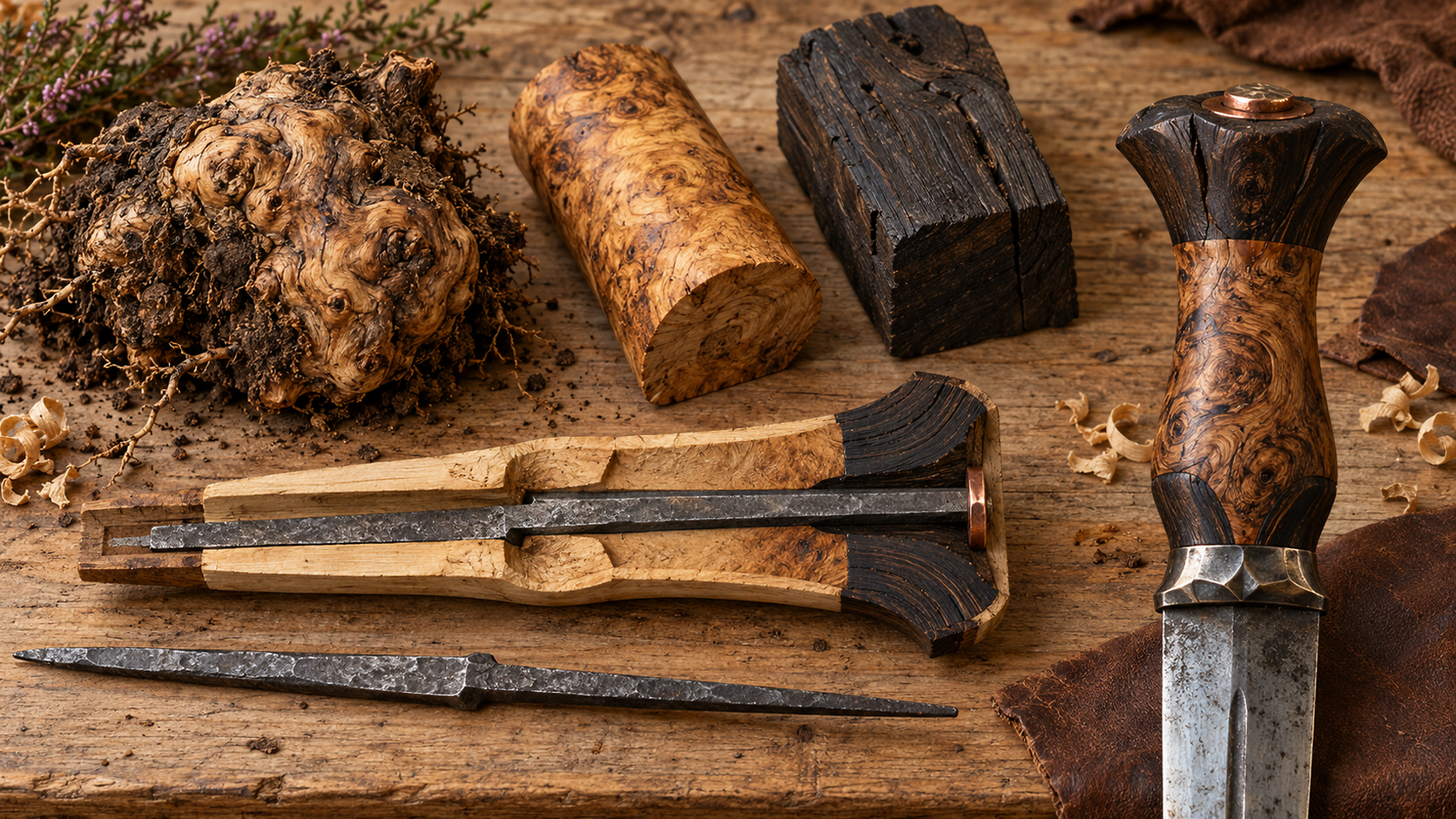
Central to the character of the traditional dirk was its hilt material. Early English and Scottish inventories repeatedly describe these daggers as made of dudgeon, a historical term denoting the dense, gnarly root-wood of the boxwood tree (Buxus sempervirens). Boxwood root offered remarkable structural integrity, resisting splintering along grain lines when subject to lateral shock, while providing an ideal medium for fine, detailed relief carving.
Because true boxwood was scarce in the northern Highlands, local woodturners and carvers made extensive use of native substitutes. Heather root (Calluna vulgaris), laburnum, bog oak, and juniper roots served as regular alternatives. The root burls of old heather bushes, dug from peat moorlands and thoroughly cured, presented a close, swirling grain pattern that resisted moisture and decay. Once turned on a pole lathe and carved, these native timbers took on a deep, rich brown or pitch-black patina from animal fats and smoke.
The single-piece construction of the grip was an engineering choice born of utility. Without separate crossguards, pommel caps, or loose bolsters, there was little that could come loose during vigorous work. The tang of the blade ran entirely through the length of the wooden core, anchored over a small iron, brass, or copper washer at the crown of the pommel. This straightforward assembly created a rugged knife suited for butchering game, shaping timber, and lethal defense.
Transition in Hafts: The Flaring Shoulders and Haunches
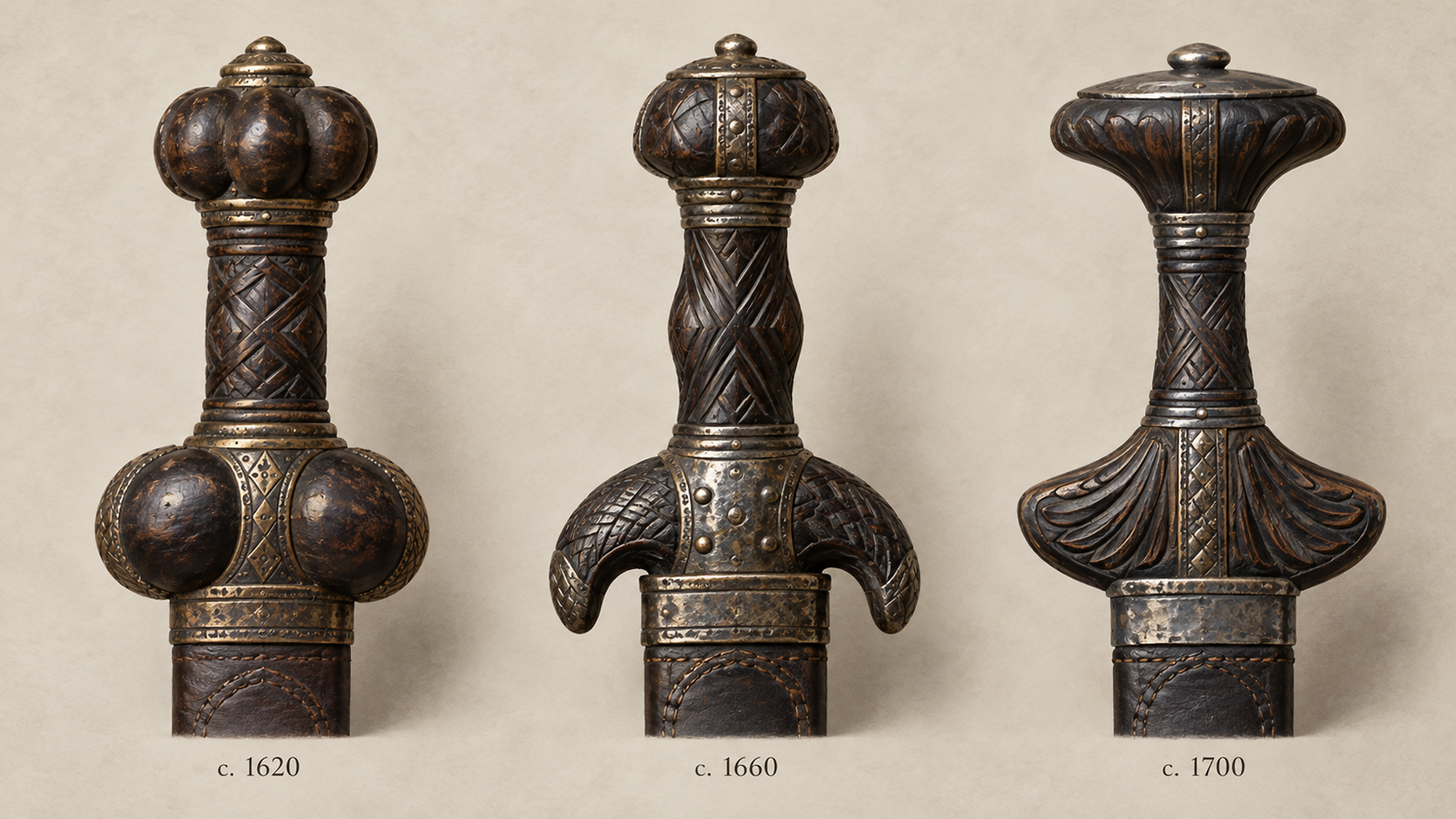
Between 1600 and 1700, the physical silhouette of the Highland dirk underwent a defined stylistic evolution. The bulbous, spherical haunches inherited from medieval ballock daggers gradually compressed. In early seventeenth-century examples, the lobes remained prominent and swollen, but by the mid-seventeenth century, makers began to carve them into flattened, down-turned haunches that formed an arch over the top of the scabbard mouth.
This shift changed the weapon's balance and grip ergonomics. The flattened haunches provided an anchor for the thumb when pressed forward, assisting in close-quarter cutting tasks and skinning. The grip cylinder directly above the haunches was turned into a slender, hourglass waist, swelling outward again toward the pommel. This contour seated the fingers securely, preventing the hand from pulling free when the knife was extracted from a deep cut.
The pommel section broadened into an expansive, mushroom-shaped cap. In early variants, this cap was modest and capped by a simple iron button. As the eighteenth century approached, the pommel flared aggressively, presenting a wide, angled surface that rested against the base of the palm. This broad pommel served two distinct mechanical functions: it allowed the user to deliver powerful downward thrusts driven by palm pressure, and it counterbalanced the substantial mass of longer, heavier blades.
Interlace Carving and Celtic Knotwork Traditions
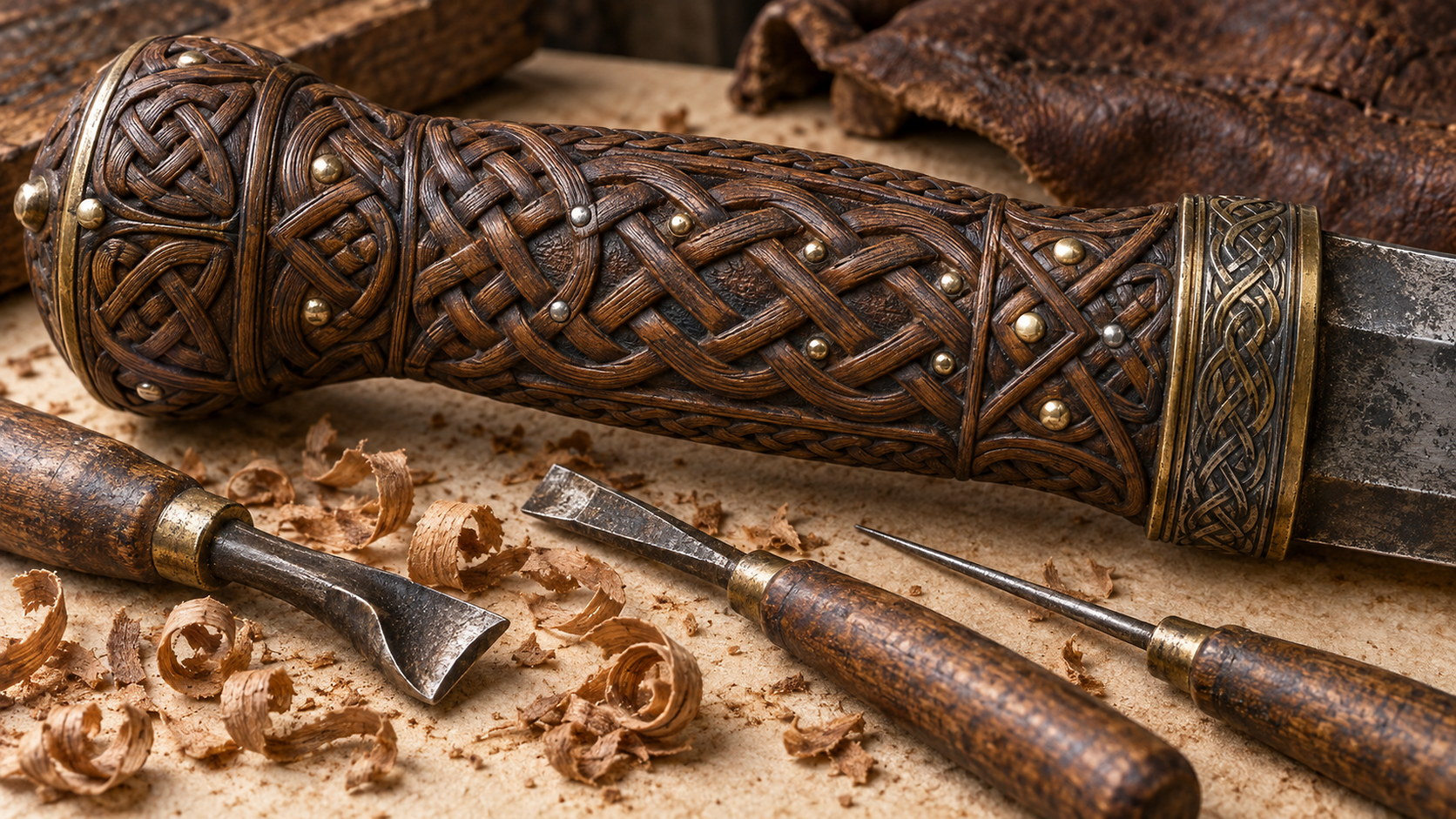
The most recognizable visual feature of classic seventeenth- and eighteenth-century Highland dirks is the intricate carving covering the wooden hilt. Unlike contemporary European sidearms that favored gilded brass castings or pierced steel guards, the Scottish dirk was embellished directly into the organic timber through meticulous manual carving.
Carvers applied patterns derived from early Insular art, including Celtic strapwork, continuous plaiting, running knotwork, and braided key patterns. These were not stamped or mechanically impressed; each channel was cut by hand using small gouges, chisels, and v-tools. The knotwork was typically arranged in distinct bands running around the waist of the grip, while the flat faces of the haunches received complementary scrolled or interlaced motifs.
At the intersections of the carved ribbons, makers frequently drove tiny brass, pewter, or copper pins into the wood, clipping them flush with the surface. Known among collectors as nailing, this technique created a dotted, gleaming field across the dark grain. Beyond aesthetic appeal, the relief of the raised knotwork and the textured metal pinheads provided practical utility: they created a positive, non-slip purchase even when the handle was soaked in rainwater, sweat, or animal fat.
Blade Architecture: Cut-Down Broadswords and Specialized Profiles
The steel fitted to Highland dirks varied widely depending on local wealth and workshop availability. While dedicated cutlers in towns such as Perth, Inverness, and Stirling produced purposeful dirk blades, a significant percentage of surviving seventeenth- and eighteenth-century dirks feature repurposed steel. Highland fighters regularly salvaged snapped or damaged blades from basket-hilted broadswords, backswords, and European imports.
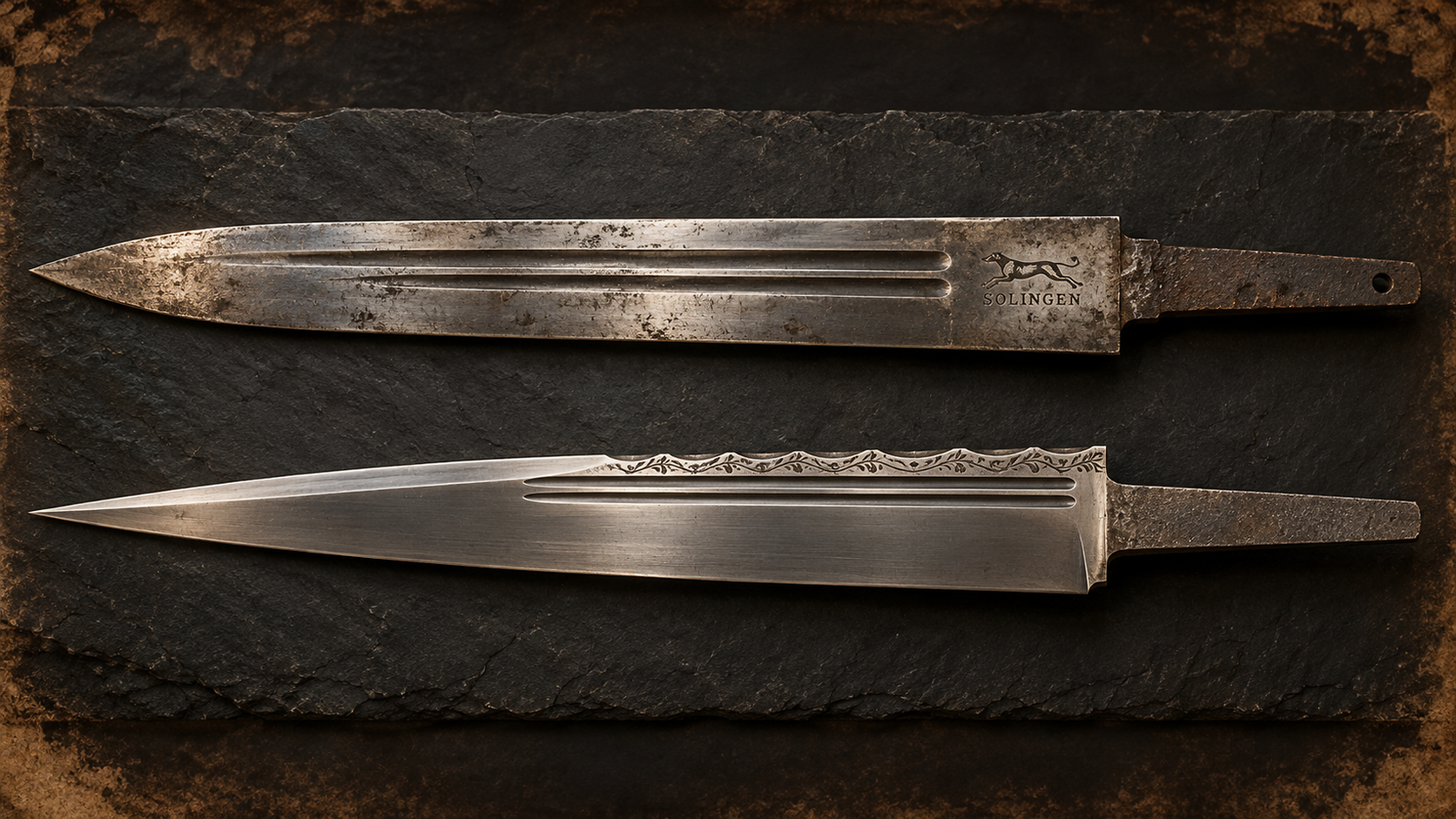
Highlanders prized German sword blades from Solingen and Passau, and when a broadsword shattered in the field or suffered severe edge failure, the sound sections were seldom discarded. A competent smith could anneal, reshape, and re-harden a broken sword tip or central blade section into a stiff, dangerous dirk blade. These recycled blades are easily spotted today by fullers that run out abruptly at the tang or through makers' running-wolf marks and blade inscriptions that appear truncated near the hilt.
Purpose-made dirk blades developed their own distinctive geometry. They were predominantly single-edged, featuring a thick, wedge-like cross section with a flat, rigid spine. Near the spine, cutlers often ground one, two, or three parallel narrow fullers to shed weight without sacrificing longitudinal stiffness. The unsharpened spine was frequently enriched with decorative filework, comprising stepped notches, fluting, and alternating triangular indentations known colloquially as scalloping or vine-work.
Scabbard Systems, By-Knives, and Eating Sets
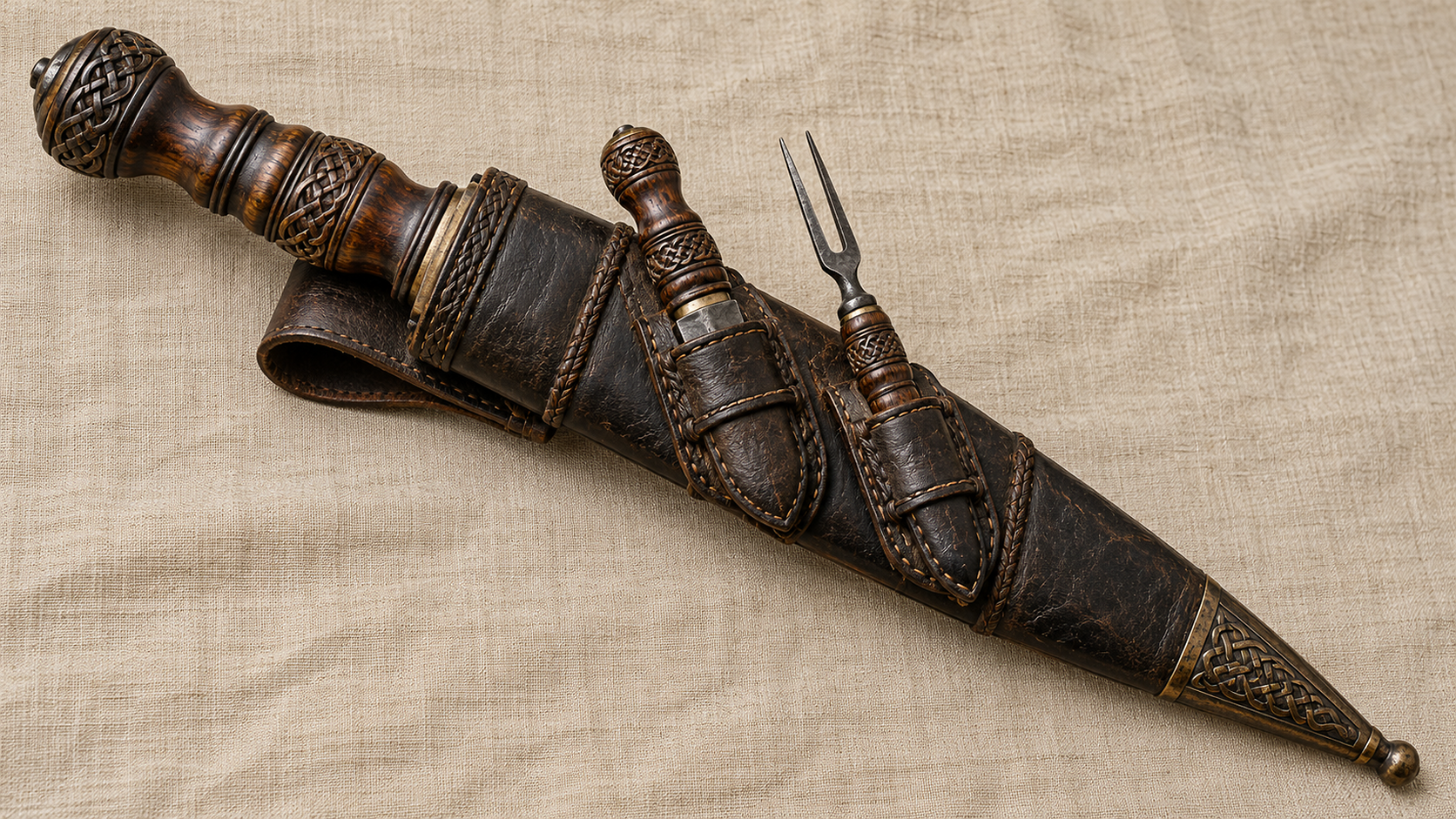
A dirk was not carried as a solitary blade; it was an integral part of an outdoor survival and travel kit. The sheath was traditionally formed around a light wooden liner wrapped in stiff cowhide or goatskin, stitched neatly down the reverse spine. Unlike military swords that used suspended frog loops or rings, early dirks were designed to slide directly through a waist belt or an integrated broad leather loop.
Beginning in the late seventeenth century and becoming standard through the eighteenth century, dirk sheaths incorporated external companion pockets. These housed smaller auxiliary tools: a small utility knife (sgian) and a two-pronged fork. In an era when travelers were expected to carry their own eating utensils to inns, camps, or community feasts, the dirk sheath served as a mobile dining and working garniture.
The by-knife and fork featured handles that matched the main dirk, turned from the same wood and carved with diminutive interlace or ring-turning. The steel prongs of the fork and the small slicing edge of the companion knife prevented unnecessary dulling of the heavy primary blade on mundane tasks like trenching trenchers or skinning poultry, leaving the main dirk honed for heavy timber work, large game processing, or defense.
The Dirk as an Oath Weapon and Social Instrument
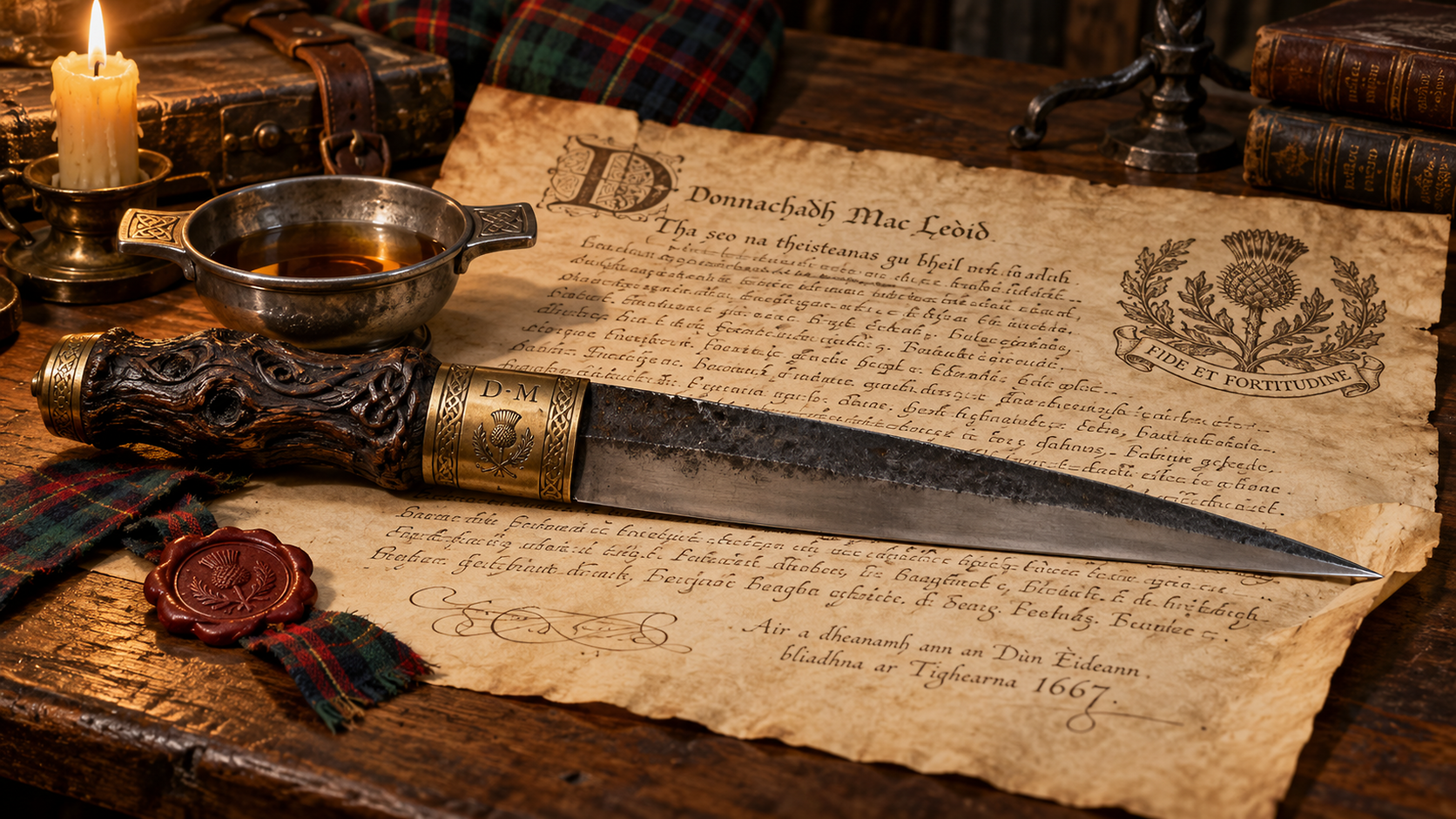
In traditional Gaelic culture, the dirk carried formal legal and ritual weight alongside its daily utility. The phrase to swear on the cold iron or on the dirk carried binding legal authority among clan members. Under Gaelic customary law, an oath sworn upon the bare blade of one's dirk invoked immediate doom or death if broken, reflecting ancient taboos surrounding iron, steel, and weapons of the hearth.
The carry of the dirk signified personal autonomy and status. In Highland society, an adult male walked abroad armed; carrying cold steel was the dividing line between a free clan member and a disenfranchised person. When entering another chieftain's hall, etiquette dictated that long arms such as broadswords and muskets be surrendered or placed in an outer lobby, but the dirk remained on the person, worn at the front right of the waistbelt.
This social prominence meant that even men of modest means invested substantial effort into embellishing their dirks. Brass or pewter ferrules were engraved with owners' initials, clan crests, or biblical proverbs. The weapon accompanied its owner from youth to the grave, functioning as an heirloom passed down lineages, acquiring accumulated family status with every campaign.
Surviving clan inventories and estate rolls reveal specific legal and ceremonial applications for the bare dirk:
- Settlement of land disputes and border agreements, where boundaries were sealed by joint oaths on the steel.
- Pledges of truce and temporary cessations of blood feuds between rival septs.
- Informal baptismal rites where the newborn child was lightly touched with the flat of the family dirk to impart resilience.
- The formal swearing of allegiance by tacksmen and warriors directly to their clan chieftain.
Fighting Dynamics in the Highland Armament
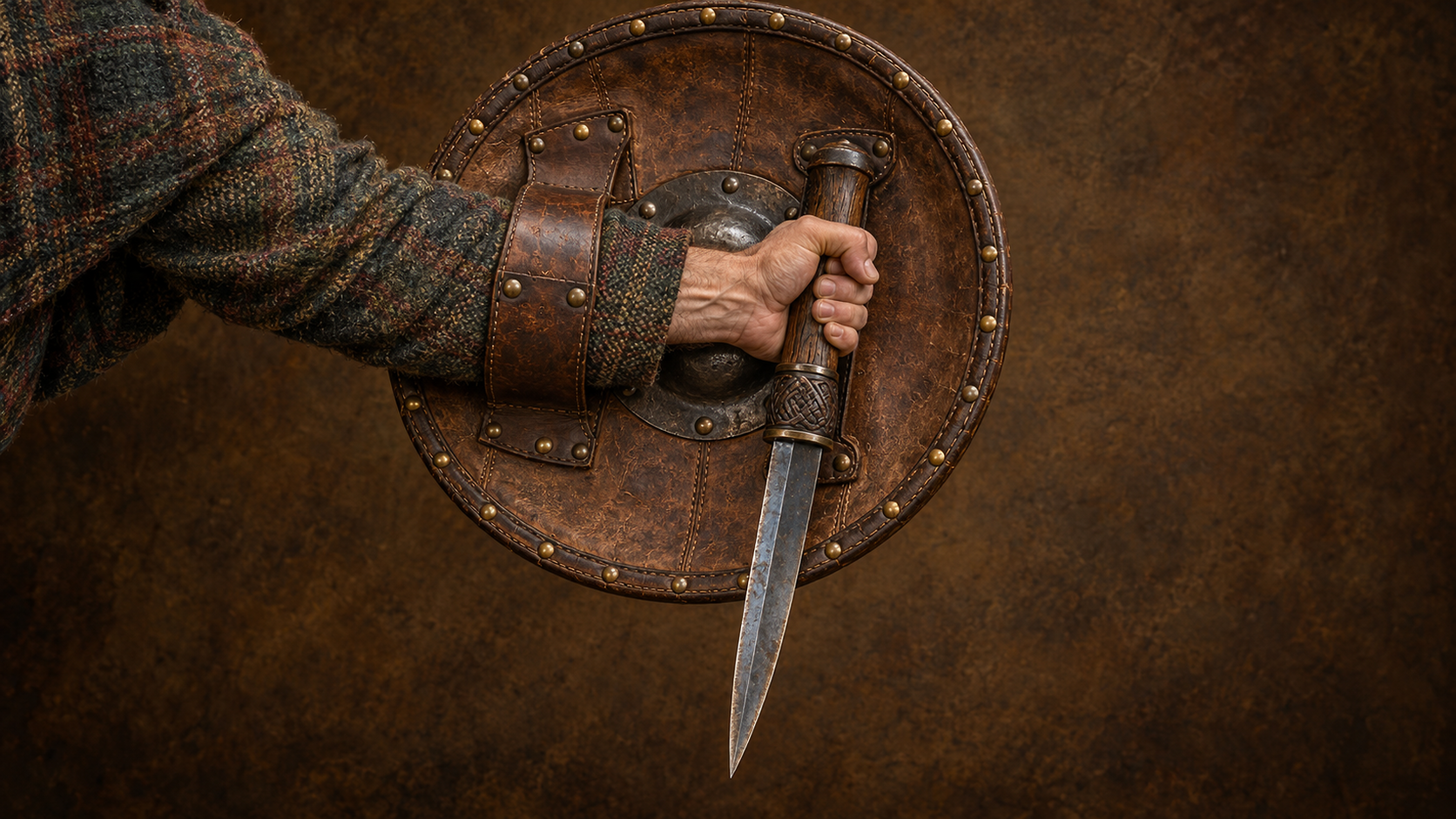
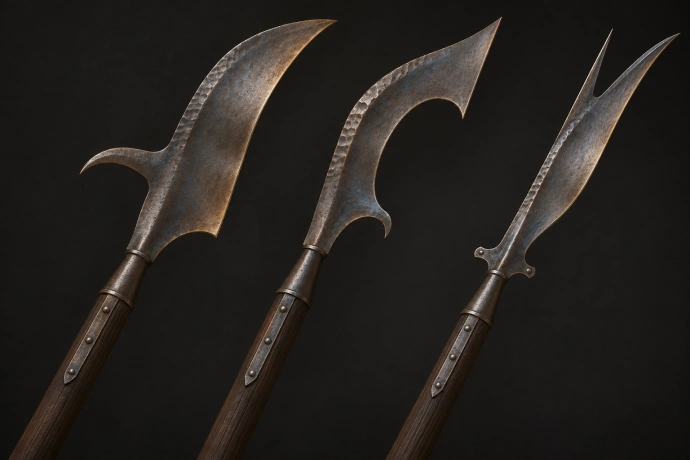
The Highland dirk played a well-documented secondary role in the traditional Highland battle array. Contrary to popular portrayals, warriors did not wade into musket volleys wielding only a knife. The primary offensive weapons of the clan levy were firearms, pole weapons such as the Lochaber axe, and the iconic basket-hilted broadsword (claidheamh-mòr). The dirk was an auxiliary implement held in reserve.
Its combat function appeared most prominently in close-quarter entanglements when weapons collided and space collapsed. In the classic charge against infantry lines, Highland fighters often carried a small round shield—the targe—on the left forearm. Hand-to-hand accounts describe fighters holding the grip of the targe with the left hand while simultaneously grasping the hilt of the dirk, the blade extending downward beneath the rim of the shield.
This double-grip arrangement provided the fighter with an unexpected thrusting point beneath the shield line. While the right hand swung the broadsword at the opponent's head, neck, or musket barrel, the left arm could punch forward with the targe, using the downward-projecting dirk blade to pierce the torso or unarmored lower abdomen of an opposing soldier caught in tight formation.
The 1746 Disarming Acts and Concealment
The catastrophic defeat of the Jacobite forces at the Battle of Culloden in April 1746 marked a violent watershed for Highland martial culture. Determined to break the clan military system permanently, the British Parliament enacted the Act of Proscription in 1746, which incorporated and drastically intensified the earlier Disarming Acts of 1716 and 1725.
Under this statute, any person residing within the designated Highlands found carrying, using, or possessing broadswords, targes, guns, pistols, or dirks faced severe punishment: an enormous fine and immediate enlistment into government military service for a first offense, followed by seven years' transportation to overseas penal colonies for a second breach. Crown soldiers conducted rigorous, destructive searches of crofts, clachans, and estates.
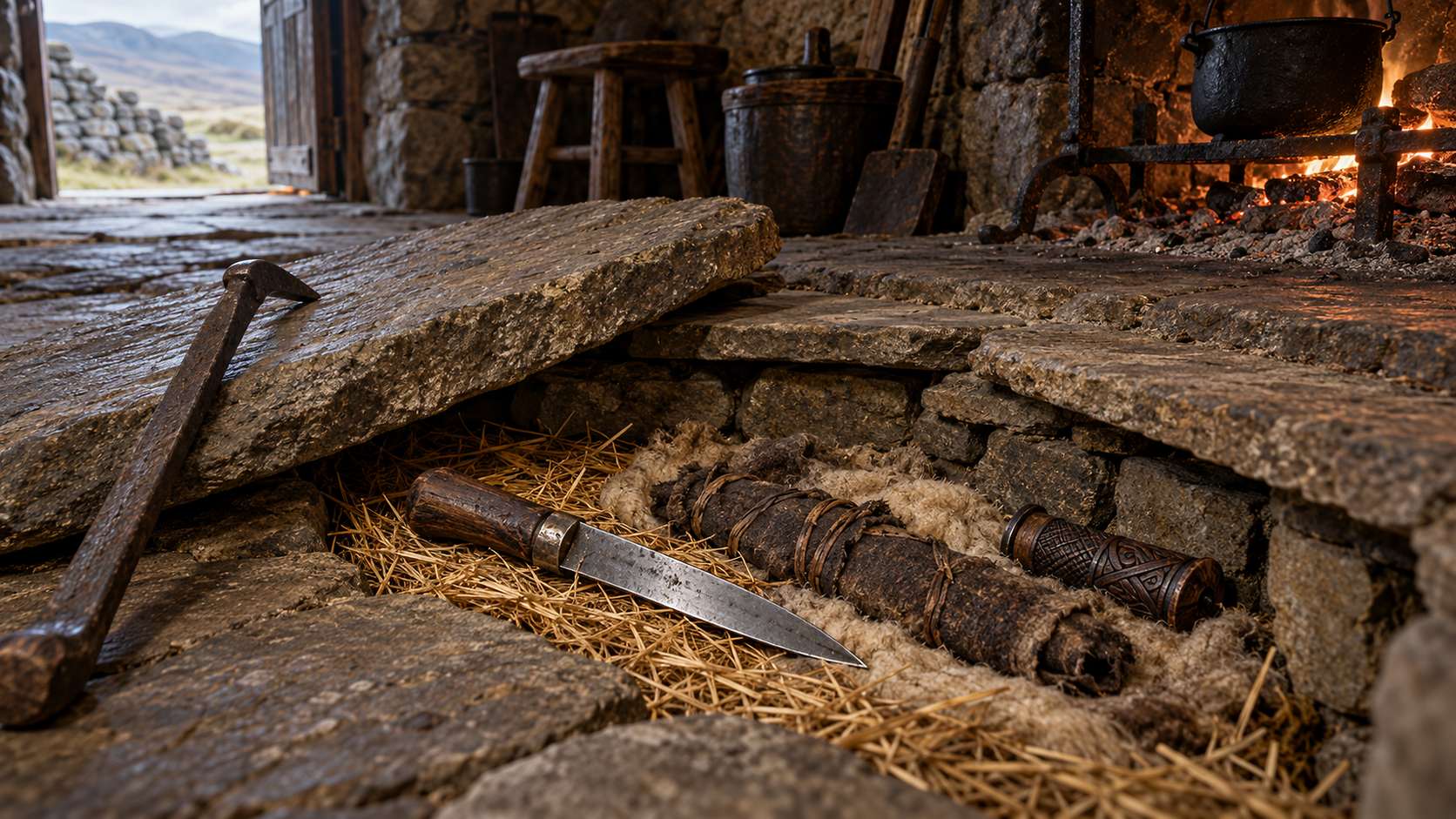
Faced with these penalties, Highlanders concealed thousands of weapons beneath floorboards, in dry-stone field dykes, inside peat bogs, and up chimney flues. Many dirks were deliberately altered to escape detection: carvers cut away the tell-tale flared haunches, ground down broad pommels, and trimmed the blades into shorter, innocuous utility knives. Other blades were separated from their carved hilts and hidden until enforcement loosened decades later.
The Highland Regiments and Uniformity
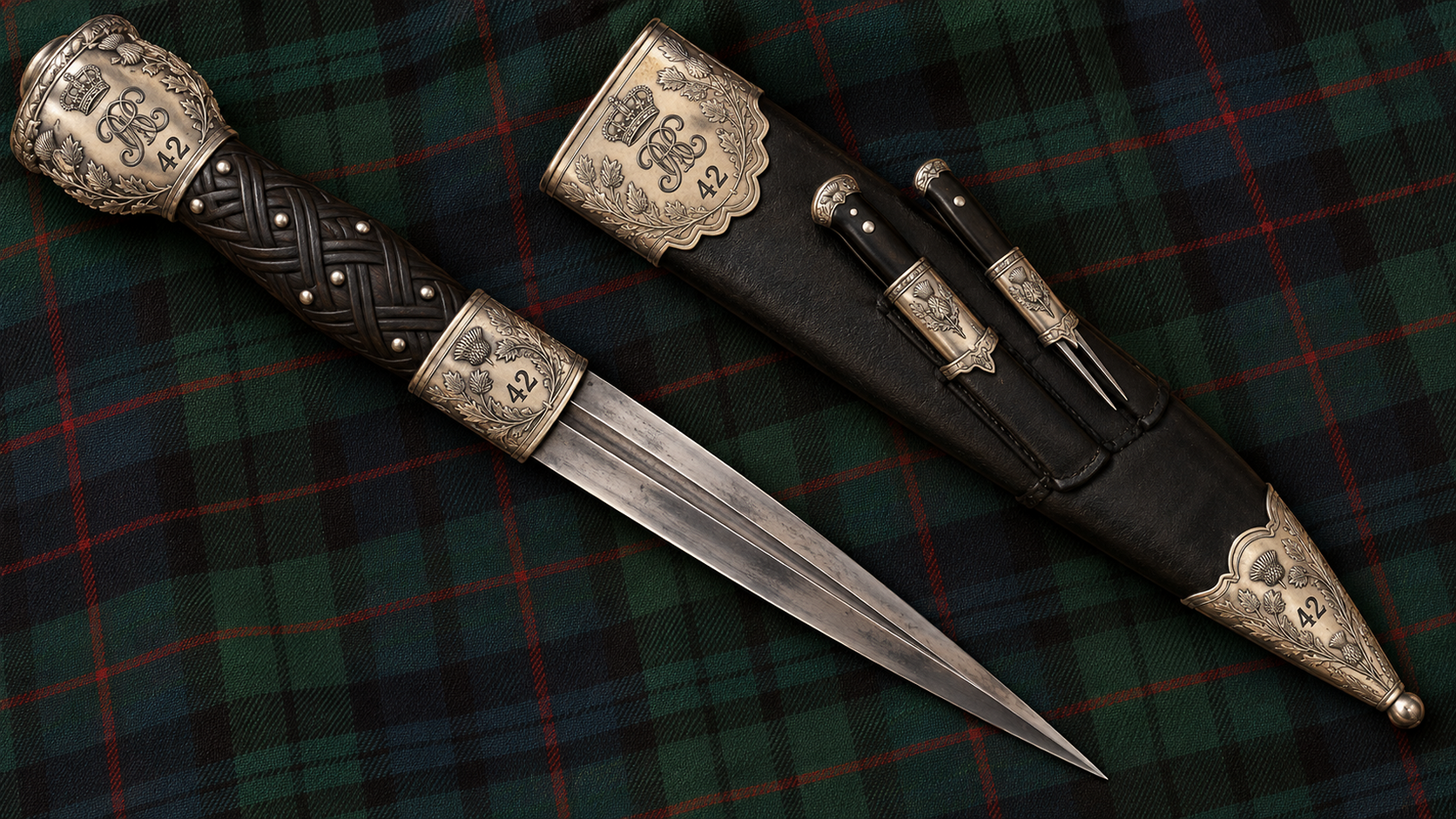
While the Disarming Act systematically stripped the civilian population of weapons, the British Crown discovered an effective method for harnessing Highland martial traditions: the recruitment of Gaelic-speaking regiments for service in the British Army. Units such as the 42nd Regiment of Foot (The Black Watch) and the Fraser Highlanders were exempt from the bans on Highland dress and arms while on active military duty.
Within the regimental structure, the dirk transitioned from an idiosyncratic personal weapon to an official military accoutrement. Officers, pipers, and enlisted sergeants carried dirks alongside their regulation service broadswords. Initially, soldiers carried personal heirlooms, but as the late eighteenth century arrived, quartermasters and commanding officers sought uniformity.
By the 1790s and early 1800s, specialized military cutlers in Edinburgh, Glasgow, and London began producing standardized regimental patterns. The hilts kept the hourglass profile and carved interlace of civilian models, but the materials shifted. Heavy brass or silver ferrules bearing regimental numbers, thistles, and crown devices encased the base of the grip, while polished pommels replaced the bare wood closures of earlier centuries.
From Weapon to Regalia: Victorian Romanticism and Jewels
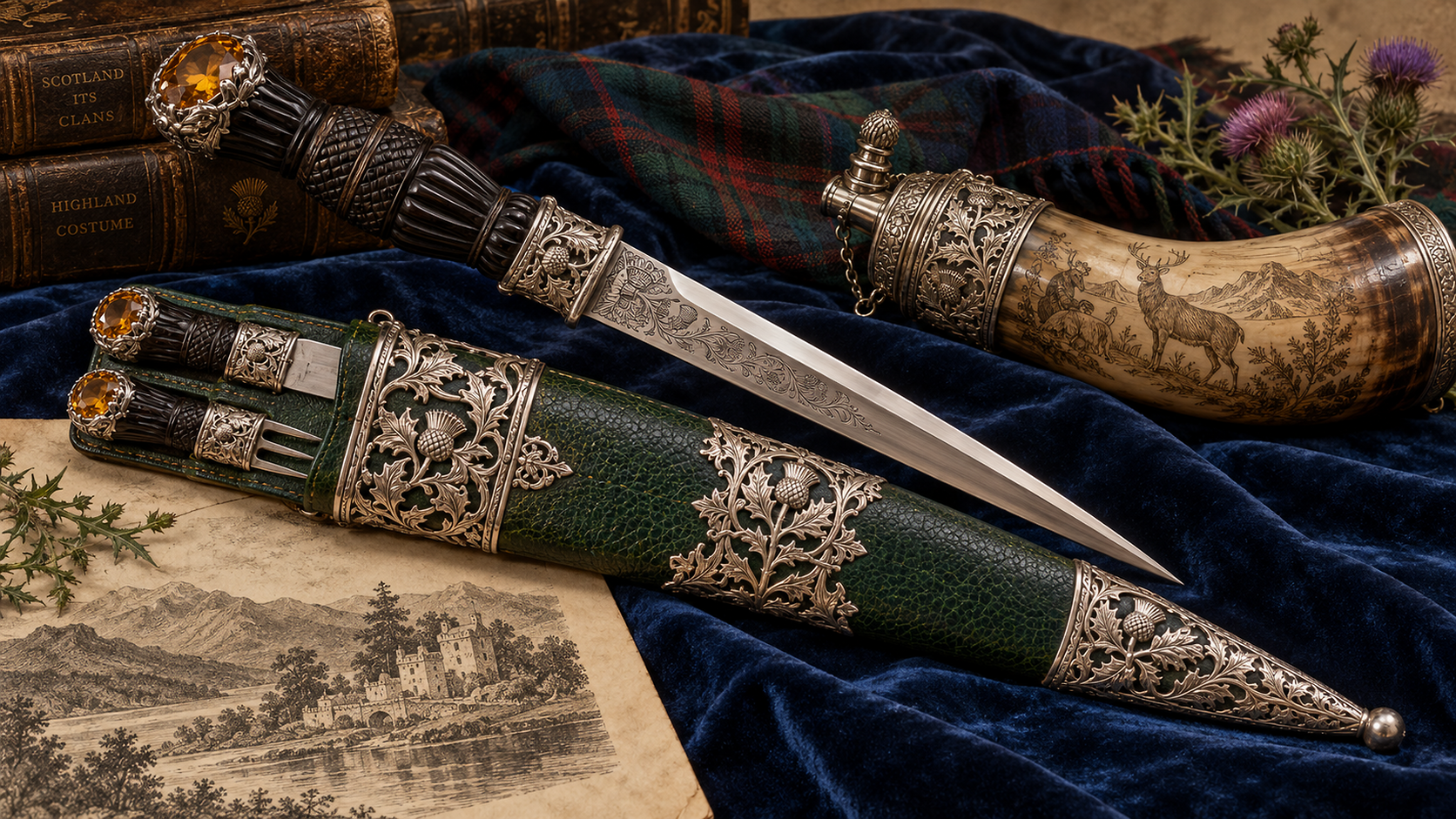
The nineteenth century witnessed a sweeping romanticization of Highland history, accelerated by Sir Walter Scott's historical novels and King George IV's highly choreographed visit to Edinburgh in 1822. When Queen Victoria and Prince Albert fell in love with Deeside and established their royal residence at Balmoral in 1848, Highland costume became fashionable across the British Empire.
This cultural shift transformed the dirk from a sharp, practical field tool into an opulent status symbol worn with evening formalwear. Victorian silversmiths like Mackay & Chisholm of Edinburgh or Hamilton & Inches produced dirks cast entirely with intricate rococo and faux-Celtic scrolls in high-relief sterling silver. The scabbards were wrapped in polished, dyed morocco leather or velvet rather than rough hide.
The most dramatic visual change occurred at the pommel. The traditional flat wooden face was excavated and replaced with a heavy claw-set faceted quartz crystal—frequently cairngorm, a warm, honey-colored or smoky quartz quarried in the Cairngorm Mountains, or deep orange-brown citrine. Similar matched stones were set into the pommels of the companion knife and fork. The blade, once honed for butchery or battle, became mirror-polished, blunt, and heavily etched with thistles, royal cyphers, and patriotic mottos.
The Evolution of the Sgian-Dubh
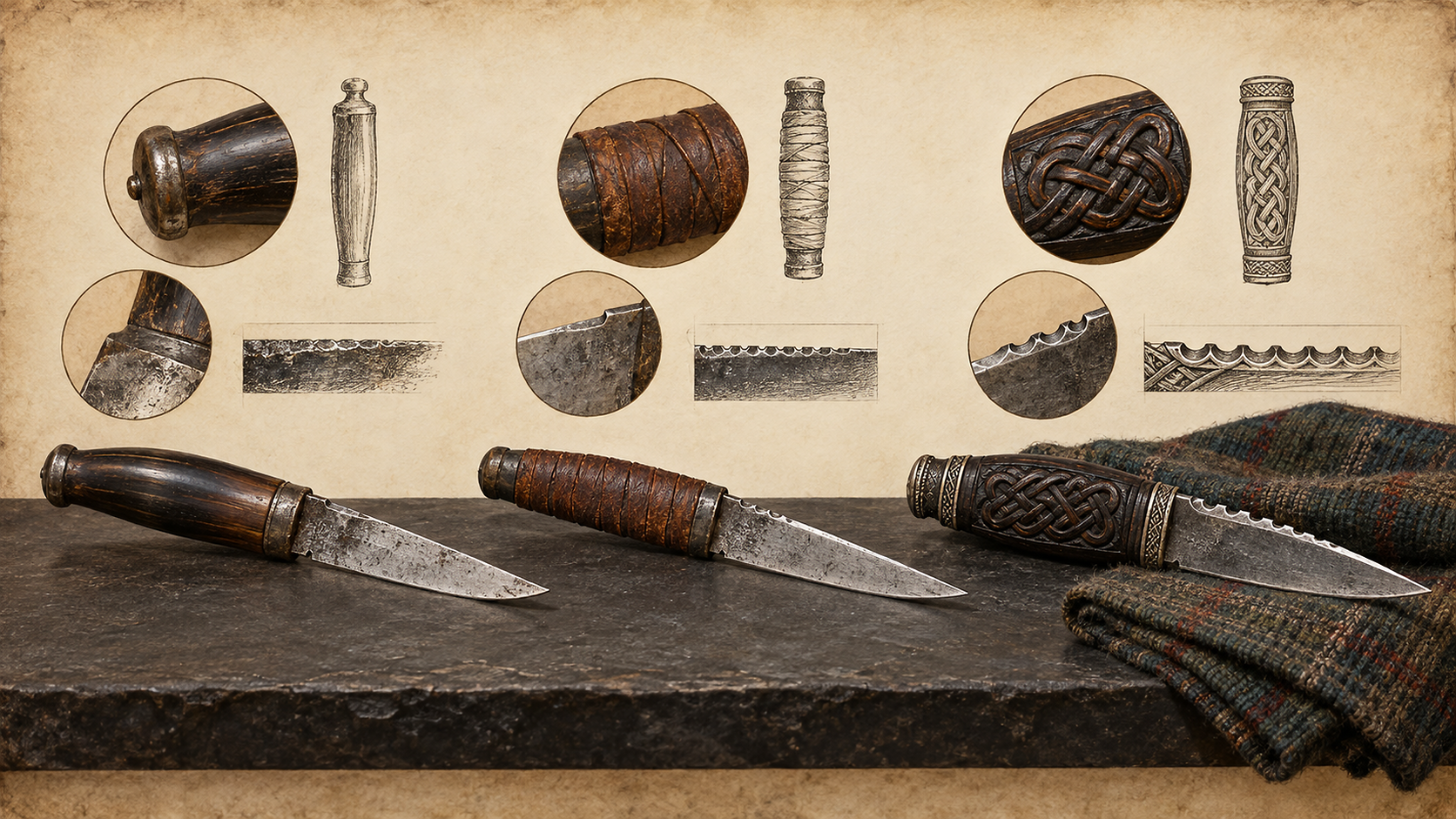
Parallel to the dirk's evolution was the emergence of the sgian-dubh (literally black knife in Scottish Gaelic). While popular twentieth-century lore frequently asserts that the sgian-dubh was carried by medieval Highlanders in their socks as a secret backup weapon, concrete archaeological and pictorial evidence for the modern sock-knife is remarkably sparse before the late eighteenth and early nineteenth centuries.
Later tradition links the origin of the sgian-dubh to small companion utility knives carried within dirk sheaths or concealed beneath the armpit inside jacket linings—known historically as a sgian-achlais (armpit knife). In traditional accounts of Highland hospitality, guests revealed concealed arms by removing the small knife from under the coat and tucking it into the garter of their hose on the dominant leg, where it remained fully visible to the host to signal peaceful intentions.
As the large dirk grew increasingly ornamental and unwieldy for everyday civilian wear in nineteenth-century towns, the sgian-dubh emerged as a practical substitute. Carved with scaled-down versions of the dirk's strapwork and fitted with cast silver mounts, it settled permanently into the kilt hose of Highland dressers, serving as the accessible, daily descendant of the dirk tradition.
The modern sgian-dubh retains several functional and decorative links to its larger forebear:
- A flat-backed hilt designed to lie flush against the wearer's leg inside the wool stocking without causing abrasion.
- Carved bog-oak or ebony handles replicating the interlaced ribbon carving of eighteenth-century dirk grips.
- A scalloped, file-worked blade spine reflecting the cutler traditions of Perthshire and Aberdeenshire.
- Silver or pewter pommel caps often adorned with a cairngorm stone matching the wearer's full dress garniture.
Conservation, Archaeological Survivals, and Modern Craft
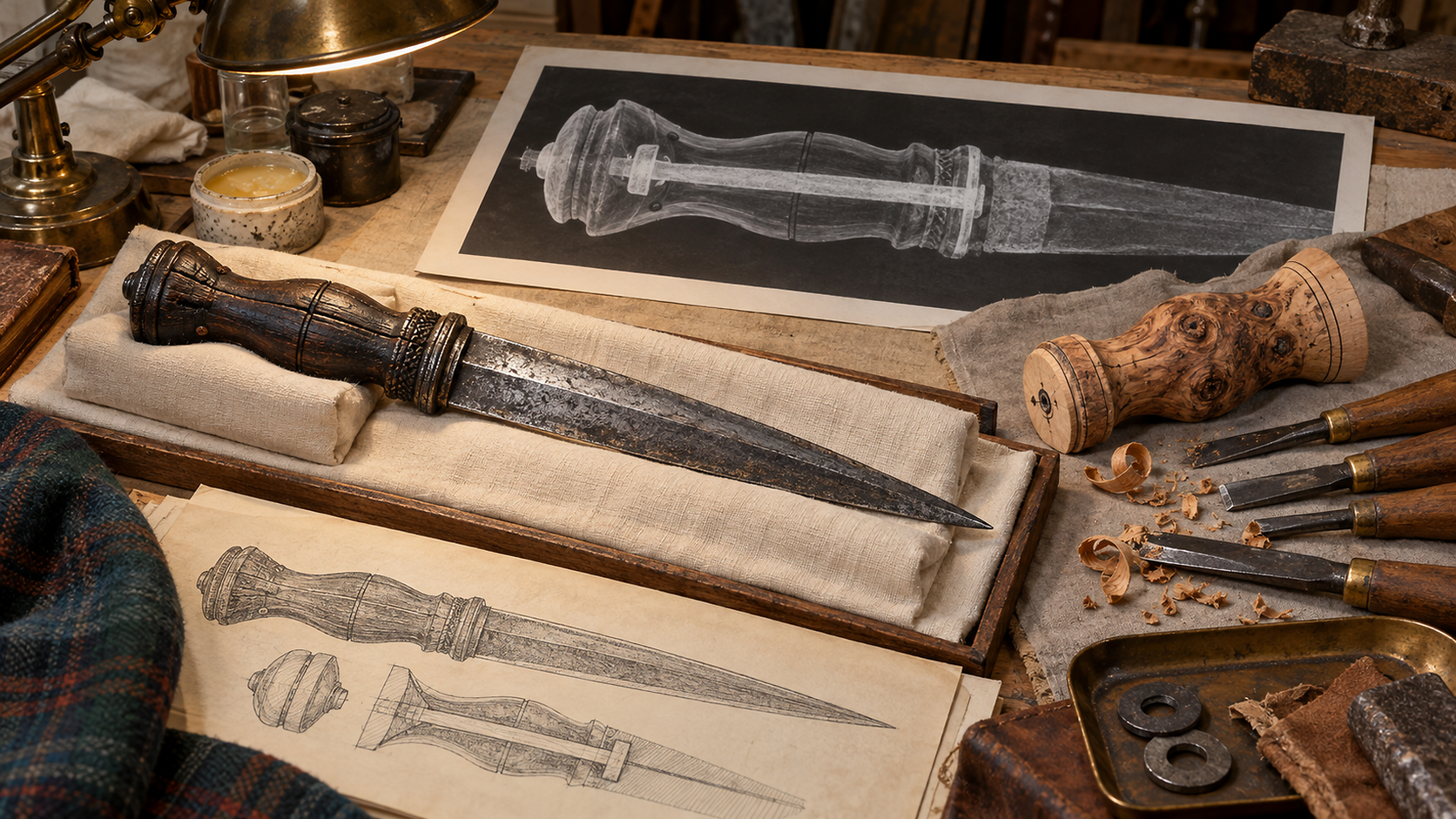
Authentic pre-1745 Highland dirks present unique challenges for modern museum curators and conservators. Because the hilts are carved from organic root timbers and the scabbards constructed of leather over wood, survivals retrieved from domestic attics or peat mosses frequently exhibit differential deterioration: the wood splits along drying shrinkage lines, while the iron tang expands from corrosion, splitting the internal canal.
Curators at institutions such as the National Museum of Scotland manage these objects through strict climate control, ensuring relative humidity remains stable around 45 to 55 percent to prevent further shrinkage of early dudgeon hilts. Rinsing treatments and controlled microcrystalline waxes are applied to preserve bare steel blades while halting active corrosion under original brass ferrules.
In the contemporary sphere, an active revival of historically accurate bladesmithing has challenged the dominance of Victorian dress garnitures. Modern bladesmiths and carvers study X-ray imagery and surviving historical specimens to recreate early dudgeon-hilted daggers with accurate single-edge profiles, root-heather handles, and authentic leather sheaths, restoring respect for the weapon's true historical function as a rugged, indispensable Highland companion.
Further reading
Follow the sources to examine the object and its historical context.
National Museums Scotland: Highland Weapons CollectionExternal reference · Opens in a new tab Culloden Battlefield Memorial Project: Arms and AccoutrementsExternal reference · Opens in a new tab Drummond, James. Ancient Scottish Weapons (1881)External reference · Opens in a new tab