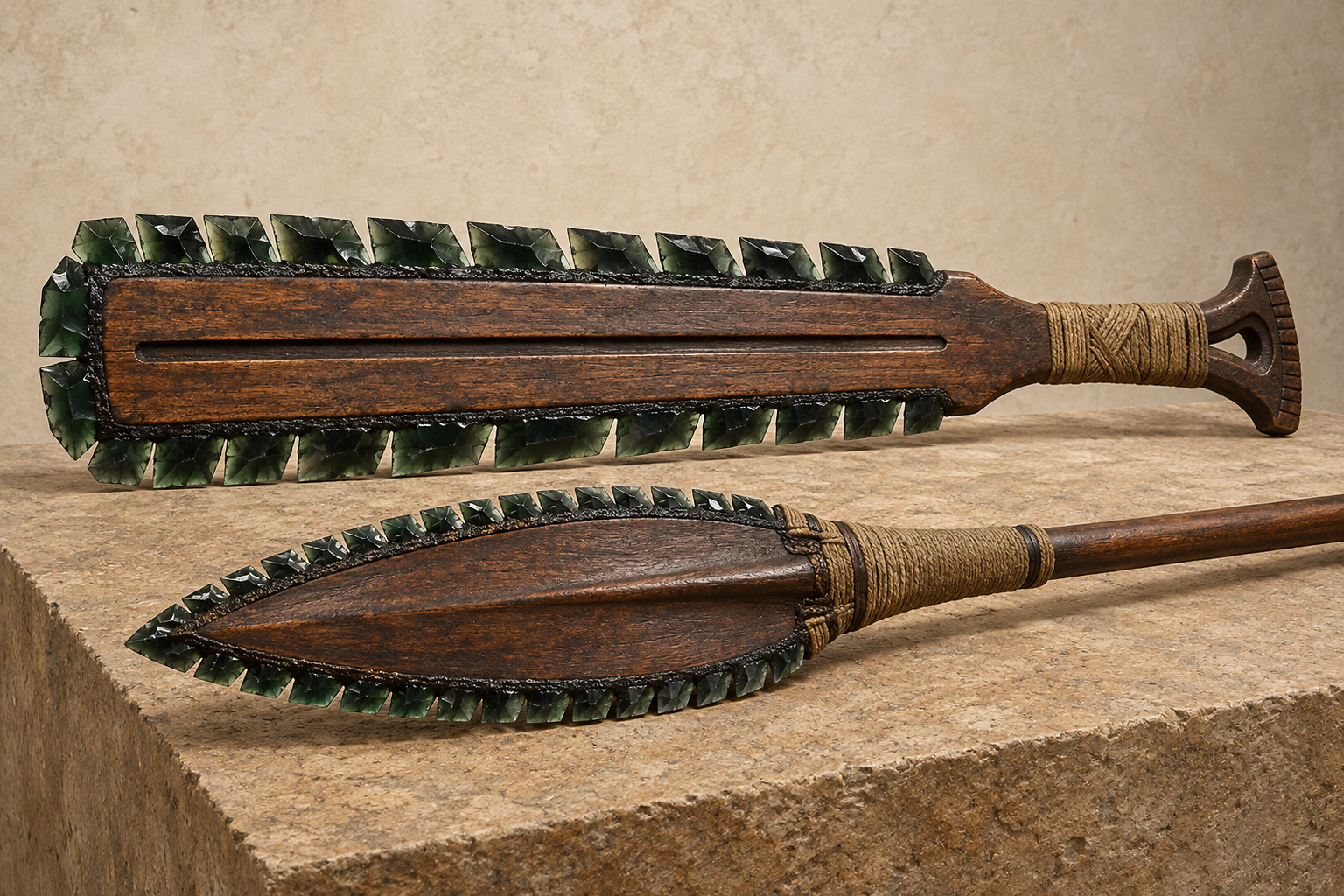
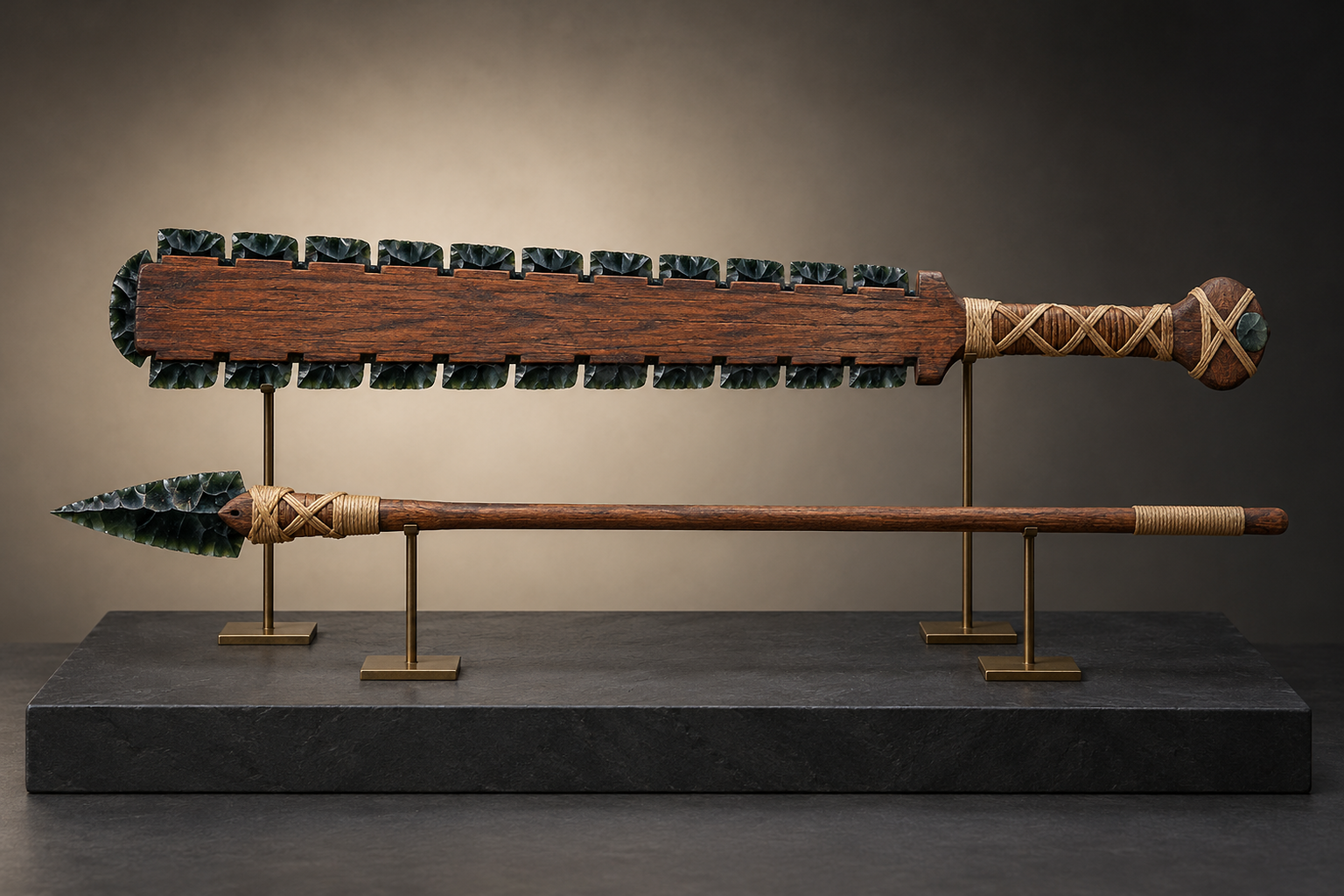
When armies of the Triple Alliance took the field in fifteenth-century Central Mexico, their tactical order rested on two complementary weapons. The macuahuitl, a shaped hardwood paddle set with razor-sharp prismatic obsidian blades along its flanks, served as an aggressive shock weapon capable of delivering terrible lacerations at close quarters. Standing alongside or directly behind those shock fighters were warriors armed with the tepoztopilli, a long thrusting spear topped by a broad wooden head also bordered in volcanic glass. Rather than operating as disorganized swarms of individual champions, Nahua forces combined the stand-off distance of the spear with the decisive clearing power of the composite blade, balancing lethality, formation cohesion, and the tactical demand for captive-taking.
The Composite Blade in Mesoamerican Warfare
Mesoamerican metallurgists produced sophisticated gold, silver, and copper alloys, but bronze edged weapons were practically nonexistent and iron smelting was entirely absent. The physical geography of Central Mexico provided an alternative material whose edge characteristics surpassed any contemporary Eurasian steel. Volcanic obsidian, particularly the prized green glass quarried at Cerro de las Navajas in Hidalgo, fractured cleanly down to molecular sharpness under controlled pressure flaking.
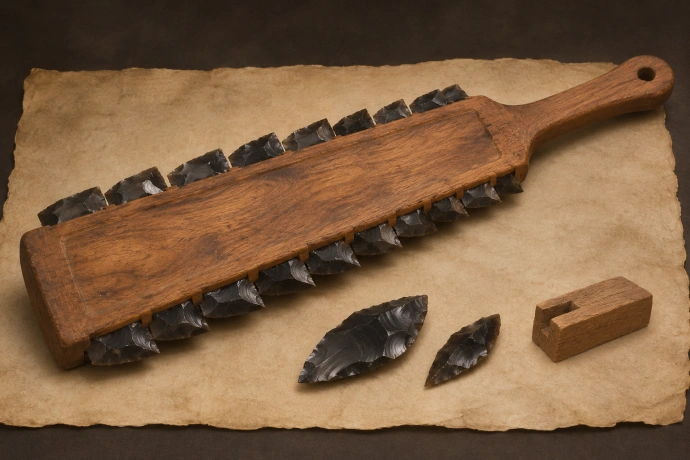
Rather than fashioning a weapon entirely from brittle volcanic glass, Nahua weapon makers adopted a composite architecture. They carved dense, resilient timber into balanced striking clubs and long shafts, cut continuous longitudinal channels into the strike margins, and secured modular glass blades within those recesses. The wooden core absorbed kinetic shock and distributed weight, while the glass provided an extraordinarily sharp cutting perimeter.
This engineering logic reached its peak in the arsenals of Tenochtitlan, Texcoco, and Tlacopan. By standardizing the production of uniform prismatic blades, Triple Alliance armories could refurbish damaged weapons quickly after battle, simply clearing cracked shards from the lateral slots and cementing freshly struck blades into the frame.
Anatomy and Craft of the Macuahuitl
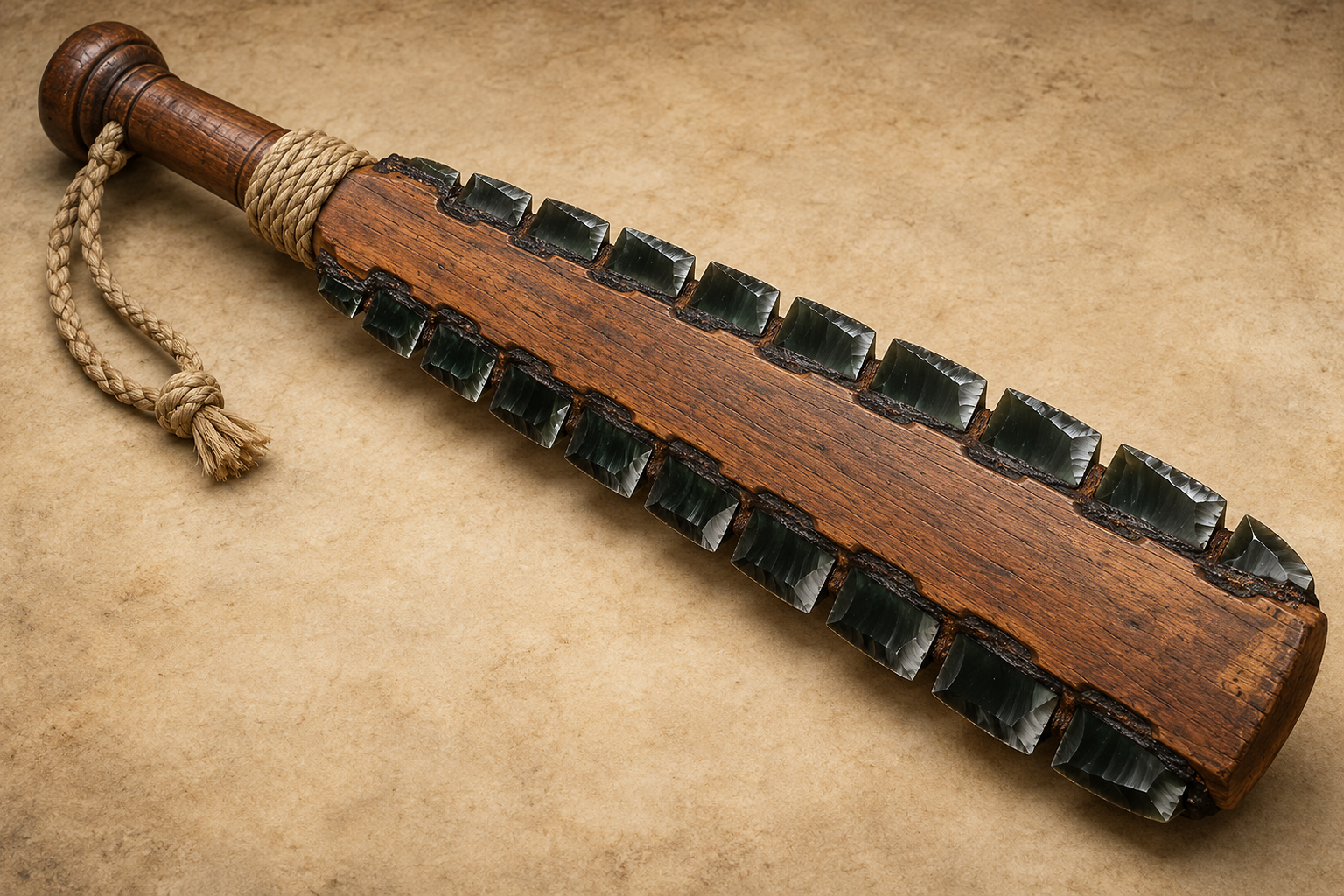
In indigenous pictorial manuscripts such as the Codex Mendoza and the Florentine Codex, the macuahuitl appears with consistent design features. The weapon featured a flat, paddle-like blade body that tapered down to a cylindrical grip, often backed by a rounded pommel with a woven wrist lanyard. Single-handed variants measured between 70 and 80 centimeters in total length, while two-handed examples spanned well over a meter.
Craftsmen cut grooves roughly one to two centimeters deep along the lateral edges. Master knappers produced long, trapezoidal or triangular prismatic blades using chest-crutch pressure flaking, yielding uniform segments with steep back facets and hair-splitting margins. These segments were inserted edge-to-edge to form an uninterrupted cutting track, or spaced at measured intervals depending on regional preference.
To lock the glass in place against heavy strikes, armorers used natural mastics formulated from tree resins, beeswax, and mineral compounds or asphaltic bitumen (chapopote). Once cured, this adhesive matrix held the obsidian firmly during shearing motions while remaining sufficiently pliable to keep shock waves from shattering the inserts at the root.
The Lost Specimen of the Real Armería
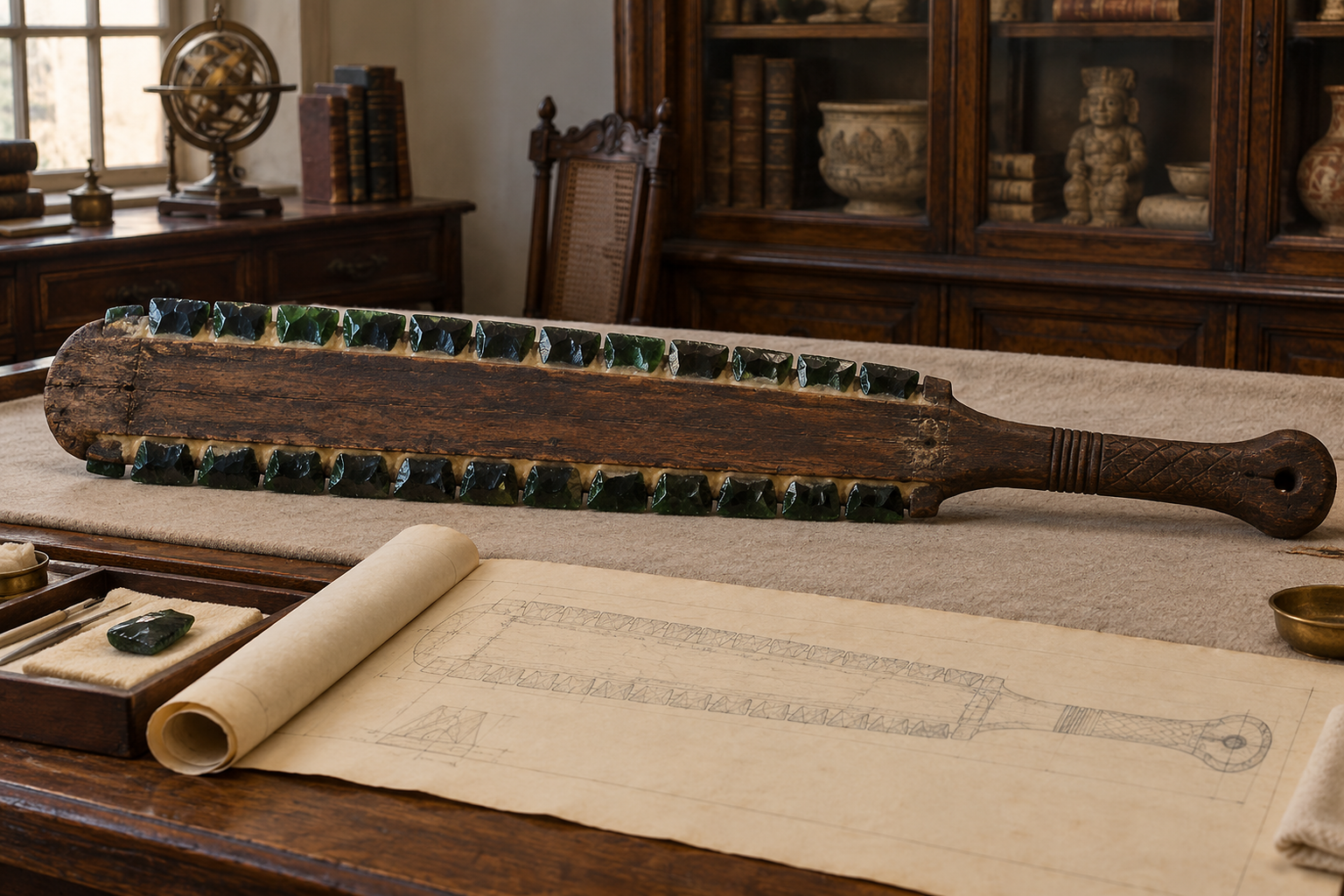
Reconstructing original macuahuitl construction is hindered by a lack of surviving artifacts. While thousands of obsidian blade segments lie cataloged in museum drawers, complete pre-Columbian specimens with preserved wooden stocks are practically nonexistent in the archaeological record. Organic timber degraded rapidly in the damp lakebed conditions and acidic soils of the Basin of Mexico.
The single most famous physical macuahuitl survived into the nineteenth century in the Royal Armory of Madrid. Contemporary sketches and early inventory descriptions recorded a weapon roughly three feet long and four inches wide, bearing closely fitted obsidian trapezoids set into lateral channels. Scholar Achille Jubinal sketched and documented the piece in 1838, providing one of the few technical illustrations made directly from an intact historic example.
In 1884, a devastating fire swept through the Real Armería, consuming the irreplaceable wooden weapon alongside numerous Mesoamerican featherwork shields and textiles. Today, researchers must triangulate between Jubinal's drawing, sixteenth-century line drawings from indigenous painters, and modern replicas built to test blade retention under mechanical stress.
The Tepoztopilli and the Geometry of Reach
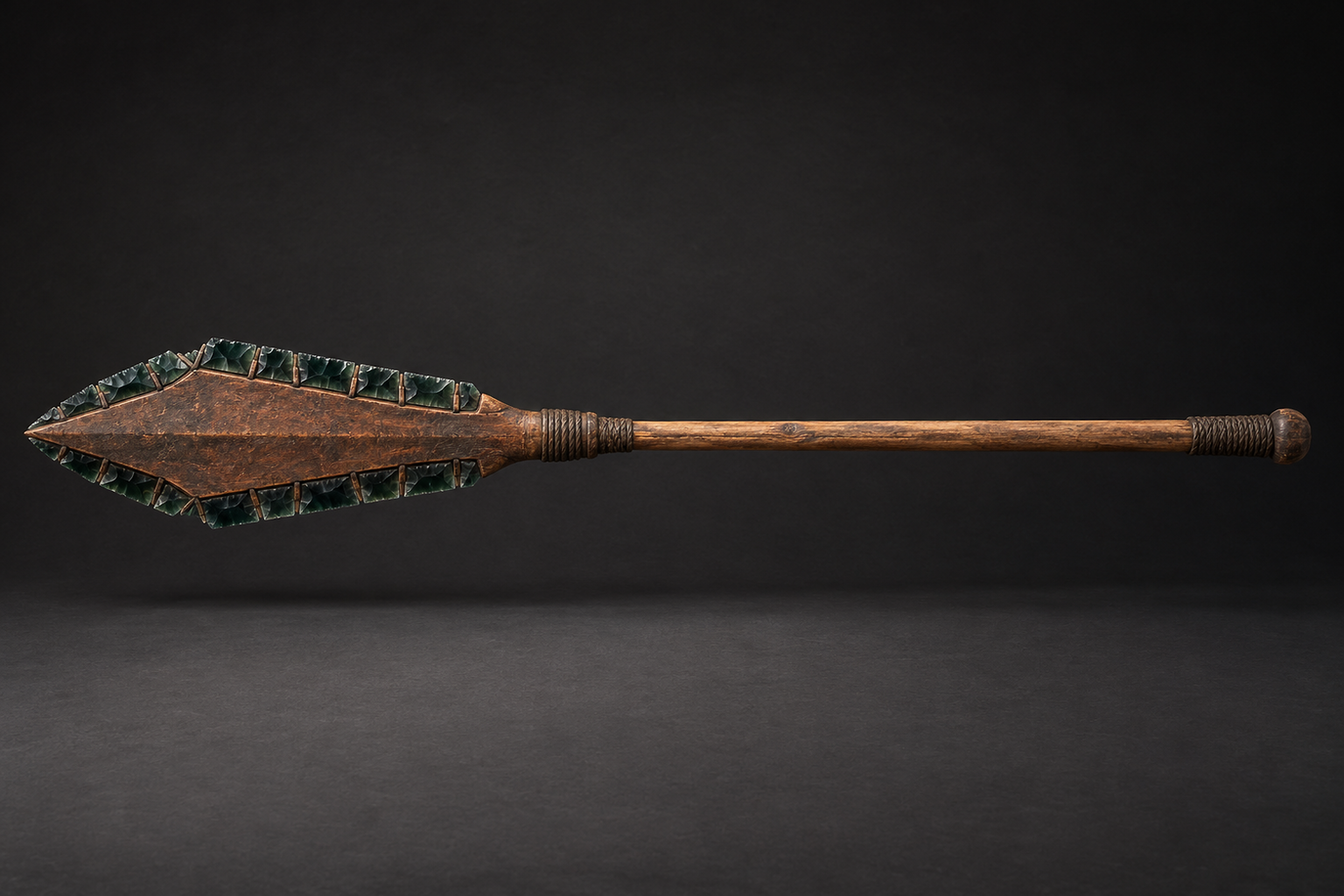
While popular imagination frequently casts the macuahuitl as the defining Aztec weapon, contemporary battle narratives demonstrate that the tepoztopilli was equally fundamental to Triple Alliance victories. The weapon was a formidable polearm, combining the reach of an infantry pike with the cutting surface of a broadsword. Its overall length varied from five to seven feet, though extended varieties approached eight feet or more.
The distinguishing feature of the tepoztopilli was its broad, elongated head. Rather than a small, piercing iron point typical of European pikes, the Nahua spear carried a flat, oval or diamond-profiled wooden head that could measure over a foot in length and five inches across. Deep channels grooved around its perimeter held continuous rows of obsidian blades cemented with resin.
This geometry granted the tepoztopilli dual utility. It delivered deep punctures against unarmored opponents or quilted cotton vestments, but its broad head could also slice during withdrawal. A warrior bracing the weapon could control space against advancing skirmishers, denying entry to anyone swinging a shorter blade.
Edge Dynamics: Micro-Cleaving Versus Impact Fracture
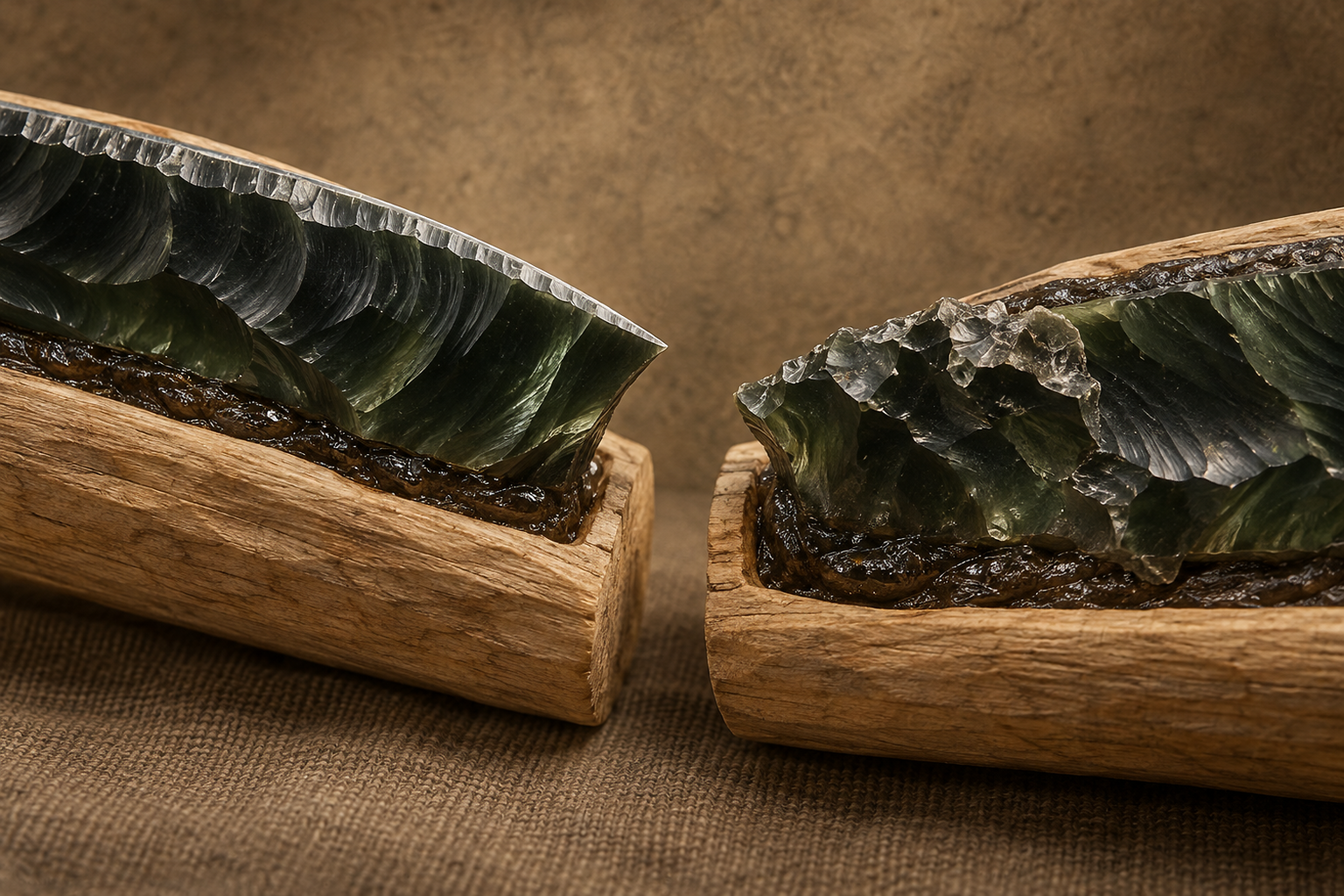
The mechanical behavior of an obsidian cutting edge differs fundamentally from that of tempered steel. Steel deforms plastically under heavy resistance, dulling or rolling its edge while maintaining structural cohesion. Obsidian is an amorphous glass without crystal grain boundaries; it cuts by microscopic brittle fracture. A freshly flaked obsidian edge measures mere molecules across, shearing soft organic tissue with far less resistance than a ground metal blade.
This extreme cutting efficiency comes with severe mechanical vulnerability. Upon striking hard bone, thick horn, or solid oak, an obsidian blade suffers immediate impact spalling. Small chips flake away from the cutting margin, micro-dulling the section or fracturing the insert entirely. If the blade strikes at an oblique angle, torsional stress readily snaps the exposed glass off flush with the wooden channel.
Because of this behavior, the macuahuitl was not intended for prolonged edge-to-edge parrying. Nahua warriors absorbed incoming strikes with heavy wooden or woven cane shields (chimalli), using the macuahuitl to strike exposed limbs, the neck, or the torso once an opponent had committed to an attack. The weapon operated on a principle of devastating initial trauma, trading long-term edge durability for catastrophic wound volume.
Decapitations and Chronicles: Evaluating the Spanish Accounts
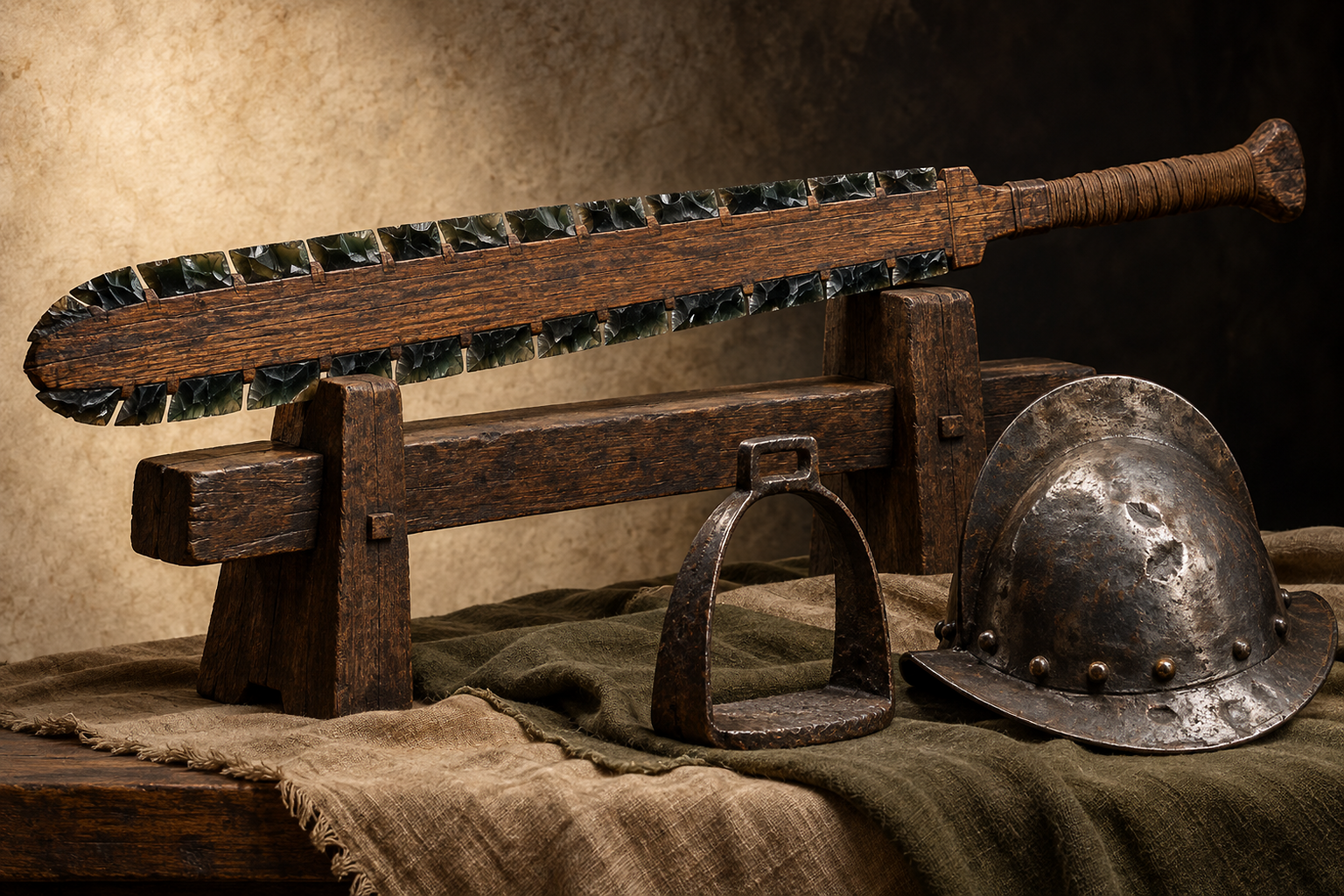
Spanish conquistadors writing in the sixteenth century left vivid, often sensational descriptions of the macuahuitl in combat. Bernal Díaz del Castillo and the Anonymous Conqueror recorded multiple instances where a single blow from a two-handed macuahuitl severed the head or neck of an armored Spanish warhorse, leaving the animal dead on the field.
Modern ballistics testing and biomechanical analysis treat the horse decapitation claims with necessary caution. Reconstructions using animal carcasses and gelatin targets confirm that a heavy two-handed swing can slice cleanly through several inches of muscle, sever major arteries, and chop deeply into cervical vertebrae. However, completely severing the neck of an adult horse in one blow requires cutting through dense muscle masses and thick, interlocking cervical vertebrae that would immediately shatter brittle obsidian blades.
It is far more probable that strikes shattered vertebrae, collapsed the windpipe, and severed both jugular veins in a single catastrophic trauma, causing the horse to collapse instantly in profuse hemorrhage. To sixteenth-century cavalrymen fighting for their lives in close quarters, such immediate collapse was functionally indistinguishable from complete decapitation.
Tactical Harmony: Ranks, Files, and Distance Control
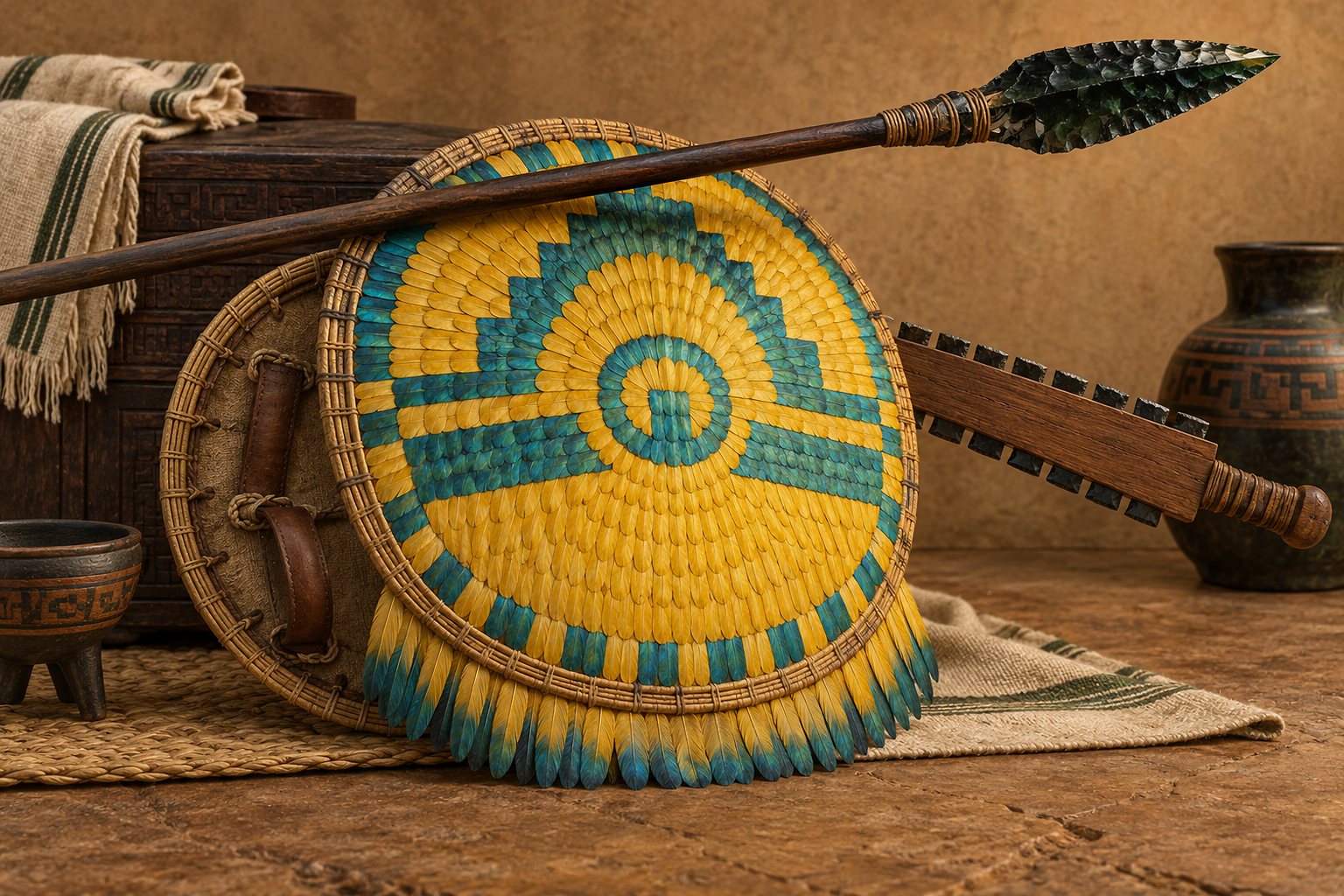
Triple Alliance commanders organized their forces around tightly calibrated echelons that balanced missile fire, reach weapons, and shock blades. When marching onto the field, an army deployed its missile troops—slingers throwing smooth river stones and archers shooting reed arrows—in loose screening ranks ahead of the infantry mass.
Behind this missile screen formed the dense files of seasoned warriors. Military historians such as Ross Hassig have demonstrated that the tepoztopilli formed the defensive spine of these formations. Warriors bearing the long spear stood shoulder-to-shoulder, holding their weapons outward to create a bristling perimeter that denied enemy units the momentum needed for an overrun.
The coordinated battlefield sequence relied on clear handoffs between specialized combat tiers:
- Missile barrages weakened enemy cohesion and forced opposing fighters behind their protective chimalli shields.
- Tepoztopilli spear lines advanced to lock the opposing battle line in place, checking charges and thrusting into emerging gaps.
- Shock troops wielding the macuahuitl filtered through intervals in the spear line to engage enemy champions in violent close-quarters duels.
- Veterans flanked stalled enemy wings, using the sweeping cuts of two-handed blades to roll up exposed formations from the side.
The Captive Imperative and Lethal Restraint
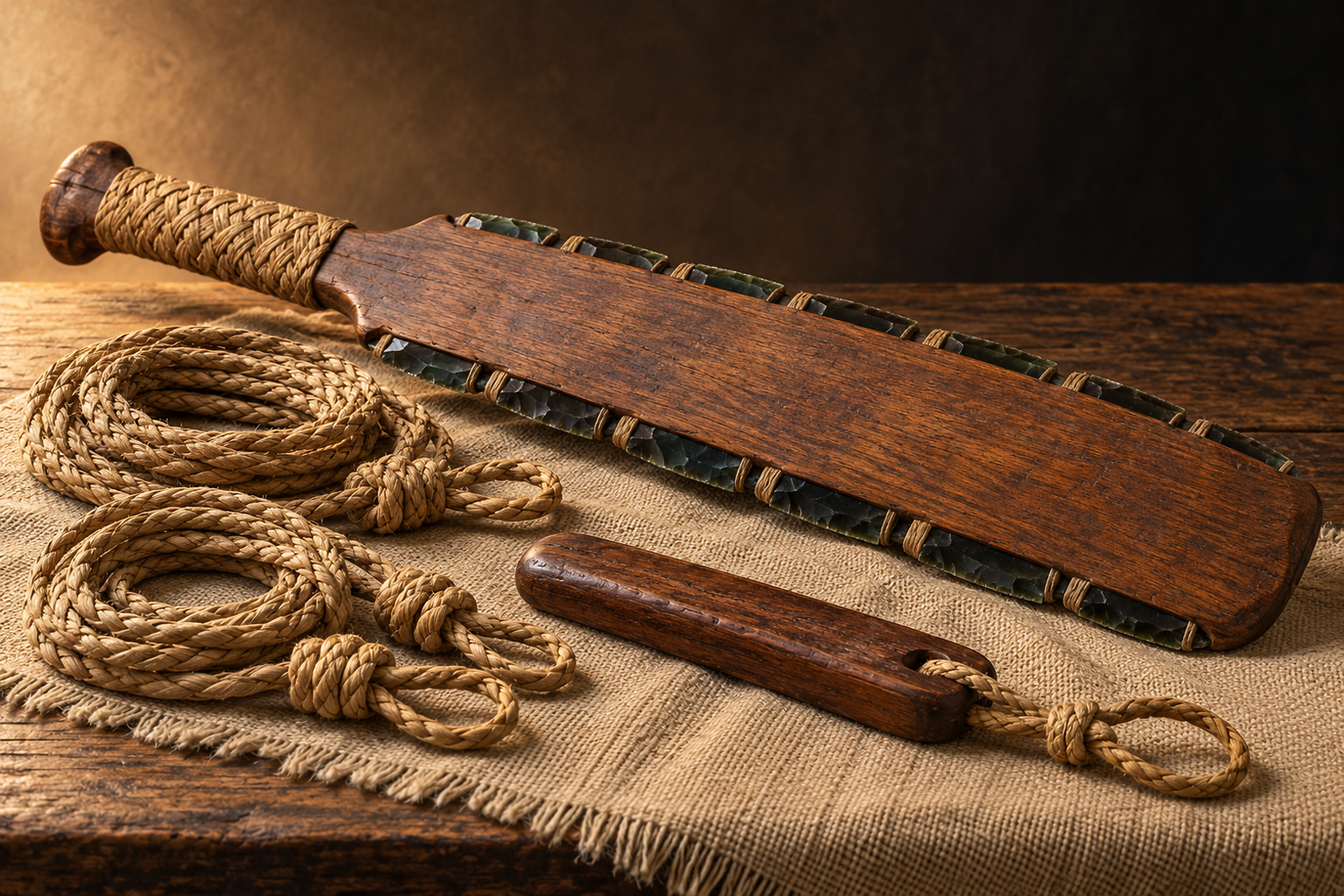
Any analysis of Nahua weaponry must account for the distinct political objectives of Mesoamerican warfare. In the expansionist campaigns of the Triple Alliance, battlefield slaughter was rarely the primary metric of victory. Imperial hegemony depended on imposing tributary obligations, while personal military advancement required capturing opposing warriors alive for ritual display and sacrifice in the capital.
This social reality shaped weapon handling. The wide wooden surface of the macuahuitl could be rotated in the hand to deliver a heavy, concussive bludgeoning strike with the flat of the paddle, stunning an opponent without opening an arterial hemorrhage. Warriors trained extensively to break limbs or strike the head with precise non-lethal force once a foe was disoriented.
The tepoztopilli served this system by holding an enemy in place without requiring an immediate fatal strike. A spearman could corner or pin a wounded warrior, allowing trailing comrades to subdue and bind the captive with maguey-fiber ropes. The presence of the macuahuitl nearby ensured that if a pinned combatant resisted with lethal intent, a decisive cutting blow was instantly available.
Armor Interactions: Ichcahuipilli and European Steel
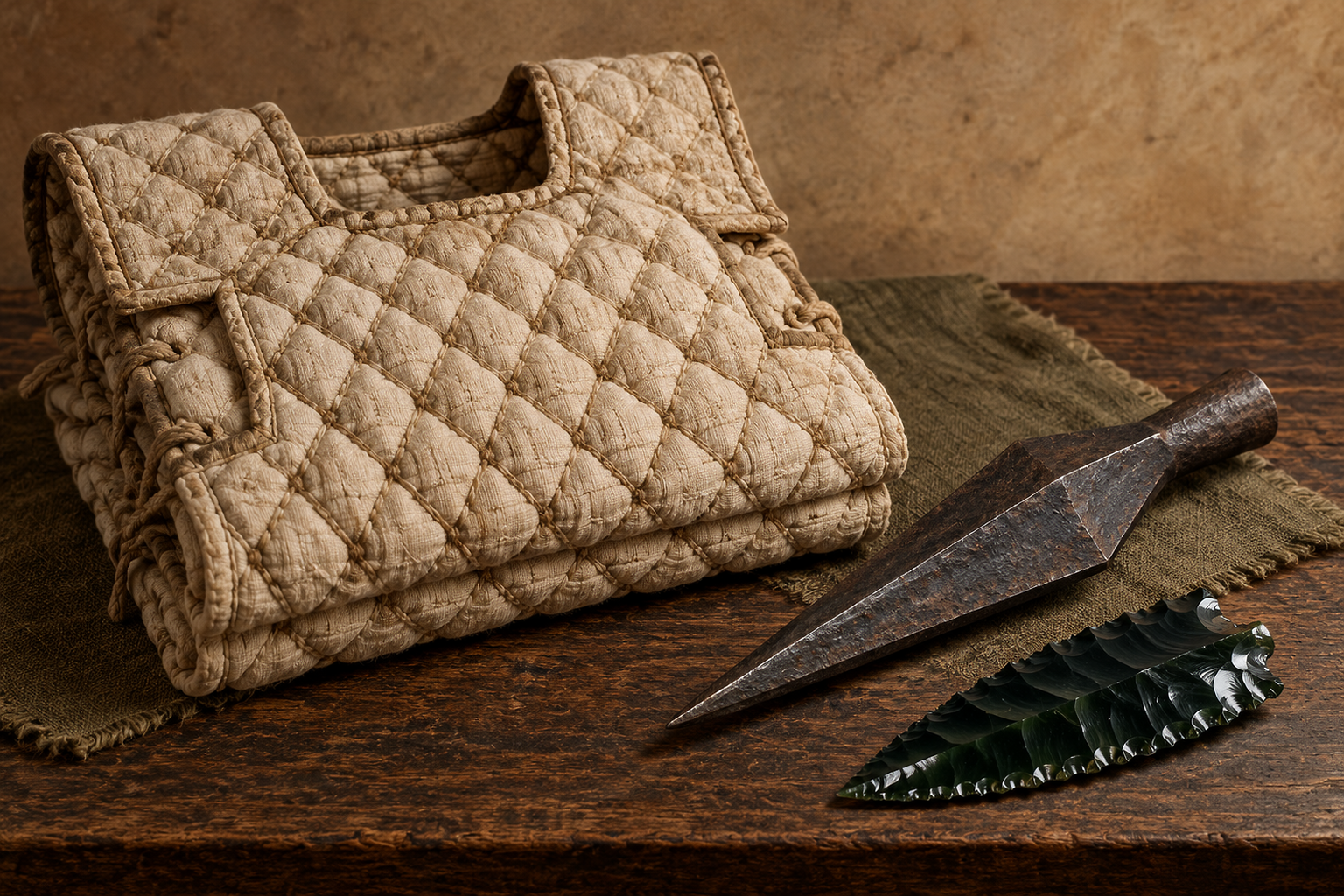
The defensive counterpart to Mesoamerican composite blades was the ichcahuipilli, a fitted jacket made of densely quilted cotton soaked in brine to harden its fibers. Typically one to two inches thick, this quilted armor dissipated blunt impact energy through hundreds of tightly packed cotton layers.
Against slashing obsidian edges, the ichcahuipilli performed exceptionally well. The flexible, fibrous batting snagged and blunted brittle glass edges, preventing shallow shearing cuts from penetrating to underlying tissue. However, against the concentrated piercing thrust of a heavy tepoztopilli, the quilted jacket proved far more vulnerable, as the narrow, high-pressure wedge could force apart the cotton threads.
When confronted with European plate and mail during the conquest, the dynamic shifted drastically. Neither the macuahuitl nor the tepoztopilli could bite into tempered steel cuirasses or cabassets; strikes against iron armor merely shattered the obsidian teeth into harmless flakes. Nahua warriors rapidly adapted by targeting unarmored legs, faces, and horse underbellies, leveraging the tepoztopilli's reach to pull cavalrymen from their saddles.
Experimental Archaeology and Blade Performance
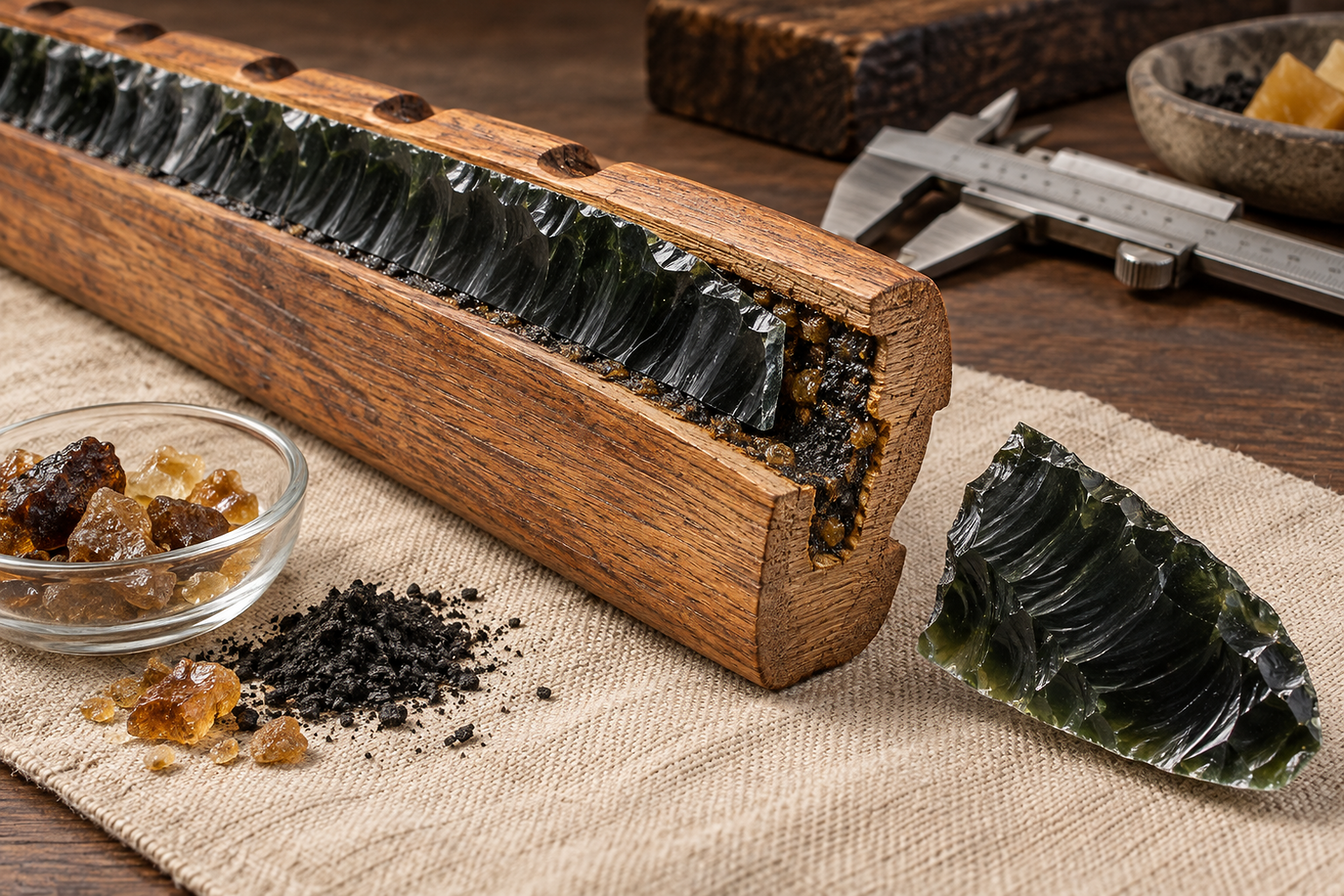
In recent decades, experimental archaeologists have constructed faithful replicas of both weapons using period-appropriate materials: seasoned mesquite, natural pine pitch, charcoal dust, and pressure-flaked obsidian struck from Cerro de las Navajas cores. These physical trials have clarified many long-standing debates regarding weapon handling and service life.
Mechanical strike tests against ballistics gelatin backed by deer carcasses demonstrate that obsidian inserts cut with astonishing smoothness, generating negligible drag compared to steel. A single strike can produce a wound pocket wider than the wooden paddle itself as surrounding flesh contracts under tension. However, the tests also confirm rapid degradation: whenever a blade segment struck dense cortical bone, it suffered edge spalling or snapped horizontally along the channel rim.
Significantly, the pitch-and-fiber resin performed far better than early twentieth-century commentators predicted. Even when an obsidian blade snapped, its base remained firmly cemented within the wooden channel, preventing the broken glass from dislodging into the weapon wielder's hand. Reconstructed tepoztopilli heads proved capable of repeated thrusts into heavy hides without shedding their glass teeth, proving the adhesive's resilience under axial loads.
Depictions in the Visual Record
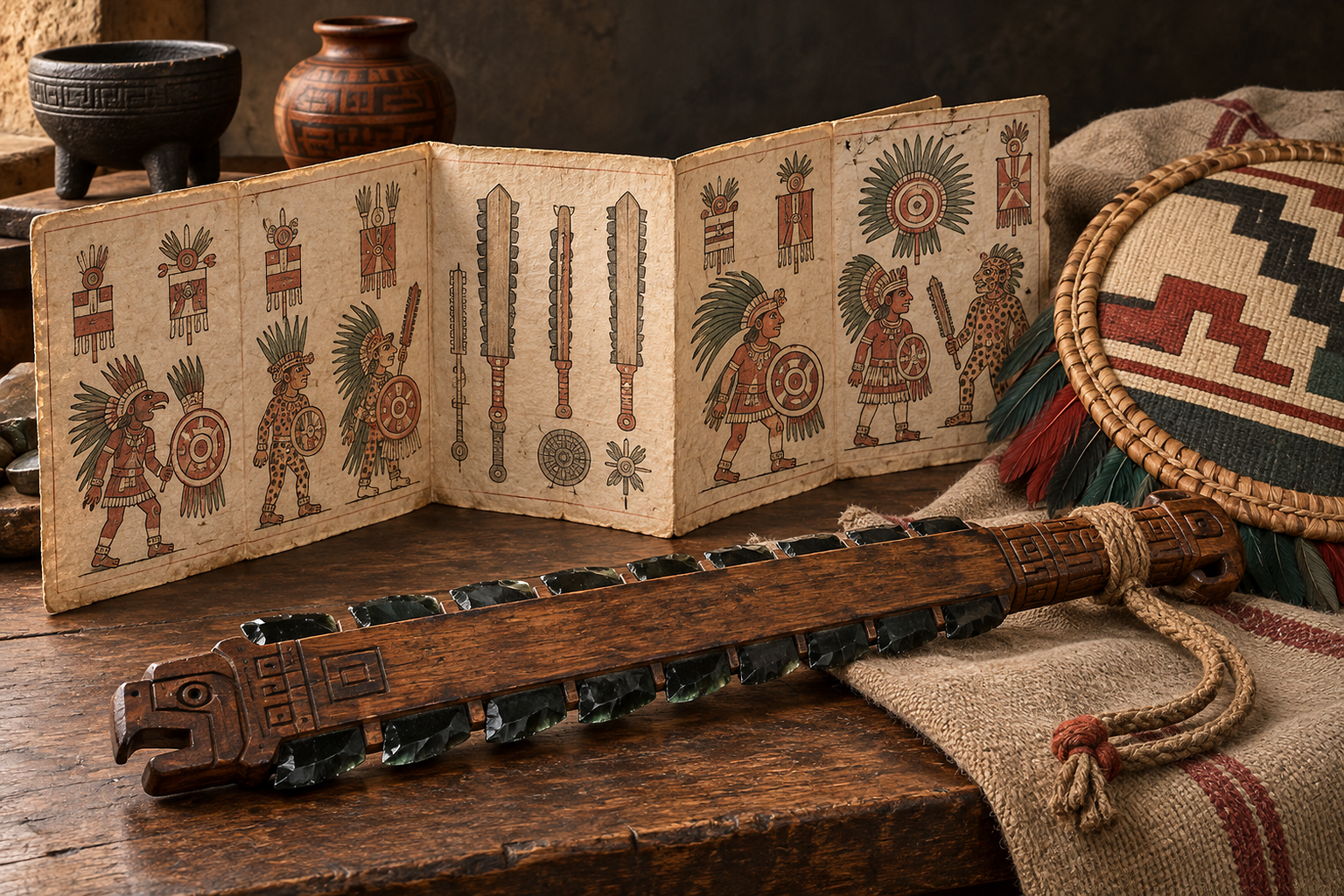
Because so few authentic wooden weapons survived colonization, indigenous screenfold books and early colonial codices serve as primary analytical documents. The Codex Mendoza, painted by native scribes (tlacuiloque) for the Spanish viceroy in the 1540s, illustrates the progressive rank insignia and weapon allocations of the Aztec military hierarchy.
In these folios, the macuahuitl is depicted alongside elaborate feathered war suits (tlahuiztli), carried by seasoned warriors who had demonstrated skill by taking designated numbers of captives. The drawings clearly differentiate between single-handed blades with wrist cords and substantial two-handed weapons carried by high-ranking captains and members of the Eagle and Jaguar military orders.
The Lienzo de Tlaxcala, an indigenous pictorial narrative chronicling the Spanish-Tlaxcalan alliance against Tenochtitlan, provides dynamic depictions of the tepoztopilli in action. Tlaxcalan spearmen appear holding off counterattacks, thrusting their long, paddle-bladed weapons directly into the ranks of Mexica defenders. These visual records capture the functional distinction between spear ranks anchoring a front and blade-wielders maneuvering through gaps.
Logistics of Mass Blade Production
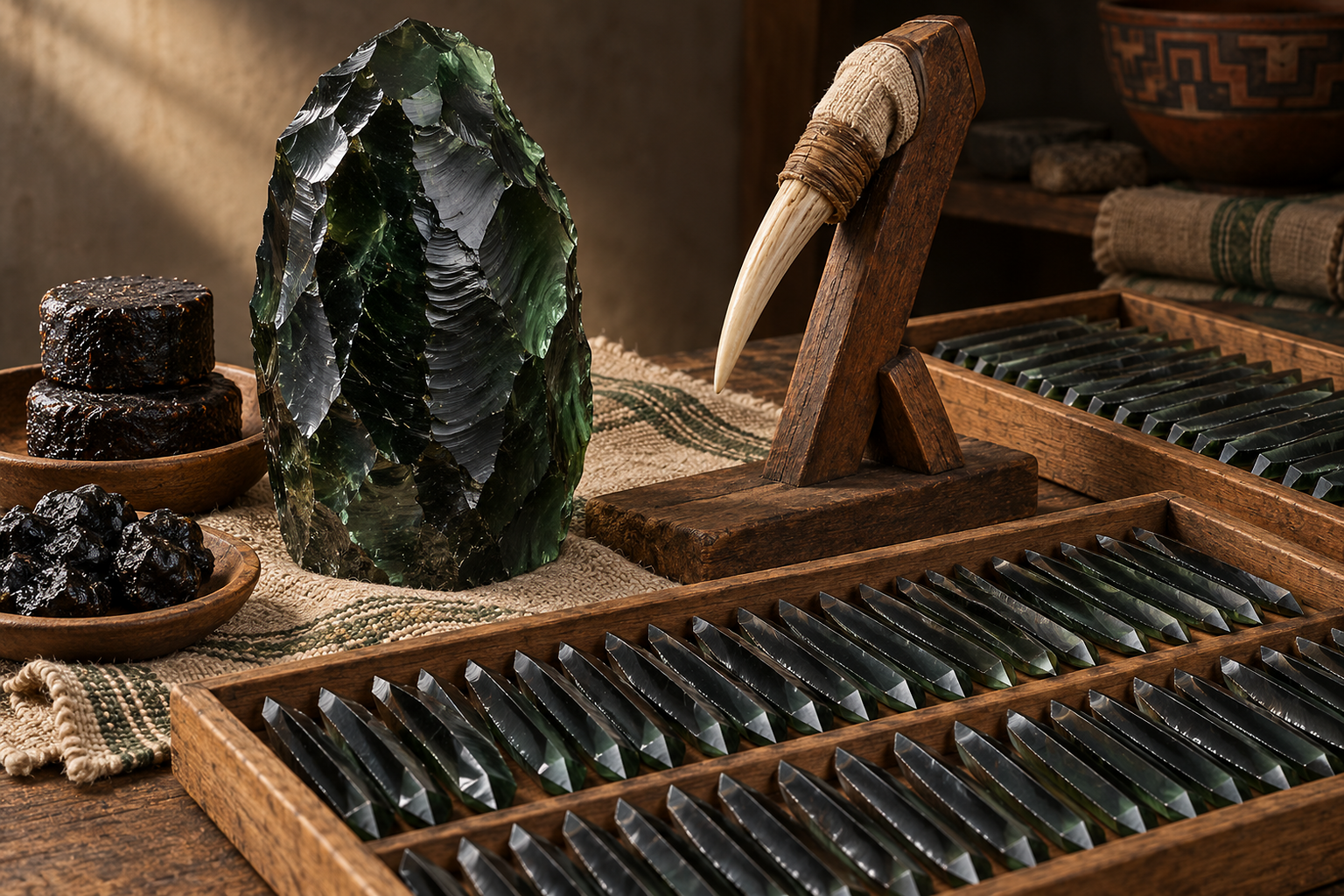
Sustaining imperial armies of tens of thousands required an industrial-scale lithic supply chain. The Triple Alliance maintained direct control over major obsidian deposits, most notably the high-quality green obsidian quarries at Pachuca and the grey-black sources at Otumba. Mining expeditions extracted raw cores, which were roughly shaped on site to eliminate transport waste.
In imperial workshops across the Valley of Mexico, specialized knappers executed core preparation with exceptional consistency. A single prepared polyhedral core could yield dozens of uniform prismatic blades with identical cross-sections and facet angles. This mass standardization allowed armory superintendents to store boxed caches of blades, ready to be issued to provincial garrisons on campaign.
The logistics of wood gathering were equally systematic. Arsenal managers collected tribute in the form of seasoned hardwood planks, resin cakes, and bundles of raw spear shafts. When mobilization orders were sent, local artisans could groove shafts and set fresh glass teeth into thousands of weapons within days, ensuring imperial armies marched with immaculate, razor-sharp front lines.
Tactical Adaptations During the Conquest of 1519–1521
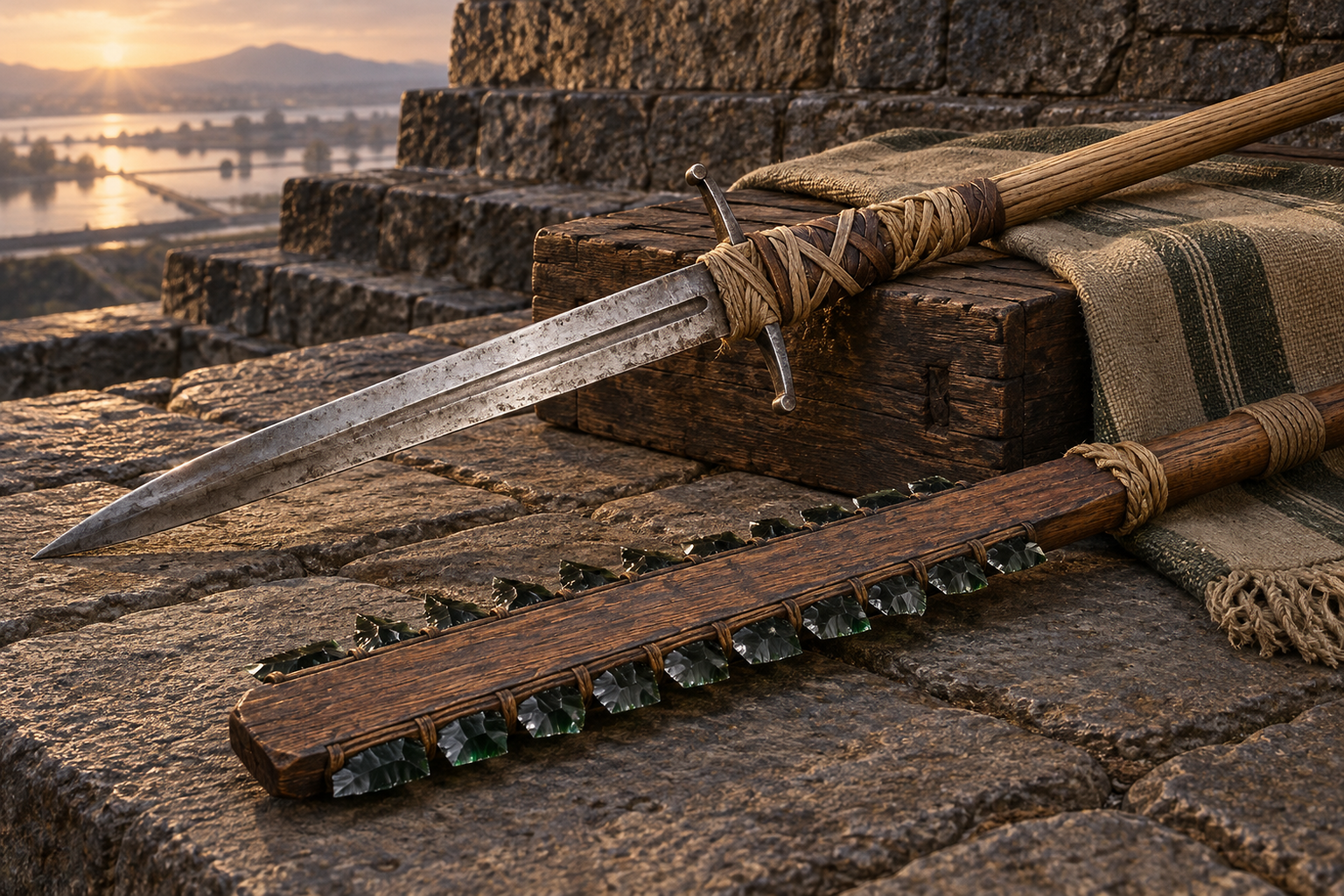
The arrival of Spanish forces, accompanied by tens of thousands of indigenous allies from Tlaxcala and other tributary states, forced rapid tactical evolution within Triple Alliance ranks. The traditional sequence of skirmishing and captive collection broke down when facing iron-jacketed infantry, crossbows, and mounted shock cavalry.
Nahua field commanders quickly recognized that isolated macuahuitl strikes could not stop a coordinated cavalry charge across open ground. In response, they shifted greater tactical emphasis onto the tepoztopilli. Chroniclers record that during the siege of Tenochtitlan, Mexica spearmen lengthened their lances using captured Spanish steel swords lashed to long poles, intermingling these improvisations with native tepoztopilli to create formidable anti-cavalry hedgehogs along the causeways.
In the cramped urban warfare of Tenochtitlan, where canal networks and demolished causeways precluded cavalry maneuvers, the macuahuitl reclaimed its lethal role. Warriors operating from flat rooftops and concealed side alleys ambushed Spanish and Tlaxcalan columns at point-blank range, where reach weapons were useless and the violent cleaving power of the composite paddle could overwhelm shields in close melee.
Legacy and Modern Misconceptions
In contemporary popular culture, tabletop gaming, and historical fiction, the macuahuitl is frequently romanticized as a crude, barbaric club or, conversely, as a magical superweapon capable of slicing cleanly through metal armor. Both depictions distort the sophisticated mechanical and tactical realities developed by Nahua engineers over centuries of campaign warfare.
The macuahuitl was neither a clumsy bludgeon nor an all-conquering sword; it was a highly specialized composite shearing tool designed to exploit the physical properties of natural volcanic glass against quilted or unarmored targets. Its effectiveness was magnified by the presence of the tepoztopilli, whose stabilizing reach created the tactical windows required for short-range composite blades to strike safely.
Understanding these two weapons as an integrated system reveals the operational depth of Late Postclassic Mesoamerican warfare. Rather than relying on individual ferocity alone, the armies of the Triple Alliance wielded a balanced combination of geometric reach and catastrophic cutting force, crafted from the volcanic earth and dense forests of their homeland.
Further reading
Follow the sources to examine the object and its historical context.
Hassig, Ross. Aztec Warfare: Imperial Expansion and Political Control. University of Oklahoma Press, 1988.External reference · Opens in a new tab Cerro de las Navajas Obsidian Source Studies, Instituto Nacional de Antropología e Historia (INAH).External reference · Opens in a new tab Florentine Codex (Codex Florentino), General History of the Things of New Spain, World Digital Library / Library of Congress.External reference · Opens in a new tab