In nineteenth-century southeastern Africa, the carved hardwood club known in isiZulu as the iwisa was an essential implement of personal defense, social standing, and military combat. While popular memory of the Anglo-Zulu War of 1879 often centers almost entirely on the broad-bladed thrusting spear, the iklwa, the iwisa served as an indispensable partner in close-quarters tactical shock. Paired with the tall cowhide shield, it provided a versatile balance of concussive force, parrying mass, and throwing utility that shaped combat encounters across the rolling hills and broken terrain of Zululand.
Wood Selection and Timber Physics
The effectiveness of an iwisa depended directly on the botanical properties of the timber selected by its carver. Southern Africa possesses a variety of slow-growing, extremely dense hardwoods whose grain structures resist shattering along natural cleavage lines even under intense shock. Makers preferred timber sourced from species such as wild olive (Olea europaea subsp. africana), pink ivory (Berchemia zeyheri), and black ironwood (Olea capensis). These species offer exceptionally high dry densities, frequently exceeding one thousand kilograms per cubic meter, which allows the weapon to sink in water and strike with significant kinetic mass despite retaining a relatively slender shaft.
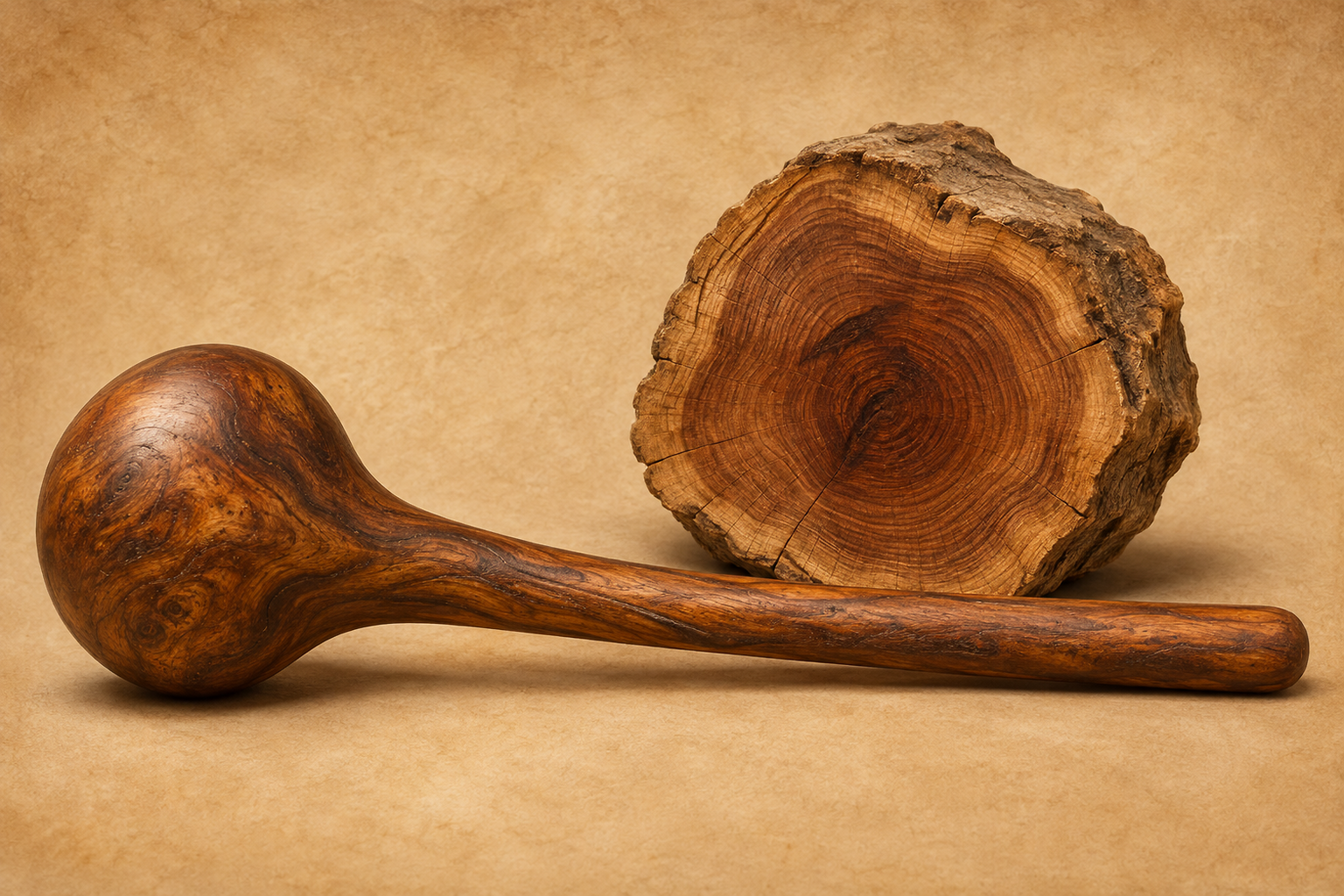
Carvers deliberately sought out specific timber configurations, particularly naturally swelling root burls or the junctions where heavy branch joints diverged from the main trunk. Utilizing a continuous grain line from shaft through head drastically reduced the risk of structural failure. When a club strikes a hard target, such as a helmet or musket stock, the shear stresses concentrate precisely at the transition between head and neck. Carving the entire weapon from a single piece of wood, with grain running naturally into the striking bulb, ensured the head would not shear off during impact.
Seasoning the harvested timber demanded steady patience. Freshly felled wood dried slowly in shaded, temperate conditions to prevent radial checking, warping, and surface cracking. Craftworkers occasionally rubbed animal fats and ox tallow into the grain over several months to retard moisture loss and harden the outer fibers. The result was a weapon with an elastic core and an unyielding, resilient exterior capable of delivering substantial shock without splitting.
Carving and Geometry of the Striking Head
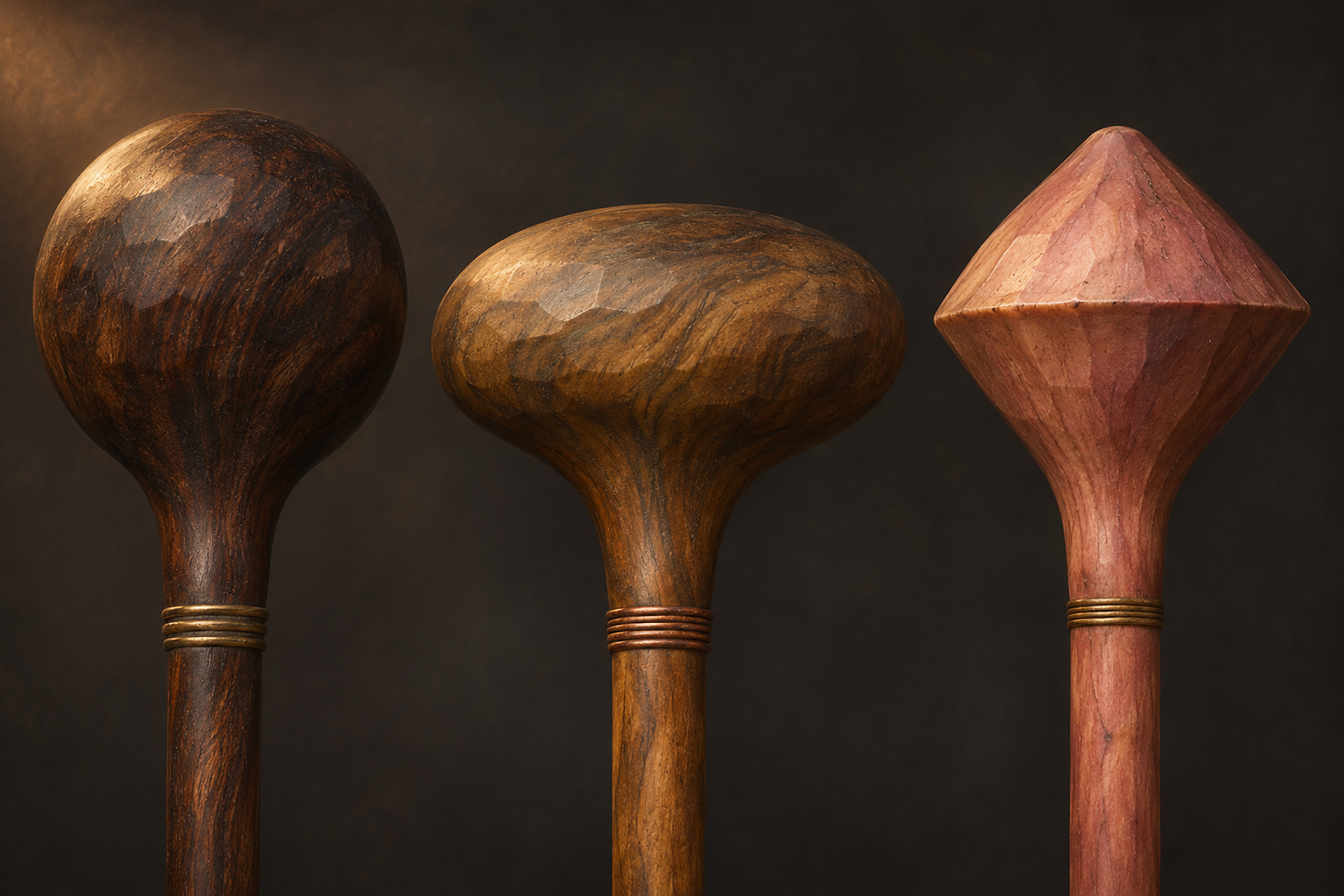
The shaping of the iwisa was executed using traditional iron adzes and scrapers, followed by abrasive smoothing using coarse leaves and sand slurry. The geometric profile of the club varied, reflecting both personal preference and functional requirements. While spherical heads remain the most iconic, carvers produced flattened spherical forms, bi-conical profiles, and compressed disc heads with distinct lateral ridges. A rounded surface concentrates the kinetic energy of a swing into a compact impact point, whereas an edge or ridge along an oval bulb magnifies localized pressure, breaking through bone or thick layers of uniform cloth.
The balance point of the weapon sat purposefully far down the shaft toward the bulbous head. Unlike a balanced European fencing foil or a long-handled quarterstaff, the iwisa was designed to act as an energetic lever. By concentrating the majority of the club's overall mass in the distal head, the carver ensured that even a short, whipping swing from the wrist and forearm could generate decisive concussive force. Shafts typically tapered toward a narrower grip, terminating in a slightly flared butt or a carved texture to prevent the weapon from sliding out of a sweat-slicked palm during engagement.
In addition to combat performance, the symmetry and finish of the head served as a visible testament to the craftsman's skill. High-status pieces display intricate cross-hatching, burned decorative zones, and precisely centered striking planes. Although functional field clubs carried on active campaigns were often plainer than ceremonial court regalia, the care given to symmetrical shaping and head alignment remained consistent across surviving examples.
The Cowhide Shield as Tactical Anchor
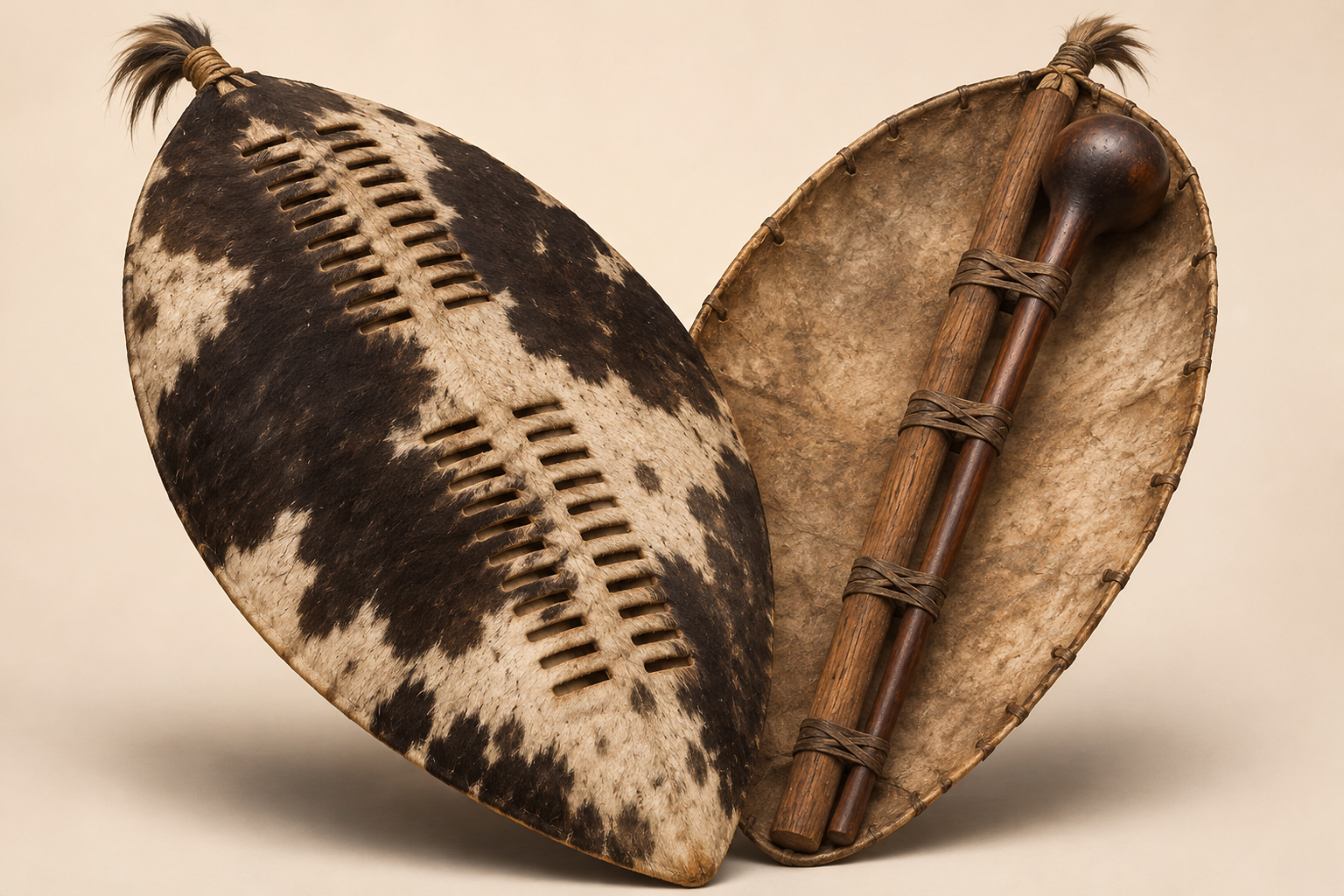
The iwisa was rarely deployed as an isolated offensive weapon on the battlefield; its tactical utility was intimately bound to the Zulu cowhide war shield. In the reformed military system associated with King Shaka and maintained through the reign of King Cetshwayo kaMpande, the oval shield served as an active offensive implement as well as a protective screen. At the start of the 1879 war, warriors carried either the full-sized isihlangu, reaching from foot to chin, or the slightly trimmed umbumbuluzo, adapted for improved mobility and denser formation fighting.
The shield was manufactured from cured oxhide, selectively stiffened through drying and beaten flat without tanning, which preserved the structural stiffness of the raw rawhide. A stout central wooden spine (umgobo) ran vertically down the interior, secured by parallel rows of split-hide thongs (amagobolondo) laced horizontally through the front face. This arrangement created a light, rigid, and springy barrier capable of deflecting thrown spears and redirecting bayonet thrusts. Held in the left hand by the central spine, the shield could be punched outward to deflect an incoming weapon or obscure an opponent's field of vision.
Carrying the iwisa alongside the shield required practiced economy of motion. When closing with the enemy, a warrior typically held the shield's interior wooden stave in his left hand while simultaneously grasping the shaft of his iwisa or spare throwing spears against the spine. This left the right hand free to wield a primary weapon, while keeping the club instantly accessible should close combat dictate a transition to crushing blows or close parrying.
Kinematics of Close-Quarters Impact
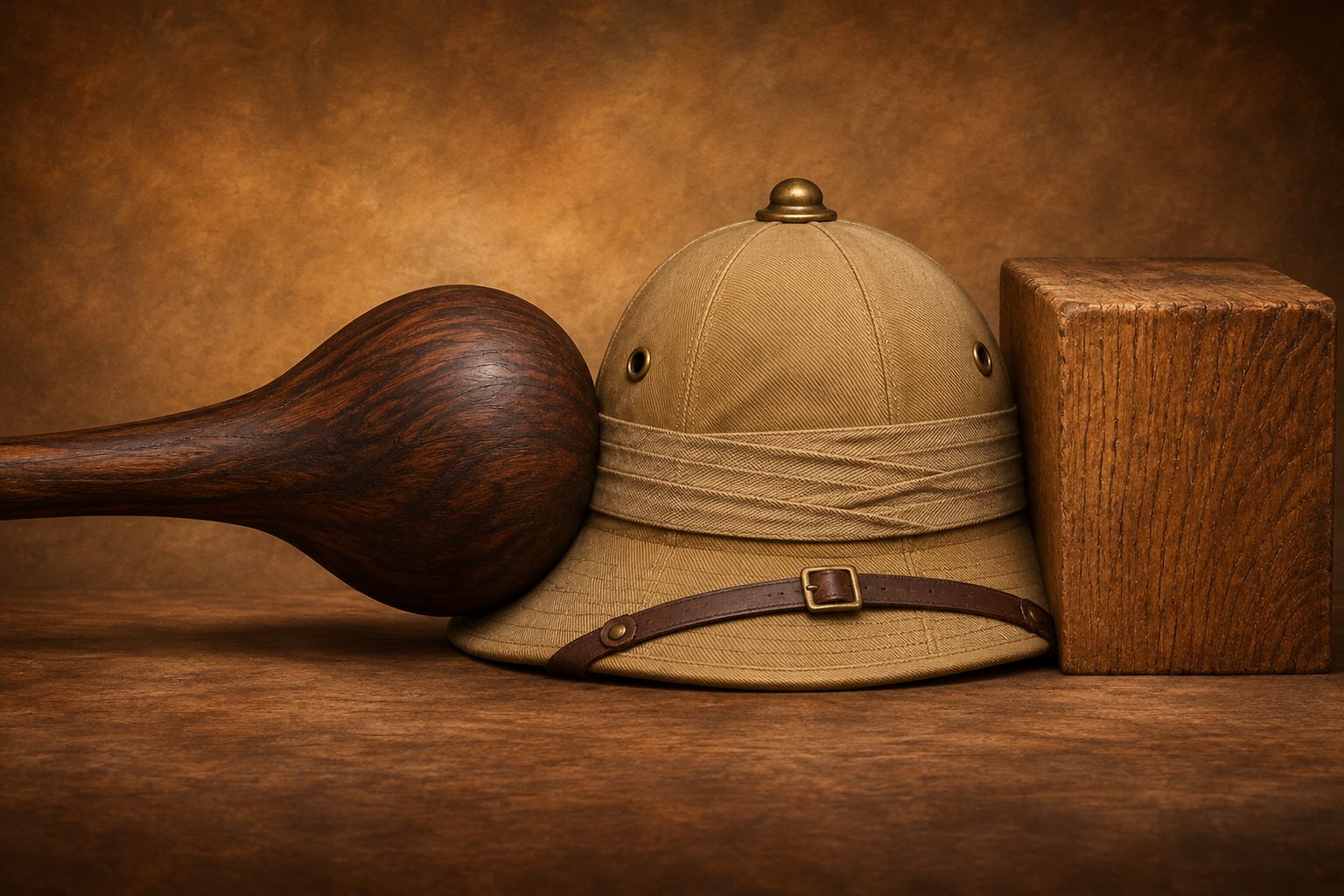
The physics of the iwisa in combat rely entirely on blunt-force trauma rather than shearing or cutting. Against an unarmored opponent, a direct hit to the cranium, clavicle, or forearm transfers energy immediately through the skeletal structure. Even when an enemy wore the British red or blue wool serge uniform, the impact traveled cleanly through the dense fabric. An iwisa blow striking a forearm raised in defense could easily fracture the radius or ulna, rendering the opposing limb incapable of retaining a rifle or sword.
Against the steel bayonets and brass-trimmed gear of British soldiers in 1879, the concussive power of hardwood presented unique tactical advantages. A sweeping strike from an iwisa could batter aside a fixed rifle barrel with enough lateral force to misalign a defensive stance. The wood possessed sufficient density to absorb contact with metal without shattering, while delivering enough impulse to knock a soldier off balance. In the chaotic, swirling melee that followed the breach of defensive perimeters, this blunt shock bypassed the precision required for thrusting weapons.
The kinetic energy developed by an iwisa relies on velocity at the moment of impact. Because the shaft is relatively short, often measuring between sixty and eighty centimeters, the user could generate high rotational velocity in confined spaces where a long spear would be unwieldy. A warrior could swing the club from the wrist and elbow within the crowded interior of an overturned wagon ring, a tent line, or a tight trench, where infantrymen struggled to operate bayonets fixed to long Martini-Henry rifles.
Hooking, Stripping, and Off-Hand Tactics
One of the central combat techniques recorded in traditional Southern African stick-fighting and tactical systems involved using the shield and club in coordinated opposition. In mutual melee, an experienced fighter used the outer perimeter of his shield to displace the enemy's guard. By driving the thick leather rim across an opponent's weapon hand, the Zulu combatant created a sudden blind spot or forced the opponent's guard outward, clearing an avenue of attack for the club or spear held in the opposite hand.
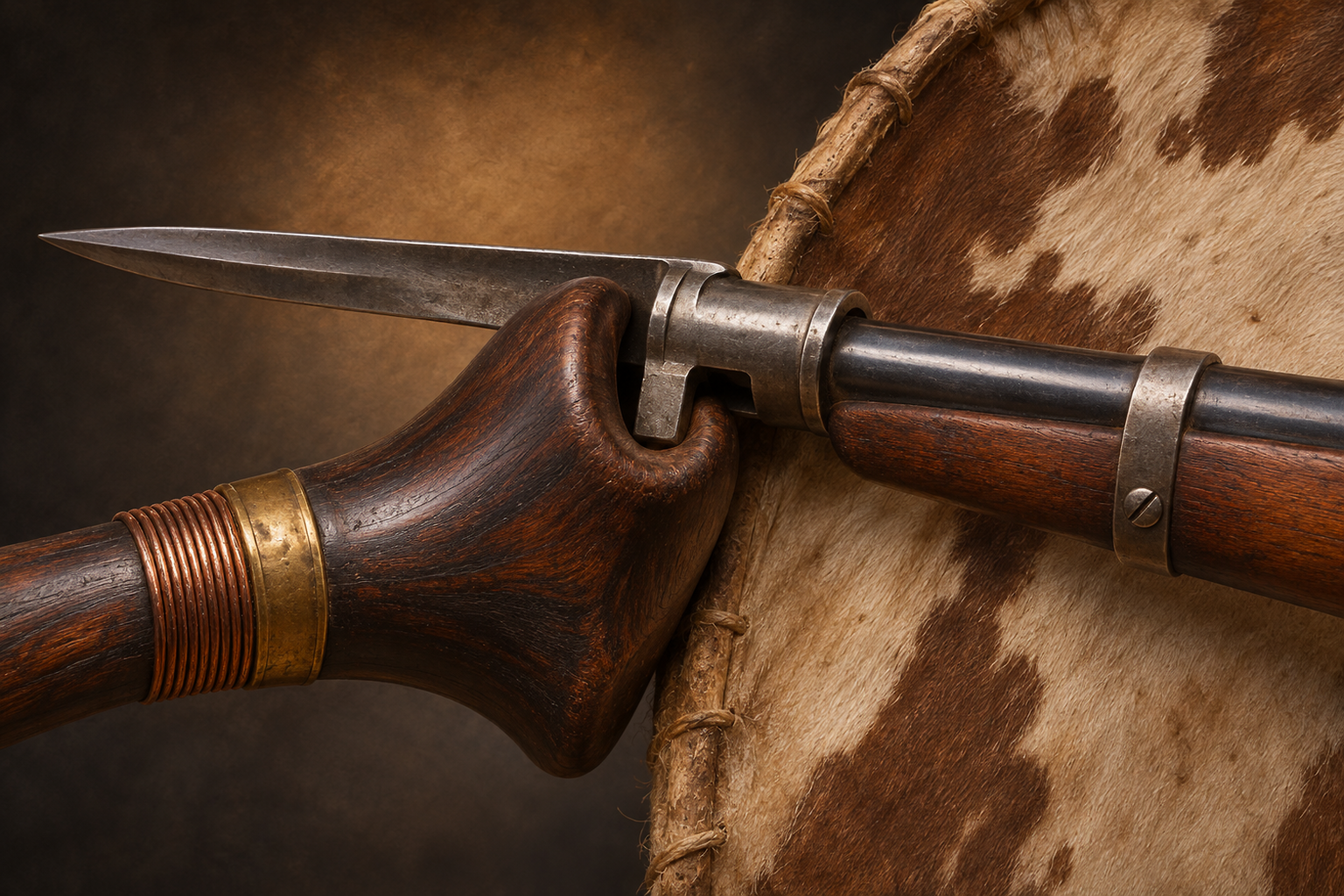
The flared head of the iwisa itself functioned as a hooking and trapping device. If an opponent offered a guard with a bayonet, rifle barrel, or staff, the back of the club's bulb could catch the opposing weapon behind the front sight or crossguard. With a swift pulling motion, the fighter dragged the opposing weapon downward or to the side. This technique relied on the structural continuity of the carved neck; a club whose head was merely pinned or joined would quickly snap under the torsional stress of weapon stripping.
In stick-fighting traditions (ukungcweka), which trained youths from childhood in the mechanics of cattle defense and tribal skirmishes, fighters routinely held an iwisa in each hand, or paired a club with a light parrying stick. These dueling habits transferred smoothly to the royal regiments (amabutho). Even under the formal doctrine emphasizing the short stabbing spear, warriors retained these instinctive reflex pathways, employing the club to parry, hook, and counter-strike whenever an engagement broke down into individual combat.
Missile Function and Ranged Dynamics
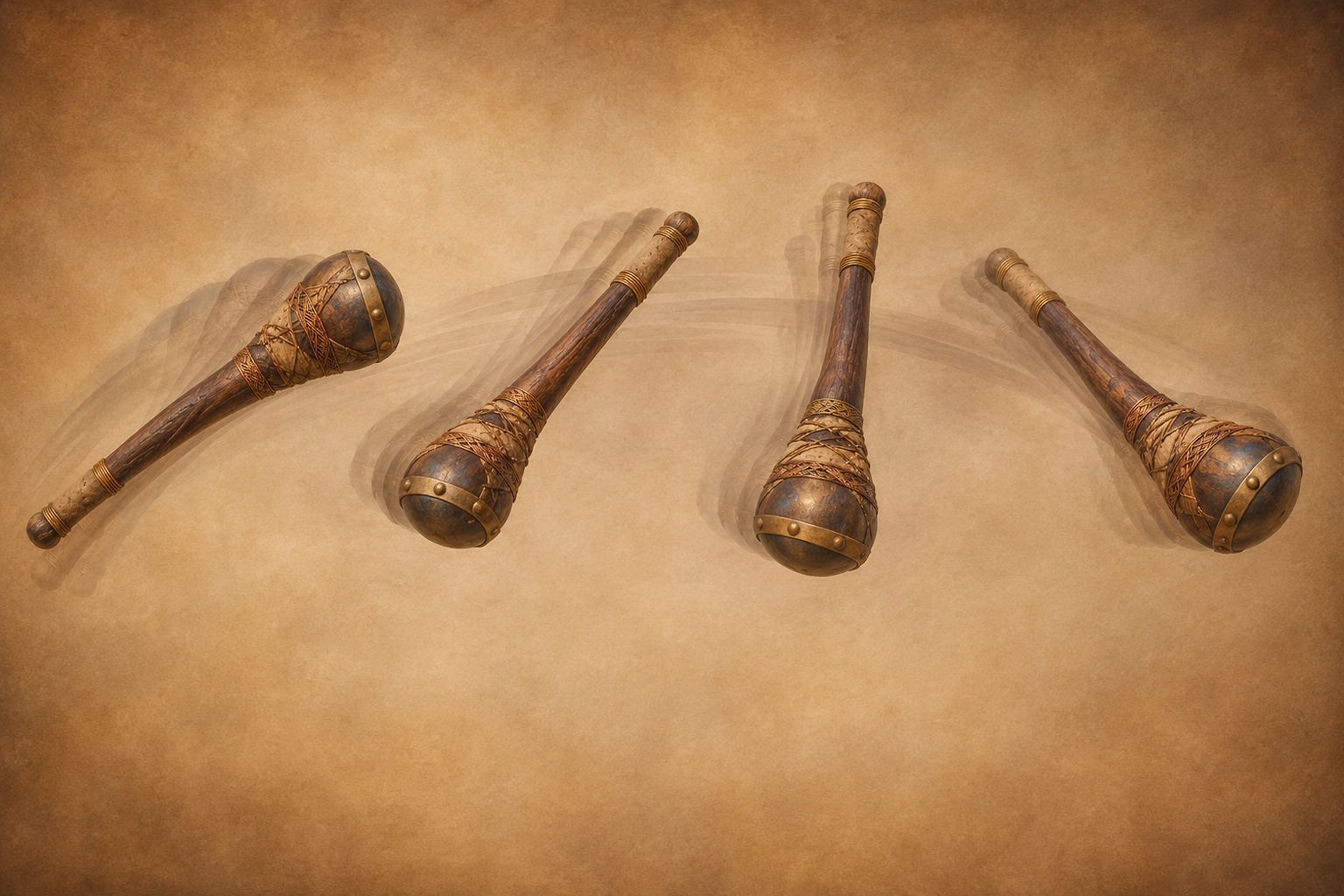
Although primarily a striking weapon, the iwisa served a recognized secondary role as a throwing missile. When hunting game or skirmishing against rival scouting parties, Zulu men learned to cast the club with rotational speed. Thrown horizontally with an overhand snap, the weapon traveled end over end, retaining sufficient momentum to break limbs or stun an escaping animal. On the open field, this missile capability offered an offensive burst moments before physical collision.
During the 1879 campaign, British survivors described receiving barrages of thrown clubs, throwing spears, and rocks as Zulu formations converged on their lines. As the horns of the charging formation (izimpondo) closed the distance, skirmishers frequently hurled an iwisa from a distance of ten to twenty paces. The goal was rarely a lethal impact; rather, the descending mass of hardwood forced the defensive line to flinch, raise their arms, or drop their sights, disrupting the disciplined volleys of defensive fire at the critical second of impact.
The aerodynamic behavior of a thrown iwisa is governed by its distal weighting. As the club spins through the air around its center of mass, the heavy head acts as an anchor point, creating a predictable rotational plane. If the head struck an adversary's shield or chest, the full mass of the hardwood imparted significant concussive force. If the weapon missed, the thrower closed the remaining yards with his primary stabbing spear (iklwa), leaving the thrown club behind on the field.
The Iwisa in the Buffalo Horns Formation
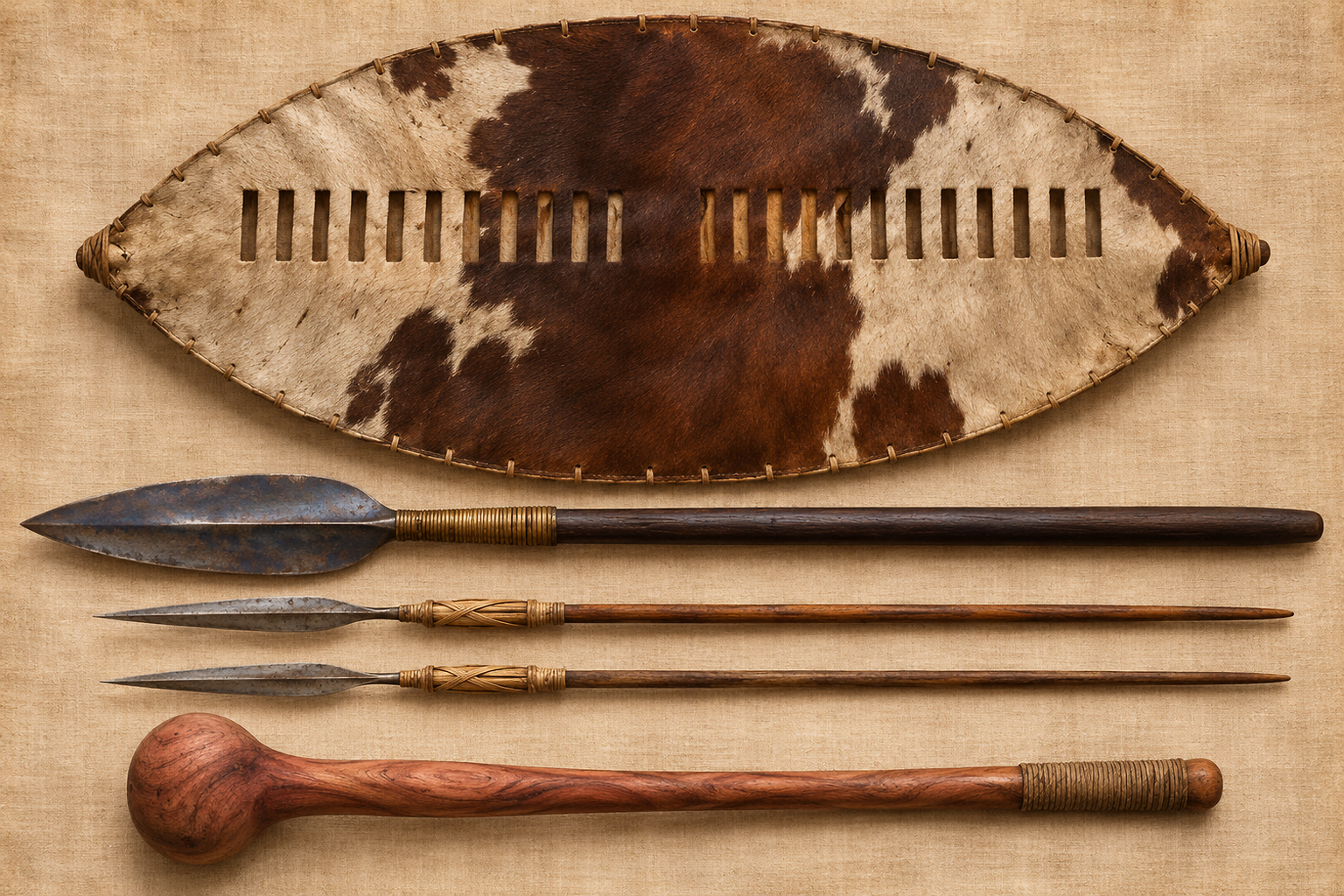
The tactical deployment of the iwisa must be situated within the broader strategic framework of the Zulu army: the famed 'horns of the beast' (impondo zankomo). In this formation, the center or 'chest' (isifuba) held the enemy's main attention, while fast-moving flank units, the 'horns', raced outward to encircle the opposition and cut off retreat. Reserves waited out of sight to reinforce points of pressure or pursue broken columns.
Within these maneuvering echelons, individual equipment was standardized by royal custom yet flexible in personal execution. Warriors carried a small bundle of weapons into the field:
The iwisa served as the vital bridge between distant skirmishing and locked physical contact. During the fast approach marches, often covering tens of miles in a day, the light weight of the club compared to metal weapons meant every man maintained high speed. In the encircling phase, when flanking horns sprinted across rough terrain to envelop British positions, the compact iwisa remained securely tucked behind the shield without hindering the warrior's running stride.
A regular Zulu warrior on active service typically carried a coordinated suite of arms:
- One heavy, broad-bladed stabbing spear (iklwa) for close-quarters thrusting.
- Two or three lighter throwing spears (isijula) deployed during the closing run.
- One hardwood combat club (iwisa) for concussive strikes, trapping, or auxiliary throwing.
- A tall or mid-sized rawhide shield (isihlangu or umbumbuluzo) bound with a central wood stave.
Clashing with British Formations at Isandlwana
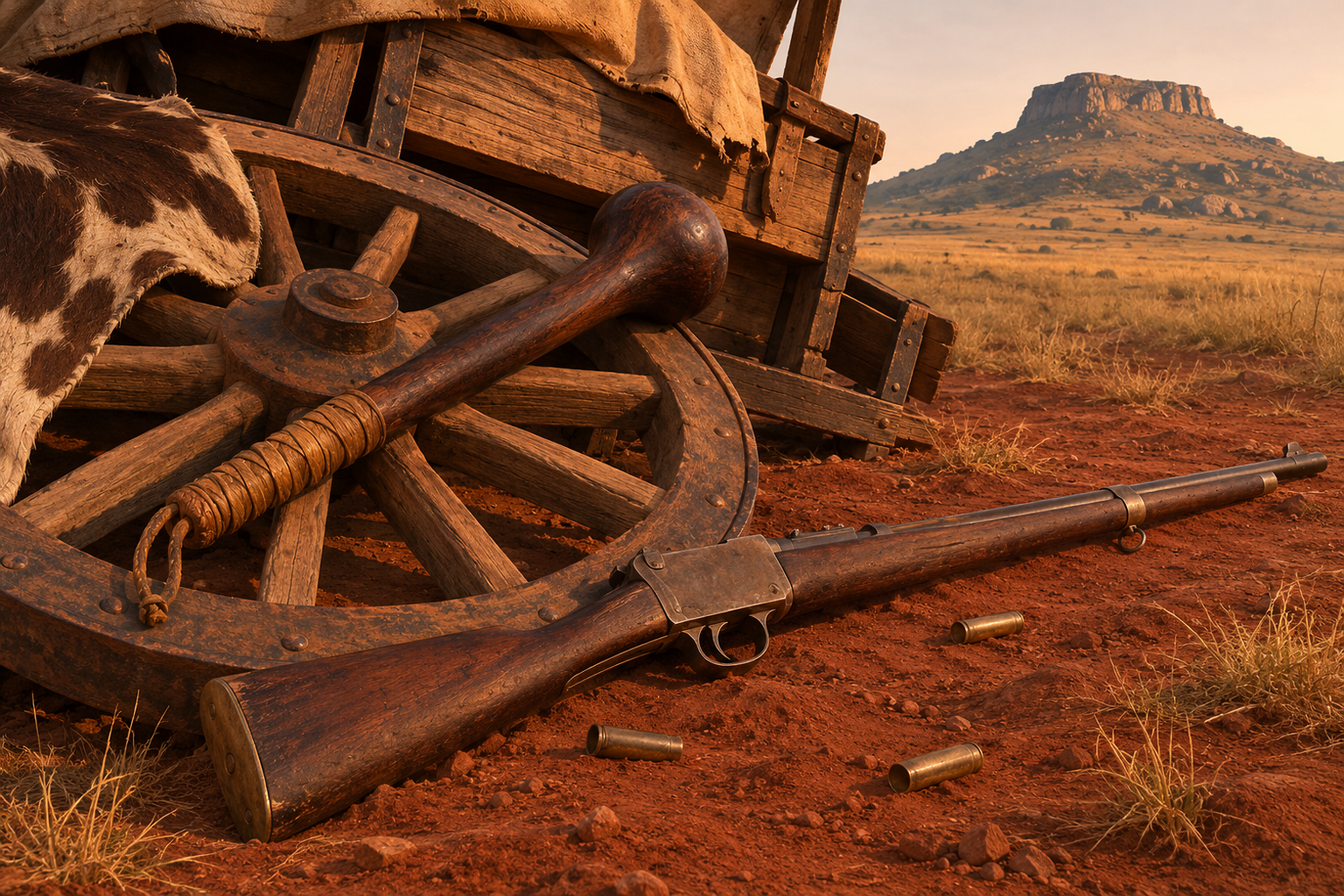
On 22 January 1879, the central column of the British invasion force was overwhelmed at the battle of Isandlwana. The resulting close-quarters fighting between the 24th Regiment of Foot, colonial auxiliaries, and thousands of Zulu warriors generated extensive primary accounts of hand-to-hand combat where the iwisa played a direct role alongside the spear. As the Zulu right horn swept around the mountain and the chest closed the gap despite intense rifle fire, the engagement fractured into hundreds of isolated melees among the tents and supply wagons.
In the final stages of the battle, when British ammunition supplies faltered and the soldiers formed defensive squares and back-to-back clusters, the bayonet met the cowhide shield and the hardwood club. While the bayonet gave the soldier a reach advantage over a kneeling or stationary foe, the dynamic movement of the Zulu warriors compromised this defense. Warriors used their shields to press the rifle barrels aside, followed instantly by crushing blows from the iwisa against exposed necks and heads, disabling soldiers before they could recover their thrust.
Accounts collected after the battle by British relief forces noted blunt trauma injuries among the fallen soldiers that were distinct from the wide wounds caused by the iklwa. Skulls crushed through pith helmets and shattered shoulder bones pointed to the wide use of heavy striking implements. The iwisa proved particularly decisive in clearing out soldiers sheltered between high-sided transport wagons, where the length of the Martini-Henry rifle and bayonet proved an encumbrance in tight corners.
Defense and Assault at Rorke's Drift
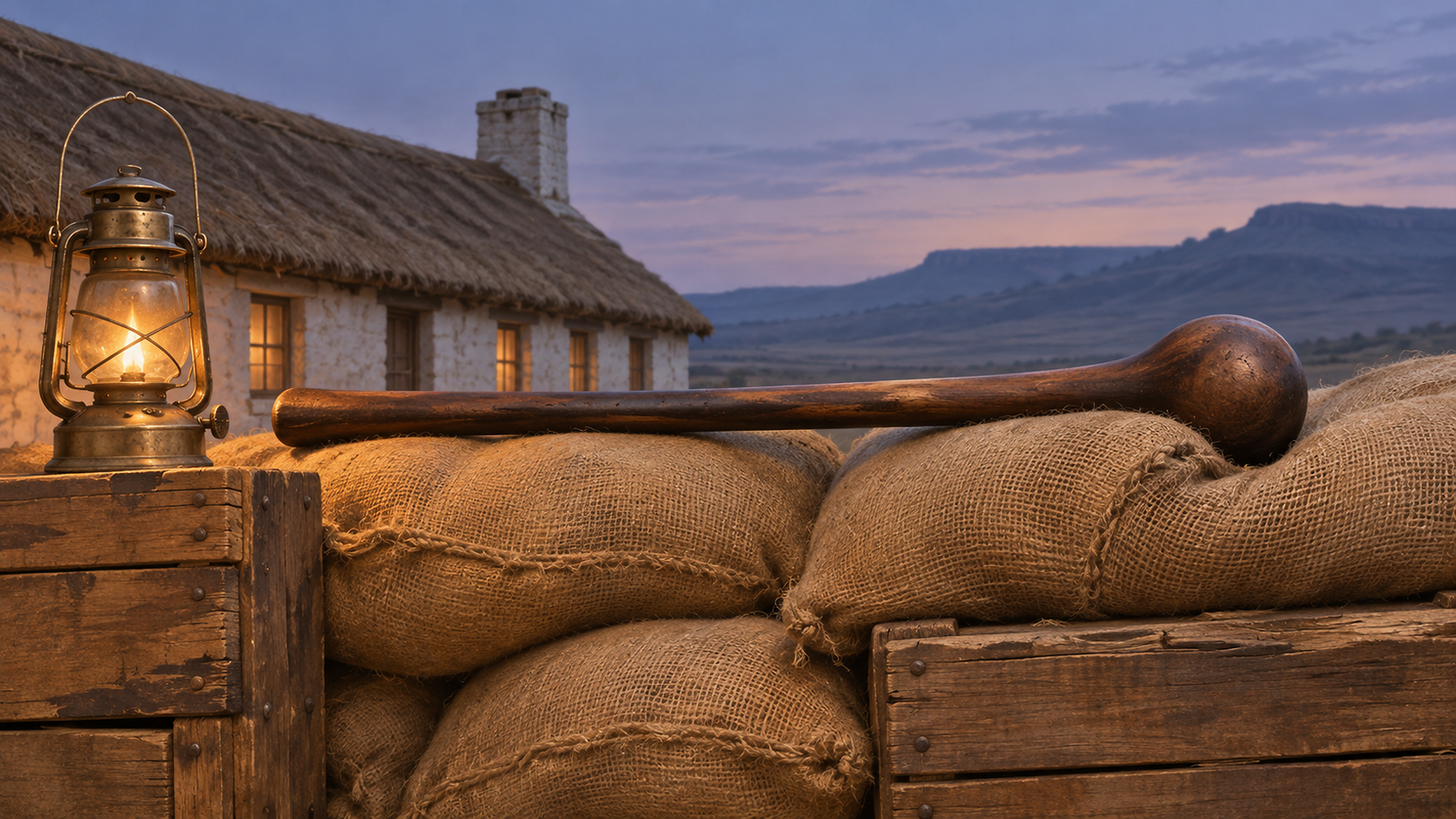
Hours after the victory at Isandlwana, elements of the reserve uDloko, inDlu-yengwe, and iNdlondlo regiments attacked the small British border post at Rorke's Drift. The tactical environment here was fundamentally different: the British garrison occupied an improvised perimeter constructed of mealie-bag redoubts, biscuit boxes, and stone kraal walls. These fortifications largely neutralized the Zulu encircling tactic, forcing a series of frontal assaults against entrenched riflemen.
At the barricades, the iwisa became a primary tool for hand-to-hand contest across the mealie-bag parapets. British survivors, including Private Henry Hook and Lieutenant John Chard, recorded desperate struggles where warriors attempted to wrest rifles directly from the hands of the defenders. Zulu fighters leaned over the bags, using the hooked heads of their amawisa to catch the barrels or bayonets of the Martini-Henrys, levering them downward while companion warriors struck over the parapet with spears or clubs.
The high wall of the cattle kraal saw intense hand-to-hand combat where the club was used to hammer at defenders attempting to hold loopholes. Because a spear thrust requires a clear line of sight and room for an arm draw, the iwisa allowed a warrior to deliver downward snapping strikes while hugging the exterior base of the stone wall. The dense timber was repeatedly slammed against projecting rifle barrels, attempting to snap the bayonet mountings or bend the metal mechanisms.
Regimental Pride, Social Status, and Adornment
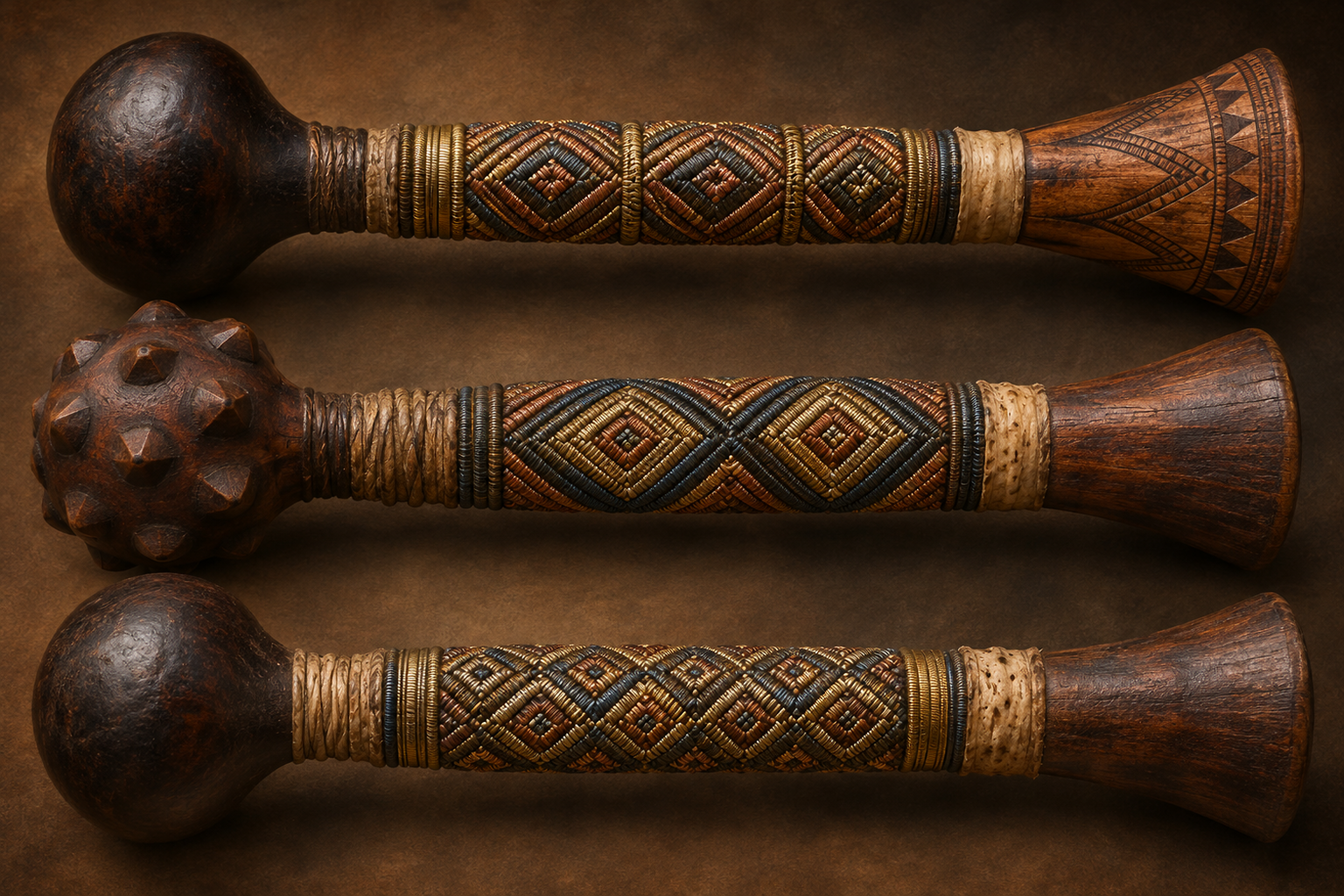
In Zulu society, weapons directly reflected a man's social identity, age grade, and regimental affiliation. The amabutho system organized young men into age-matched regiments, each assigned specific royal homesteads, shield color patterns, and ceremonial regalia. While the broad-bladed iklwa belonged in a strict sense to the military domain of the Zulu state, the iwisa occupied a hybrid space between home life and battlefield assembly.
Outside of military campaigns, every adult man carried a stick or club as an essential everyday accessory. The quality of the carving, the selection of rare, high-contrast woods like pink ivory, and the inclusion of decorative wire bindings indicated the owner's status. Men of standing bound the shafts of their clubs with fine brass, copper, and iron wire woven in tight geometric patterns, or commissioned shafts carved with raised decorative studs (amasumpa). These additions were not purely decorative; they provided a textured, non-slip grip and added balancing counterweight to the base of the handle.
When called to the royal capital at Ulundi for the annual Umkhosi wokweshwama (first-fruits ceremony) or wartime mobilization, warriors carried these finely finished weapons alongside their war gear. In royal dances and military reviews, the iwisa was brandished in synchronized movements, raised high to acknowledge the king's commands. The weapon was thus woven deeply into the civic fabric of the Zulu kingdom, serving as a sign of masculine adulthood from late adolescence to elder status.
British Battlefield Perceptions and Souvenir Culture
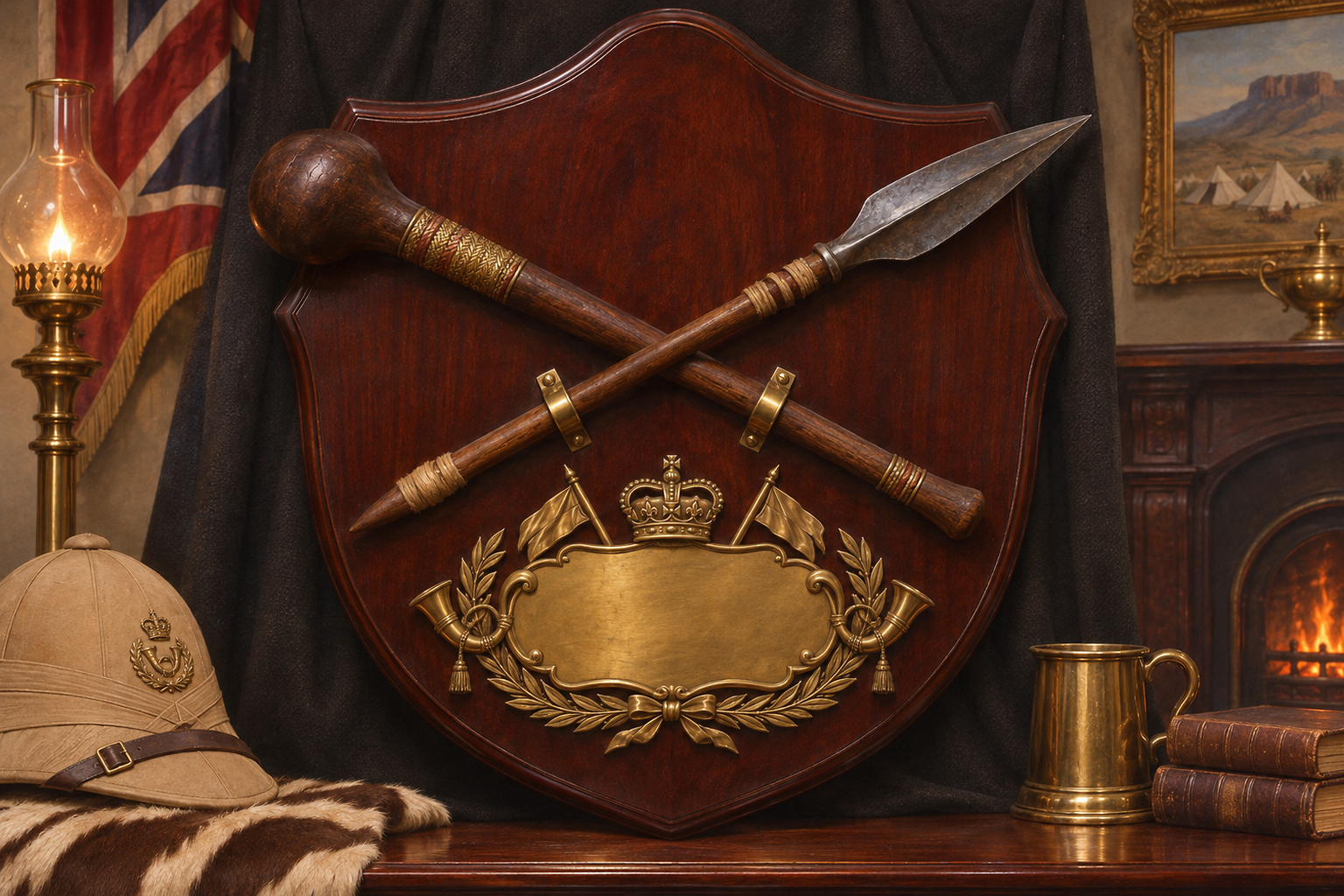
To the invading British troops and the colonial public reading reports in Durban, Cape Town, and London, the Zulu weapon kit evoked both respect and dread. Contemporary accounts often struggled with indigenous terminology, lumping all clubs under the generic label 'knobkerrie' and sometimes mischaracterizing the weapons as primitive, desperate clubs. However, frontline officers and medical staff recognized the specialized lethality of the weapon after treating fractures, concussions, and severe blunt trauma in the war's wake.
Following major engagements such as Isandlwana, Rorke's Drift, Khambula, and the final battle at Ulundi, thousands of shields, spears, and amawisa were collected from the field by British soldiers. These weapons became highly prized war trophies. Officers, enlisted men, and colonial volunteers collected them for shipment back to the United Kingdom, where they were mounted as panoplies on manor house walls, displayed in regimental messes, or donated to municipal museums.
This colonial collection impulse preserved a remarkable array of nineteenth-century Zulu woodwork, but it also stripped the artifacts of their individual provenance. Clubs gathered from the field were frequently cataloged without the warrior's name, regimental affiliation, or even the specific battlefield where they were acquired. Consequently, modern museum curators and arms historians must rely on material analysis, wood typology, and carving characteristics to reconstruct the history of individual surviving specimens.
Archaeological Evidence and Museum Preservation
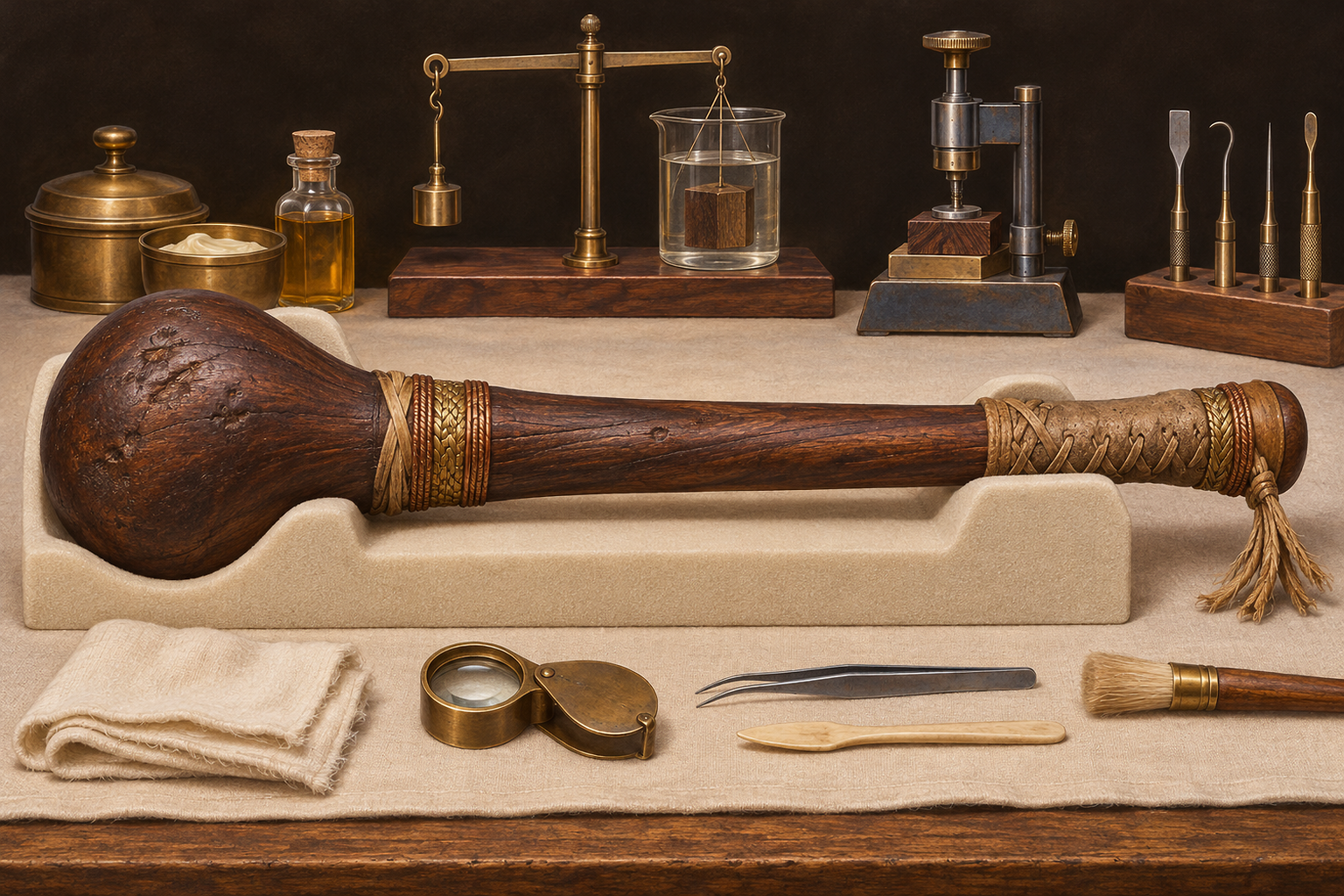
Surviving nineteenth-century amawisa in ethnographic collections and military museums provide tangible evidence of Southern African woodworking technology. Major repositories, such as the British Museum, the Royal Armouries in Leeds, and various South African provincial museums, hold hundreds of examples whose surfaces can be examined under modern conservation methods. These artifacts show distinct tool marks, wear patterns, and organic residues that confirm historical usage.
Microscopic analysis of the striking heads often reveals compression fractures, grain bruising, and indentations matching contact with hard edges, such as iron fittings or firearm components. The handle surfaces frequently retain a deep, aged patina generated by years of contact with palm sweat, red ochre, and animal fats. Conservation of these wooden artifacts presents continuous challenges: dry museum environments can cause the dense hardwoods to shrink and crack, requiring carefully stabilized relative humidity between forty-five and fifty-five percent.
Radiocarbon and botanical analyses continue to confirm the timber choices recorded in colonial journals. The identification of wild olive and pink ivory in combat-grade clubs reinforces early ethnographic descriptions of specialized tree harvesting. The sheer survival of these monolithic wooden weapons without glue or metal pins speaks to the sophisticated understanding of wood mechanics possessed by Zulu carvers working under the pressures of nineteenth-century colonial conflicts.
The Iwisa in Modern Memory and Heritage
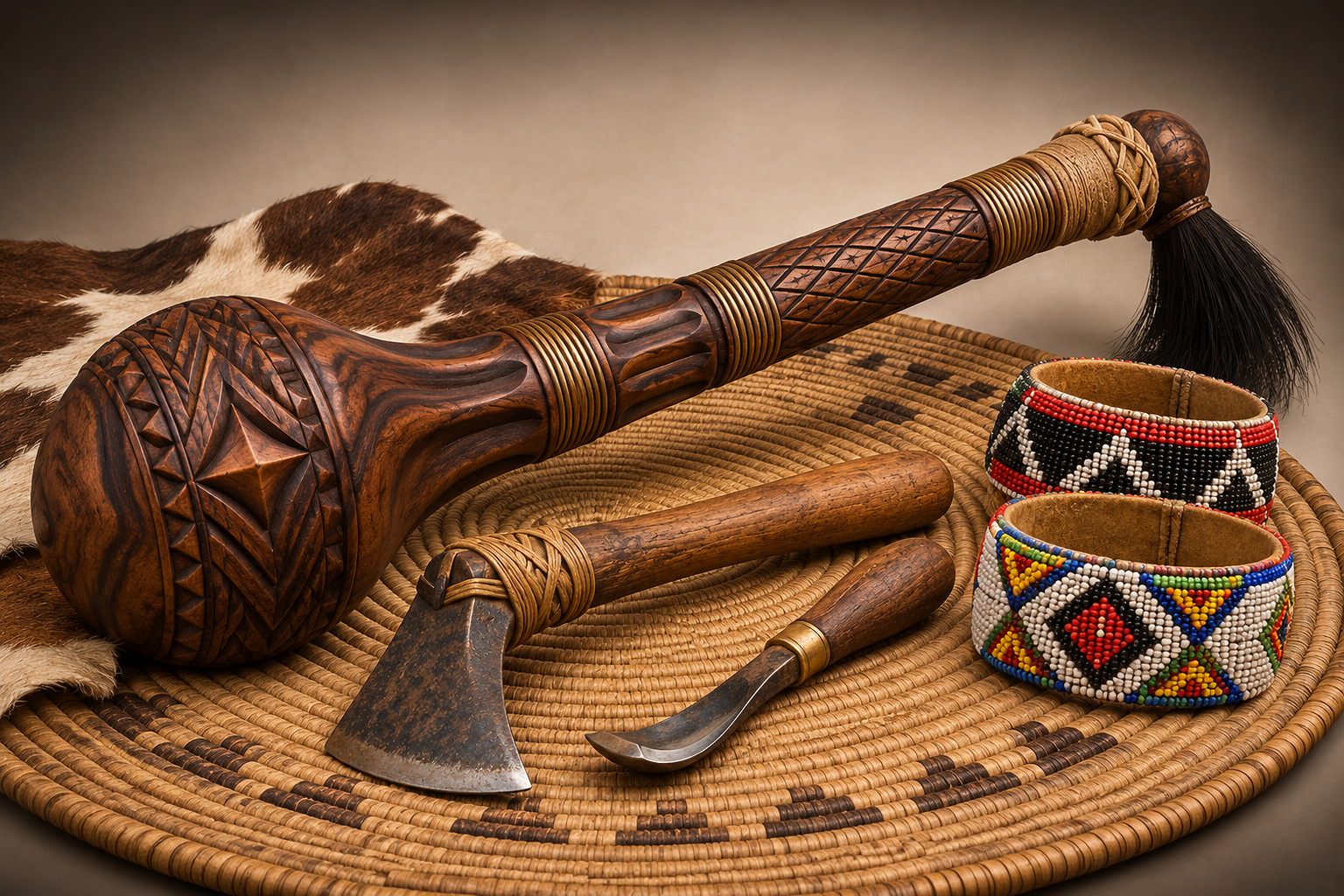
Long after the dissolution of the independent Zulu kingdom following the war of 1879 and the subsequent civil conflicts of the 1880s, the iwisa has retained an enduring symbolic role in Southern African culture. Rather than vanishing with the collapse of the formal regimental system, the club transitioned into an emblem of traditional authority, cultural heritage, and political identity. It remains an essential accoutrement carried by traditional leaders, Zulu royal family members, and participants in ceremonial occasions across KwaZulu-Natal.
In the political sphere of twentieth- and twenty-first-century South Africa, the carrying of the iwisa (frequently referenced in legal statutes under the traditional weapon exemptions) has sparked significant national debate. During periods of civil unrest and political rallies in the late apartheid era, the club was brandished as a symbol of cultural pride and martial readiness, leading to legal deliberations concerning where and when traditional weapons could be carried in public spaces.
Today, contemporary Zulu artisans continue to carve amawisa, using traditional timbers where available, as well as introduced species like jacaranda and eucalyptus for commercial markets. While tourist curios are often turned on mechanical lathes, master woodworkers still hand-carve ceremonial and heirloom pieces using time-honored methods, preserving woodworking techniques developed across generations of craftsmanship.
Further reading
Follow the sources to examine the object and its historical context.
Laband, John. The Atlas of the Later Zulu Wars: 1883-1888. University of KwaZulu-Natal Press, 2001.External reference · Opens in a new tab Knight, Ian. Anatomy of the Zulu Army: From Shaka to Cetshwayo, 1818-1879. Greenhill Books, 1995.External reference · Opens in a new tab Duminy, Andrew, and Charles Ballard, eds. The Anglo-Zulu War: New Perspectives. University of Natal Press, 1981.External reference · Opens in a new tab British Museum Department of Africa, Oceania and the Americas: Zulu Material Culture Collection.External reference · Opens in a new tab