Across the military workshops of Safavid Iran, Mughal India, and the Afghan borderlands, arms makers confronted a persistent physical contradiction. Crucible steel, known in modern metallurgy as wootz and across the Persian-speaking world as jawhar or pulad, offered an exceptionally hard cutting edge due to its high carbon content and dense network of iron carbides. Yet that same crystalline structure rendered the steel vulnerable to sudden brittle fracture when exposed to intense lateral bending or shock. When facing an opponent protected by riveted mail, padded textile coats, or composite armors, a conventional broad-bladed knife could not concentrate sufficient force at a single point, while an unreinforced slender bodkin risked flexing or snapping. The solution developed between the sixteenth and seventeenth centuries was the pesh-kabz, a single-edged dagger characterized by a rigid T-shaped spine that stabilized a tapering, needle-pointed blade.
The Architecture of the T-Section Blade
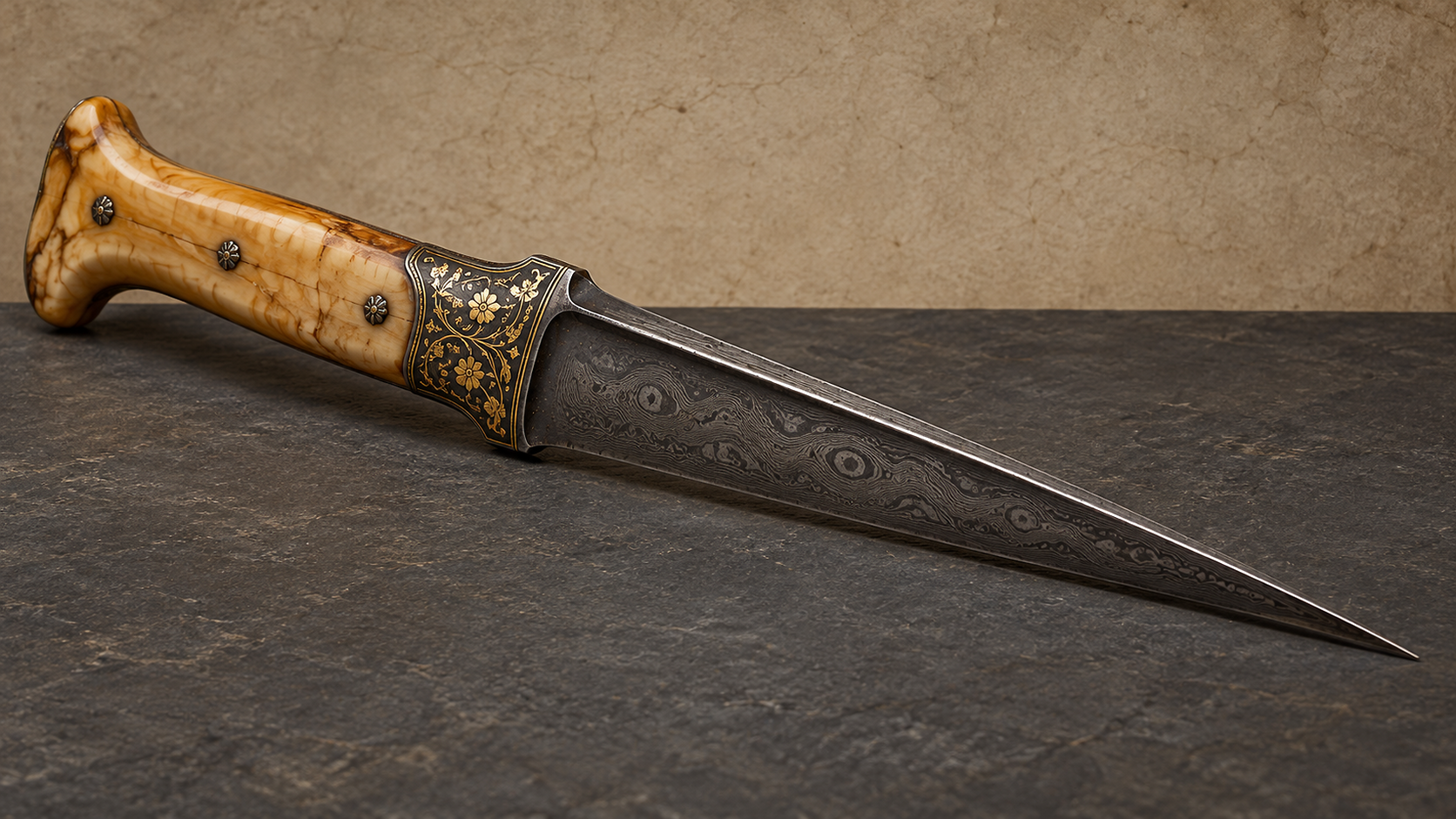
The distinguishing feature of the pesh-kabz is its dorsal spine, which widens abruptly from the blade flat to create a continuous flange along the back. Viewed down its length from hilt to tip, this profile forms a clear letter T, mirroring the load-bearing principle of a structural beam. While the blade faces taper downward to form a razor-sharp primary edge, the top surface remains flat or slightly crowned, measuring several millimeters across before narrowing toward the terminal point.
This geometric profile is not decorative; it represents a functional answer to the mechanics of bending moments during an axial thrust. When a dagger strikes an unyielding surface, such as an iron ring or thick horn scale, the deceleration exerts enormous compressive stress along the longitudinal axis. In a standard flat-ground knife, this sudden load causes the slender steel to bow outward, leading instantly to plastic deformation or catastrophic fracture. The wide flanges of the T-spine redistribute the applied load across a broader cross-sectional area, vastly increasing the blade's second moment of area and preventing lateral deflection before the tip can penetrate.
Origins Across the Safavid and Mughal Frontier
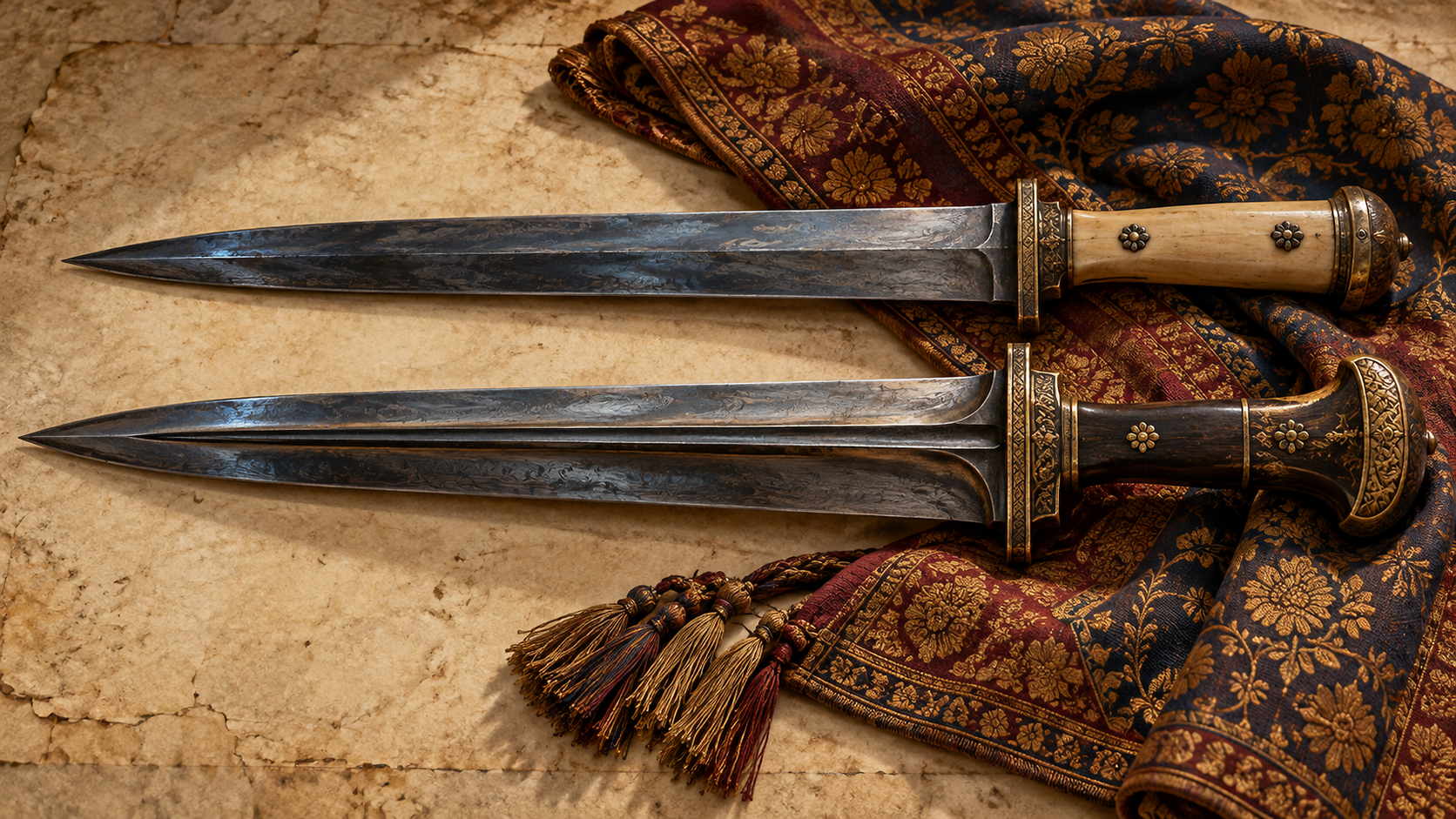
The name pesh-kabz derives from Persian, translating literally to fore-grip or front-hilt, denoting a sidearm worn thrust forward through the waist-sash (patka) for an immediate cross-body or downward draw. Although early visual depictions in Persian illuminated manuscripts place precursors of this straight-backed knife in the Timurid realm during the late fifteenth century, the weapon reached its mature architectural form under the Safavid dynasty in Iran and the contemporaneous Mughal Empire in northern India.
Trade networks linking Isfahan, Kabul, Lahore, and the Deccan facilitated the exchange of both raw materials and metallurgical specialists. Persian smiths brought refined tastes in chiseled steel and calligraphic cartouches, while Indian armories contributed unmatched experience in smelting low-phosphorus, high-carbon crucible cakes. As mail-and-plate defenses evolved across Central and South Asia to protect horsemen against both mounted archery and lance charges, the pesh-kabz transitioned from a general utility and hunting knife into a dedicated sidearm engineered to exploit the vulnerable seams between rigid plates.
The Mechanics of Mail and Textile Penetration
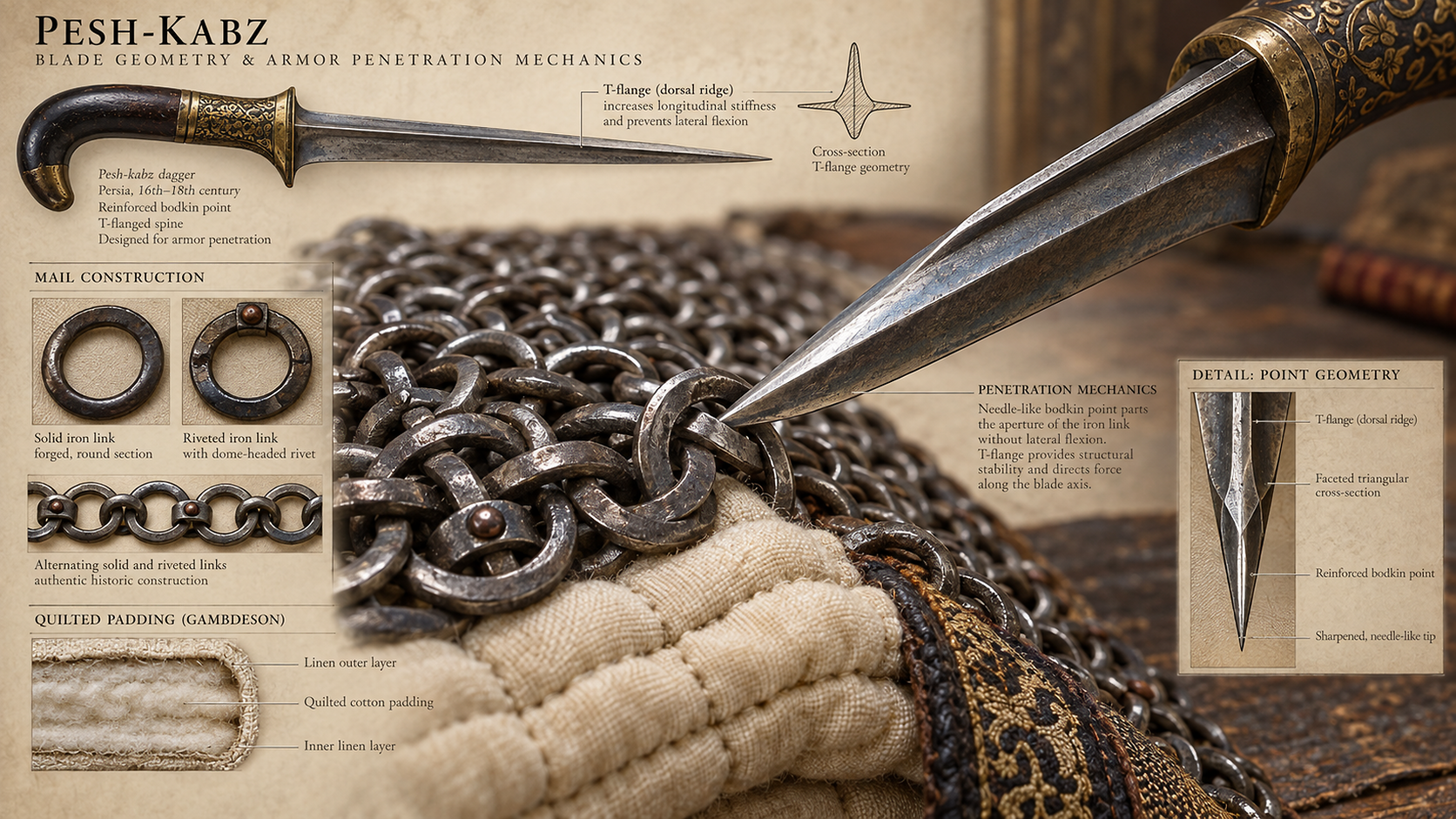
The pesh-kabz was specifically tailored to overcome defensive systems composed of riveted iron mail layered over quilted organic padding. Against such defenses, an ordinary broad cutting blade dissipates its kinetic energy across multiple links, merely bruising the wearer beneath unless swung with immense force. Even if a blade breaks an individual ring, the broad bevels wedge against surrounding links, transferring the impact into the target's body rather than breaching the defense.
By contrast, the forward half of the pesh-kabz narrows into a bodkin-like needle. Upon striking a mail shirt, this acute point enters the aperture of a single ring. Because the point possesses a stiff diamond or reinforced triangular cross-section, the forward momentum forces the surrounding rings apart along their rivets, or shears the iron rivet entirely. Once the tip passes through the broken link, the slender body slips smoothly through the void, entering the dense quilted coat (angarkha or dagla) beneath with minimal frictional resistance.
Crucible Wootz: High Carbon and Segregated Cementite
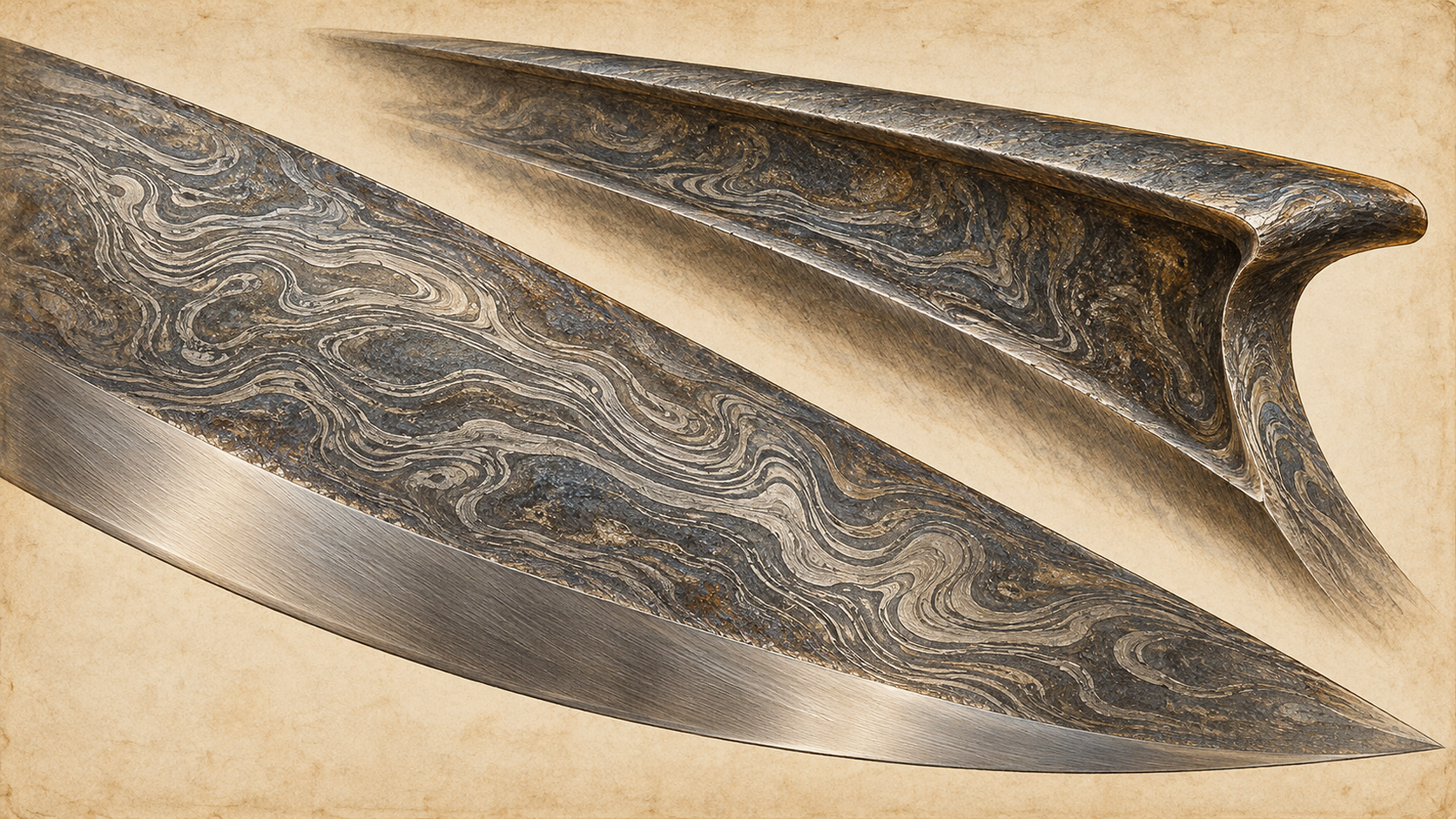
The mechanical requirements of the pesh-kabz created an acute dilemma when combined with wootz, the premier crucible steel of the Indo-Persian sphere. Smelted in clay crucibles containing iron ore, charcoal, and organic plant matter, wootz was a hypereutectoid steel, typically containing between 1.2% and 1.8% carbon. This chemistry lies far above the carbon content of standard European medieval or Renaissance blade steels, which generally ranged between 0.4% and 0.7%.
At room temperature, this ultra-high-carbon alloy consists of a matrix of tempered pearlite or martensite threaded with dense, wavy bands of microscopic iron carbide particles known as cementite (Fe3C). These hard carbides give the steel its legendary cutting performance and produce the swirling, water-like surface pattern prized by connoisseurs under the names jawhar or kara taban. However, free cementite is glass-hard and intrinsically brittle; when subjected to sudden shock or bending, microcracks initiate readily along the carbide boundaries. Forging a slender, needle-pointed thrusting dagger from such an unyielding material demanded extraordinary thermal control.
Forging the Ingot: Thermal Boundaries and Carbide Bands
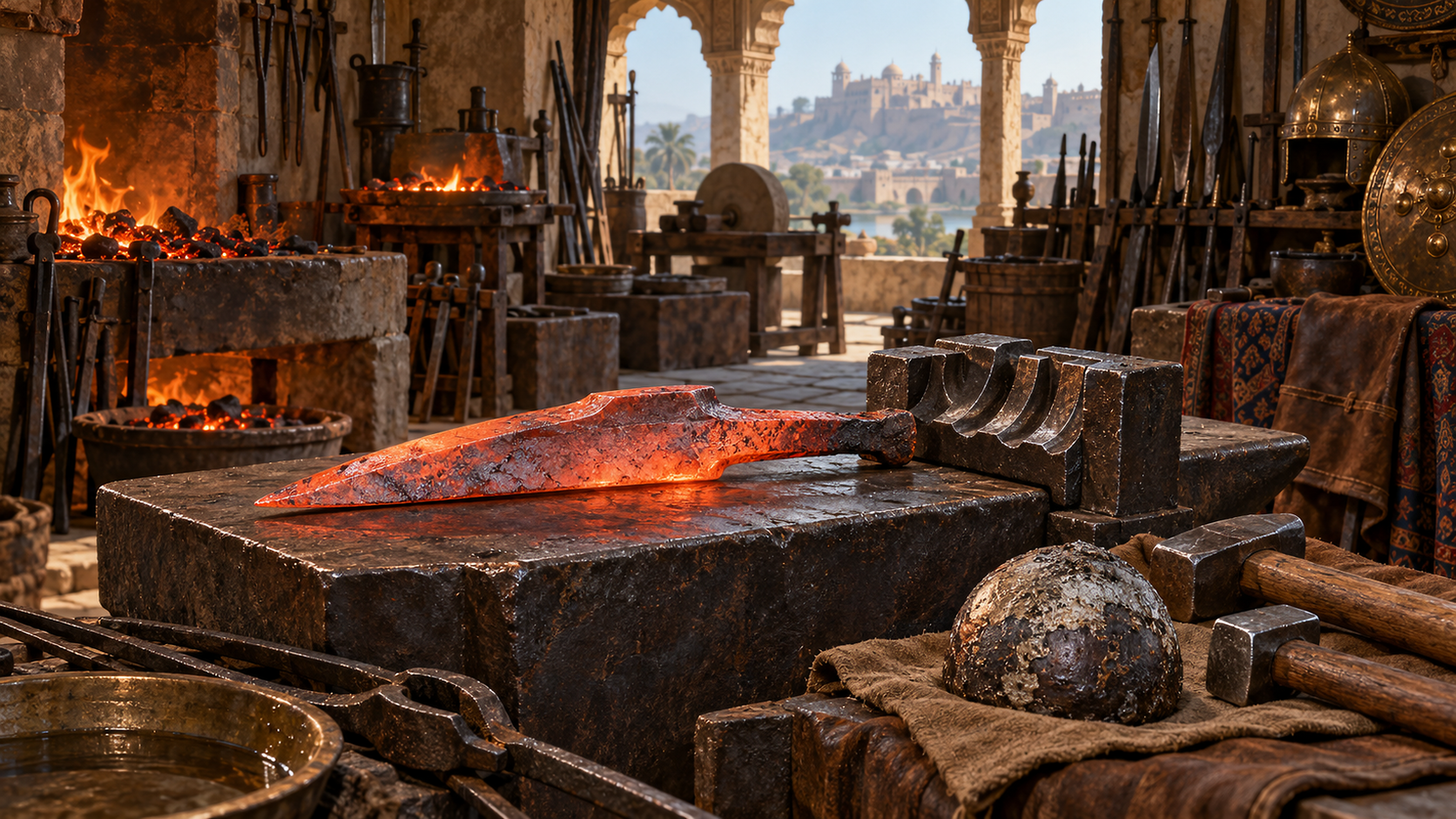
Transforming a hemispherical wootz cake into a finished pesh-kabz blade without destroying its internal structure was among the most technically demanding tasks in historical metallurgy. If the smith heated the steel beyond approximately 1,150 degrees Celsius, the carbide networks would completely dissolve into the austenite matrix, permanently erasing the visible watering pattern upon quenching. Even worse, overheating could cause the high-carbon steel to burn, melting the grain boundaries and causing the ingot to shatter under the first blow of the hammer.
Conversely, striking wootz at too low a temperature risked catastrophic cracking along the hard carbide networks. Smiths worked within a narrow thermal window, heating the metal to a dull red or low orange (roughly 750 to 900 degrees Celsius) and applying light, uniform hammer blows. To produce the elevated T-spine, the armorer could not simply grind away excess material; doing so would waste precious crucible steel and sever the continuous flow of forged grain. Instead, the smith upset the dorsal edge using specialized swages and fuller-like hand anvils, compressing the back of the blade while drawing out the slender cutting belly.
The T-Spine Cross-Section: Structural Rigidity Under Compression
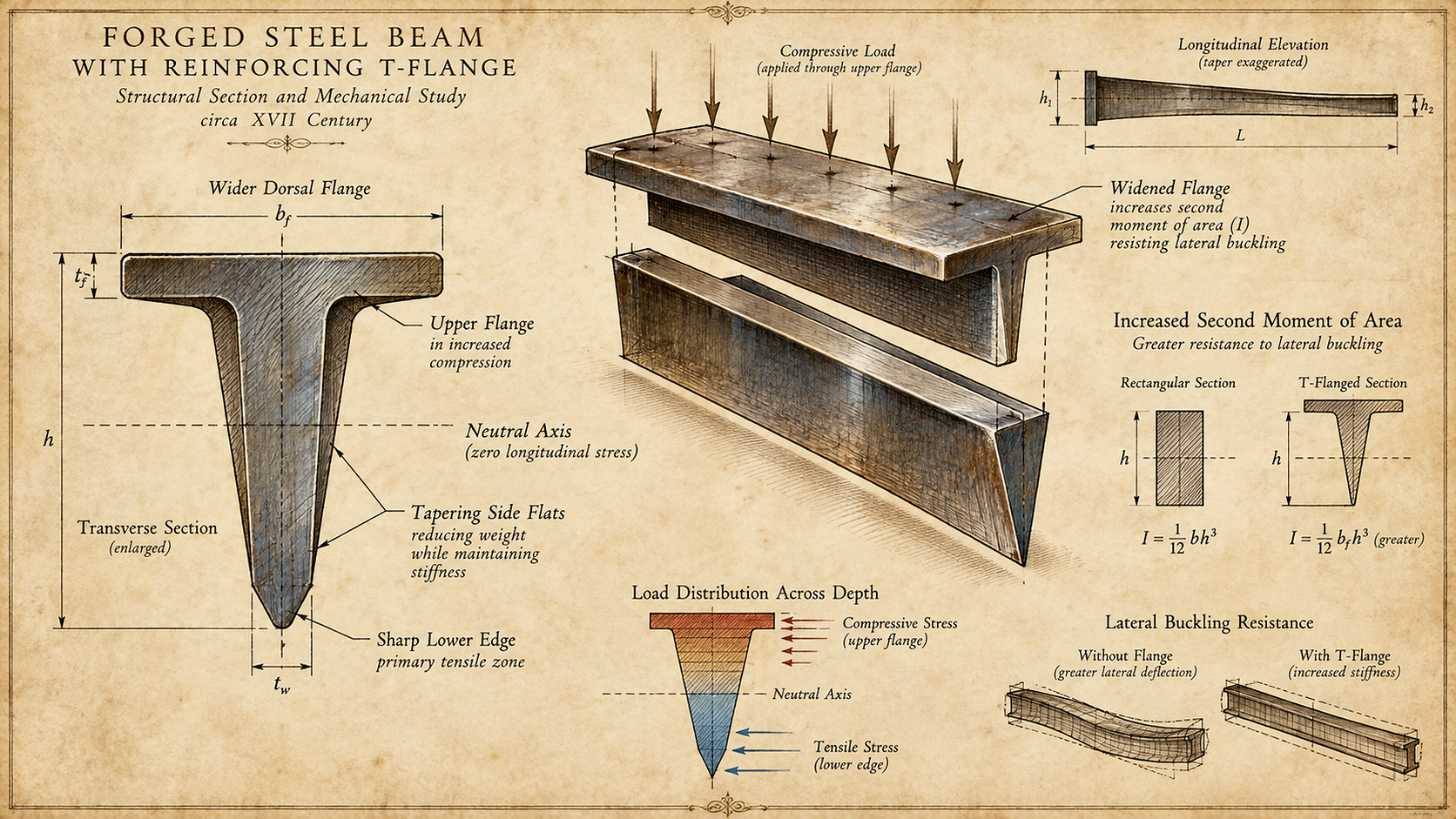
The primary mechanical function of the T-flange is to counteract the inherent brittleness of hypereutectoid crucible steel. Steel fails in tension far more readily than in compression. During a forceful thrust, if the dagger encounters a hard target slightly off-angle, one side of the blade is subjected to severe tensile strain while the opposite side undergoes compression. In a flat blade forged of brittle wootz, that tensile pull routinely triggers sudden transverse snapping.
By placing a thick bar of steel along the back of the blade, the armorer significantly increases the distance between the neutral axis of bending and the outer edges of the spine. Under lateral bending forces, the expanded dorsal surface absorbs the bulk of the compressive and tensile stresses across a massive, reinforced area. This geometry ensures that even when the slender forward edge penetrates deep into an opponent or an armor plate, the total deflection remains well within the elastic limits of the steel, preventing the blade from flexing past its breaking point.
The Needle Tip: Geometry of the Terminal Reinforcement
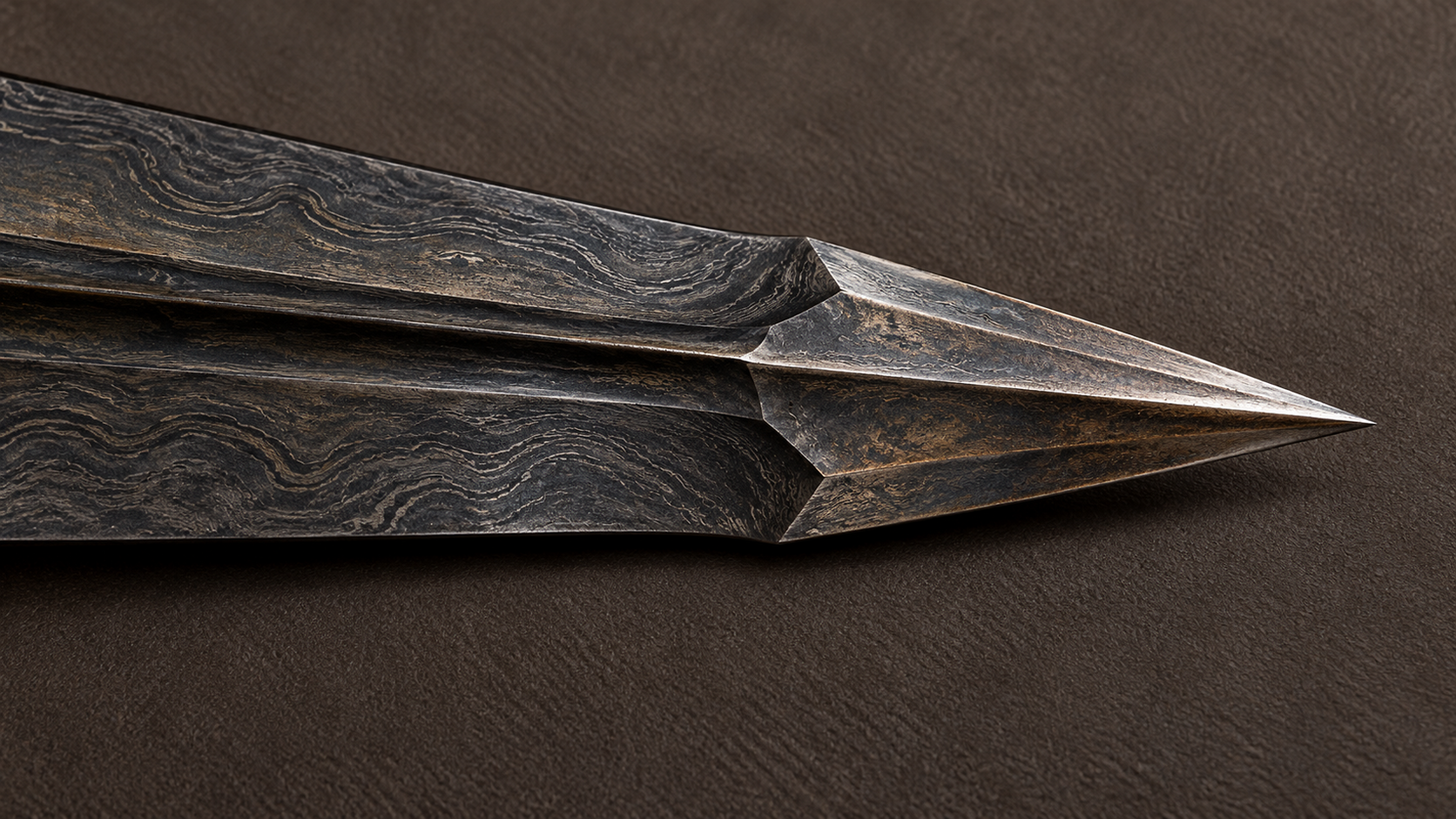
While the spine provides structural rigidity throughout the length of the dagger, the tip itself presents a distinct engineering challenge. A completely uniform tapering grind would leave the terminal centimeter of the blade excessively thin, vulnerable to curling or snapping when striking iron plates or bone. The makers of the pesh-kabz addressed this by deliberately altering the blade geometry in the final two to three inches of the blade.
Near the terminus, the single primary cutting edge ceases to taper into an acute wedge. Instead, the bevels thicken markedly, blending into an armored diamond or reinforced triangular cross-section. The T-spine flattens slightly, tapering down to merge directly with the reinforced point. This creates a solid pyramid of steel at the very extremity, concentrating all the force of the strike onto a microscopic contact patch while leaving substantial mass immediately behind the point to support the impact.
Full-Tang Engineering and Bolster Integration
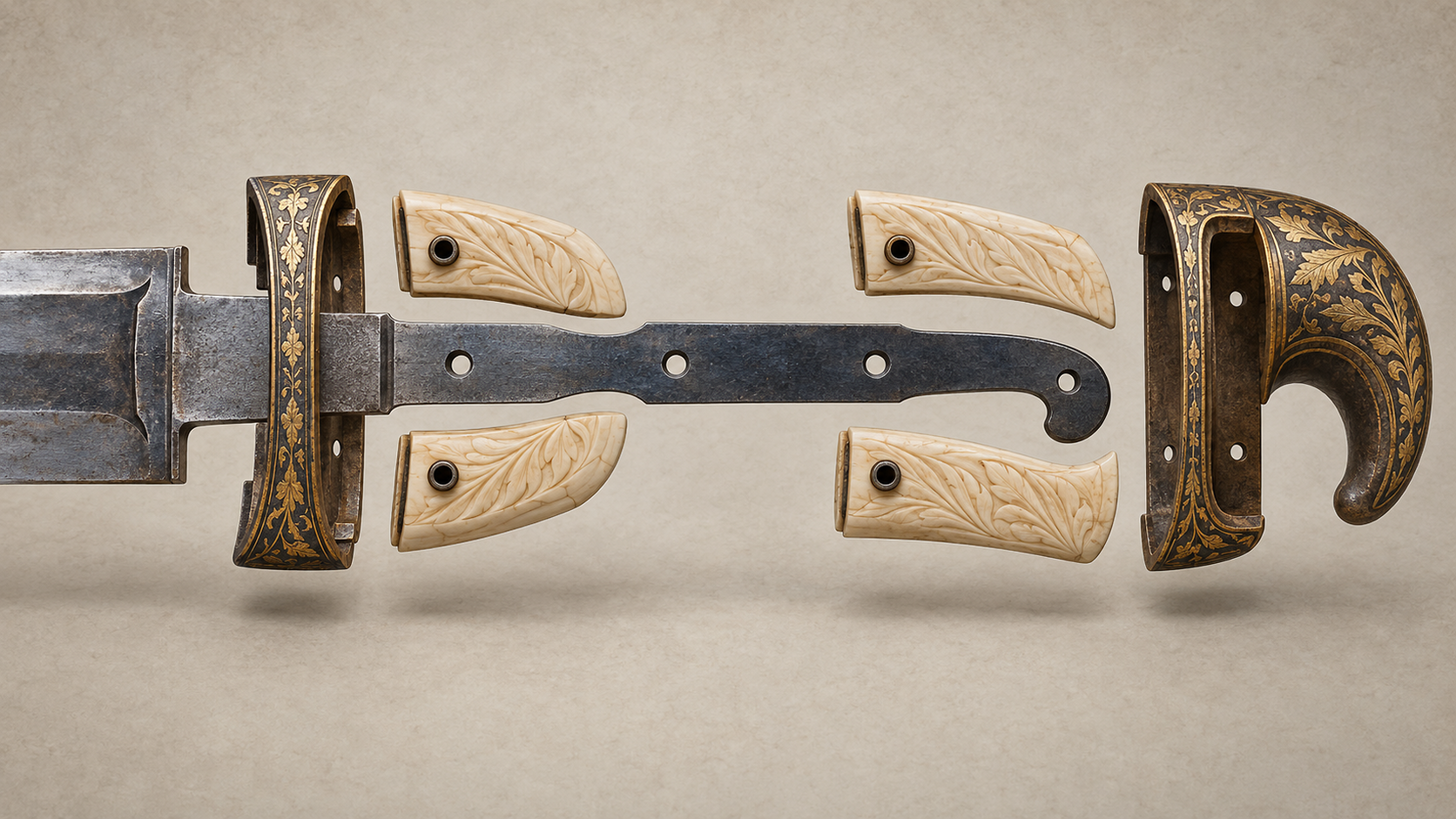
The structural integrity of the pesh-kabz depends just as heavily on the junction between the blade and the handle. Unlike many European daggers of the same era that relied on narrow rat-tail tangs peened over a pommel, the classic pesh-kabz features a robust, full-profile flat tang that matches the exact outline of the grip. The steel runs uninterrupted from the reinforced tip through to the curved terminal hook of the pommel.
To brace the blade against the grip scales, Indo-Persian armorers fitted heavy metal bolsters over the tang immediately behind the cutting edge. These bolsters were forged from iron, bronze, or low-carbon steel, often welded or pinned directly to the tang before being lavishly decorated with gold damascening (koftgari). The bolsters served as a structural collar, enclosing the base of the blade and preventing the hilt materials from splitting forward along their grain under the violent recoil of an armored thrust.
Hilting Materials: Walrus Ivory, Nephrite, and Horn
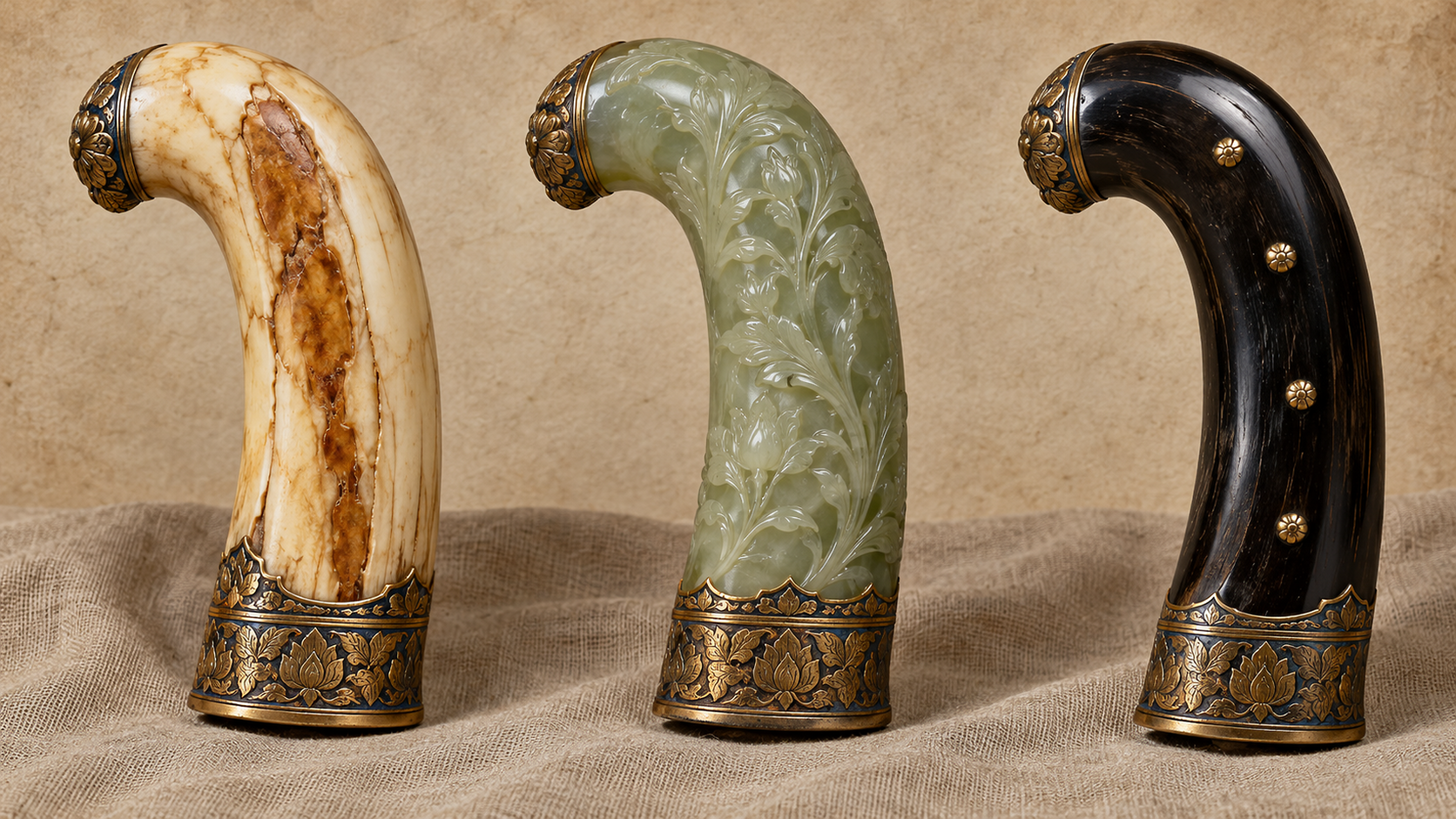
The grip scales (dastah) applied to the full tang of a pesh-kabz reflect a sophisticated balance between ergonomic utility, shock absorption, and imperial display. Three materials dominated the highest tiers of production: marine ivory (specifically fossil walrus tusk, known as shir-mahi), nephrite jade, and water buffalo horn. In lesser pieces, domestic bone or hard woods were substituted.
Walrus ivory was particularly sought after across Iran and northern India for its exceptional resilience and tactile properties. Unlike elephant ivory, which features a uniform crystalline structure that cracks along linear growth rings, walrus tusk possesses a dense, marbled inner core that absorbs mechanical vibration remarkably well and resists chipping. Over decades of handling, exposure to natural skin oils transforms the ivory from a pale cream to a deep, translucent amber or honey tone. The grip scales were shaped with pronounced finger recesses and a downward-hooked pommel, securing the wielder's hand during an overhead or forward thrust even when slick with sweat or rain.
Sheaths, Carry Dynamics, and the Draw
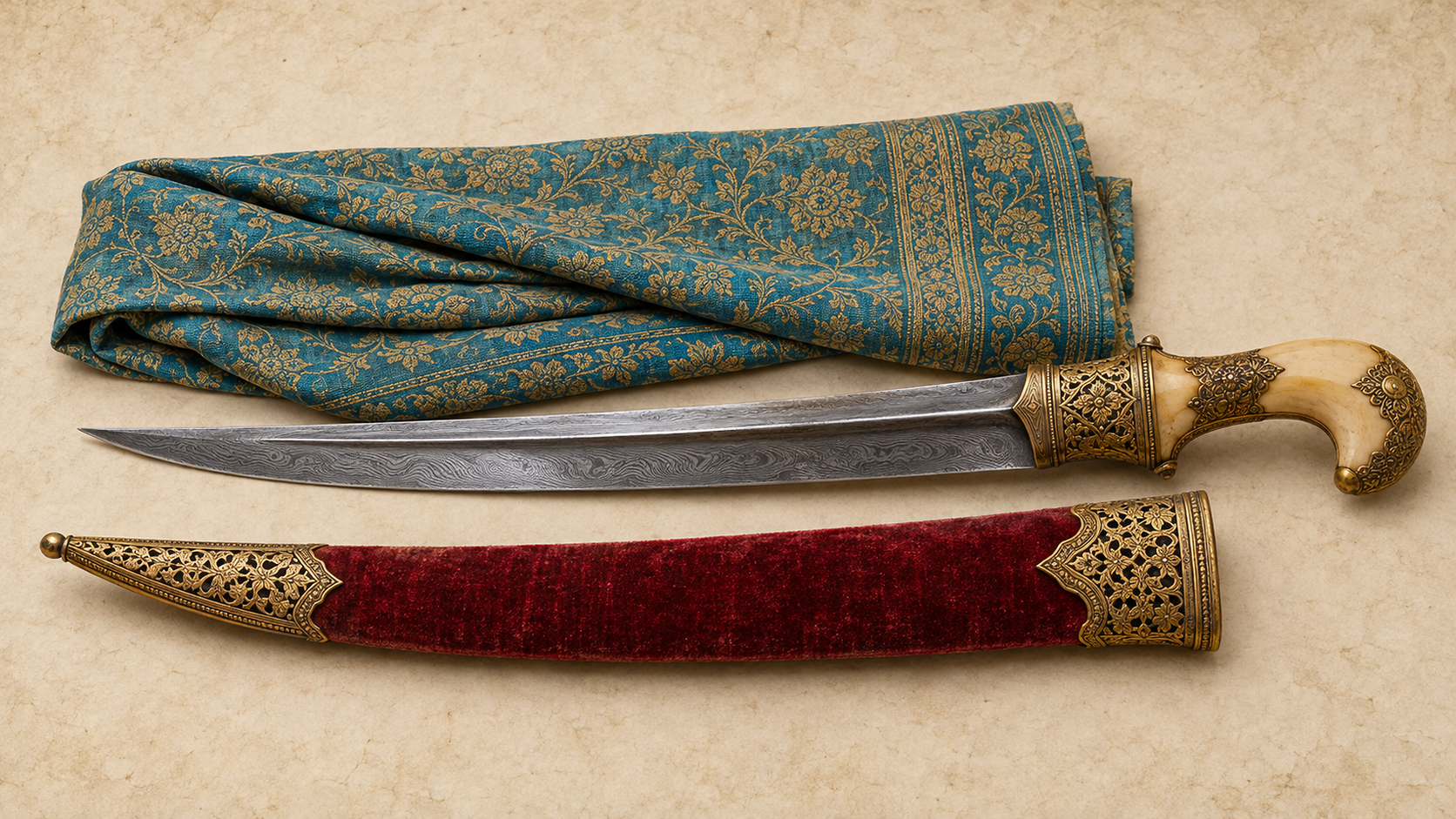
A weapon designed for rapid deployment from the waist sash requires an equally specialized scabbard. The pesh-kabz sheath was constructed from two thin laths of seasoned hardwood, hollowed to accept the distinct T-profile of the blade, and bound tightly in velvet, tooled calfskin, or worked sheet silver. Because the dagger lacks a traditional crossguard, the lower half of the hilt slips directly into the mouth of the scabbard, held securely by friction alone.
Carried horizontally or diagonally tucked into the heavy silk sash (patka), the dagger was oriented so that the hilt projected forward on the non-dominant side, ready for an immediate cross-draw, or on the dominant hip for an ice-pick reverse grip. In close-quarter scuffles where a primary talwar or shamshir became unwieldy due to tangled horses, confined palace corridors, or grappling opponents, the smooth mouth of the scabbard allowed the user to free the needle-pointed blade in a single, fluid motion without catching on textiles.
Metallurgical Vulnerabilities: Brittleness vs. Elasticity
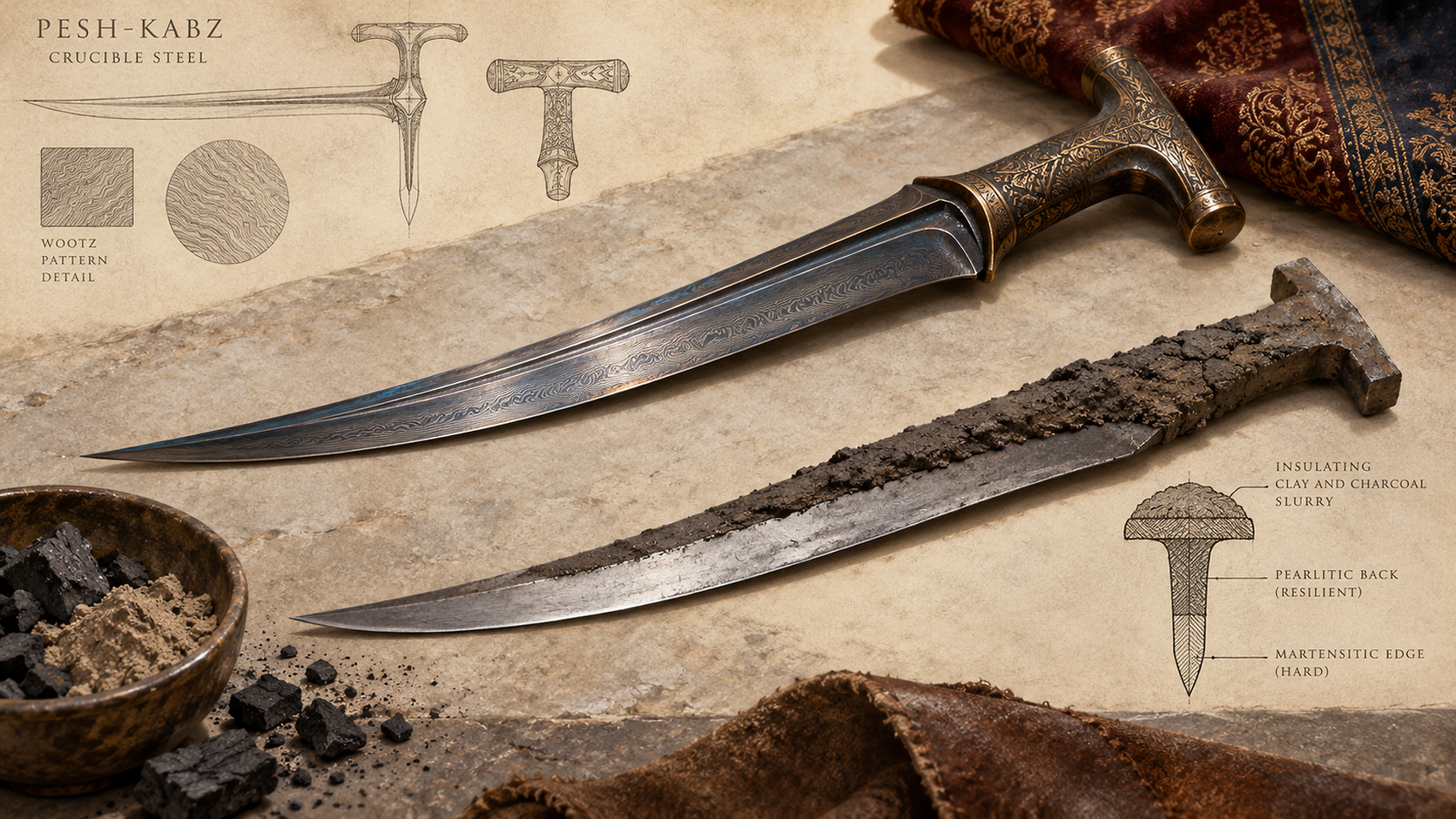
Despite the sophisticated geometry of the T-spine, the pesh-kabz was not an indestructible implement, and historical records alongside metallurgical analyses reveal its physical limitations. The very attributes that made wootz an extraordinary cutting material—its high carbon content and microstructural carbide segregation—meant it lacked the elastic forgiveness of modern spring steels or lower-carbon layered steels. If subjected to a severe prying motion or a dynamic strike delivered directly to the flat of the blade, a wootz pesh-kabz was far more likely to snap cleanly than to bend.
To mitigate this inherent brittleness, regional armorers frequently employed selective heat treatment techniques. By coating the heavy T-spine with an insulating slurry of clay and charcoal while leaving the acute cutting bevels exposed, a smith could quench the blade in oil or warm water, producing a hard martensitic edge backed by a softer, more shock-absorbent pearlitic spine. Even so, historical fighters recognized the pesh-kabz as a precision thrusting weapon rather than a pry bar; its design maximized structural strength along its longitudinal axis, relying on the user to direct energy straight into the target.
Contemporary Evidence: Chronicles and Miniatures
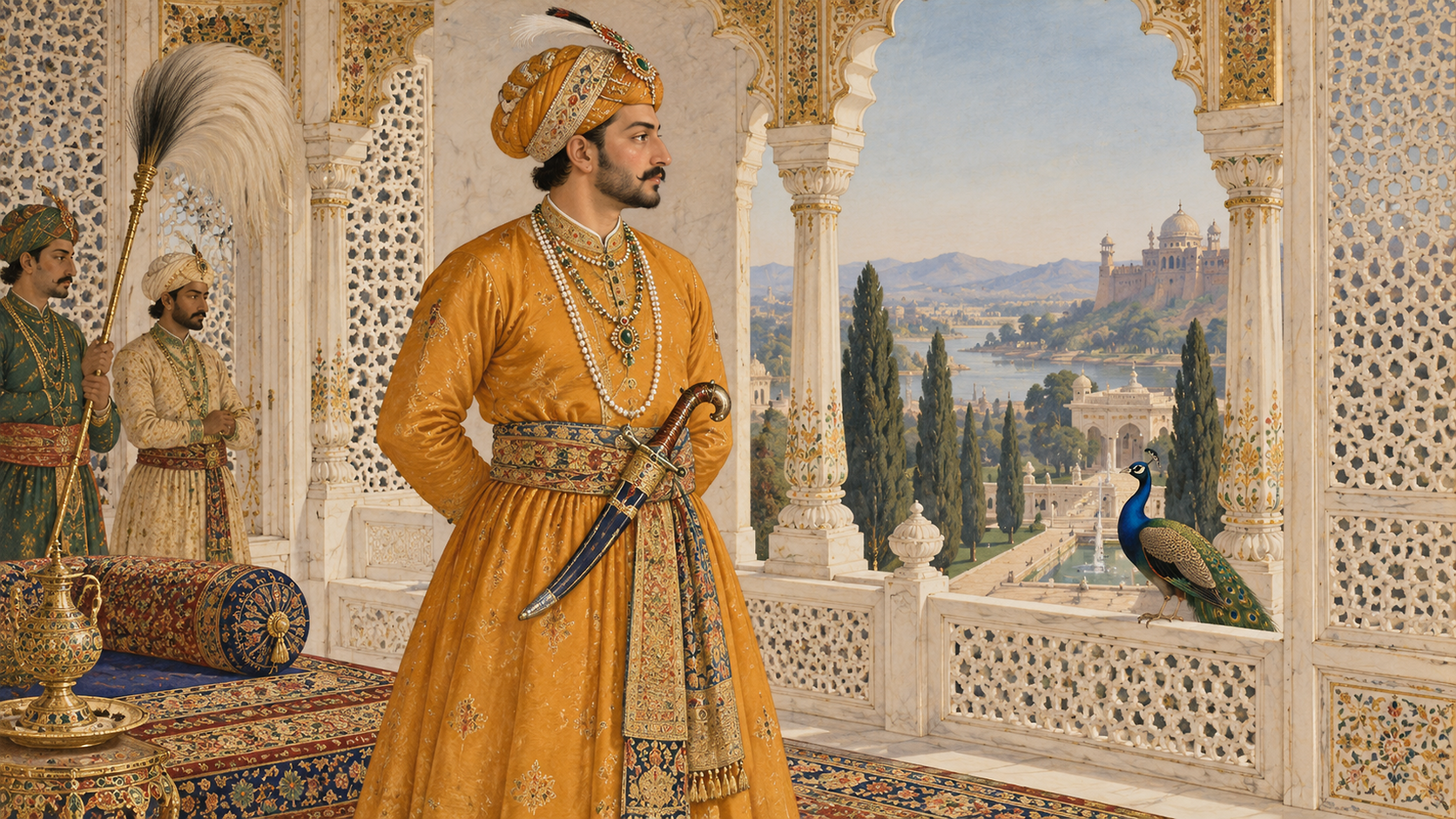
The status and employment of the pesh-kabz are well documented in the primary visual and textual records of the Mughal and Safavid courts. In the meticulously detailed pages of the Akbarnama and the Baburnama, courtiers, nobles, and imperial bodyguards are consistently illustrated with the slender, curved hilts of pesh-kabz and related kards protruding prominently from their embroidered waist sashes. The weapon signaled both martial readiness and aristocratic authority, often indicating personal proximity to the sovereign.
Written inventories from the royal armories (karkhanas) demonstrate the extraordinary economic value placed on high-grade crucible steel blades. In Mughal court records, weapons were meticulously graded according to the quality of their jawhar, the presence of specific calligraphic cartouches invoking Ali or the reigning emperor, and the material of their grip scales. Weapons possessing flawless, dark taban patterns with clear T-spines were classified among the khasa (personal imperial weapons), presented as diplomatic gifts to visiting ambassadors or bestowed upon favored generals as marks of supreme imperial favor.
Later Variations: From the Khyber Knife to the Chura
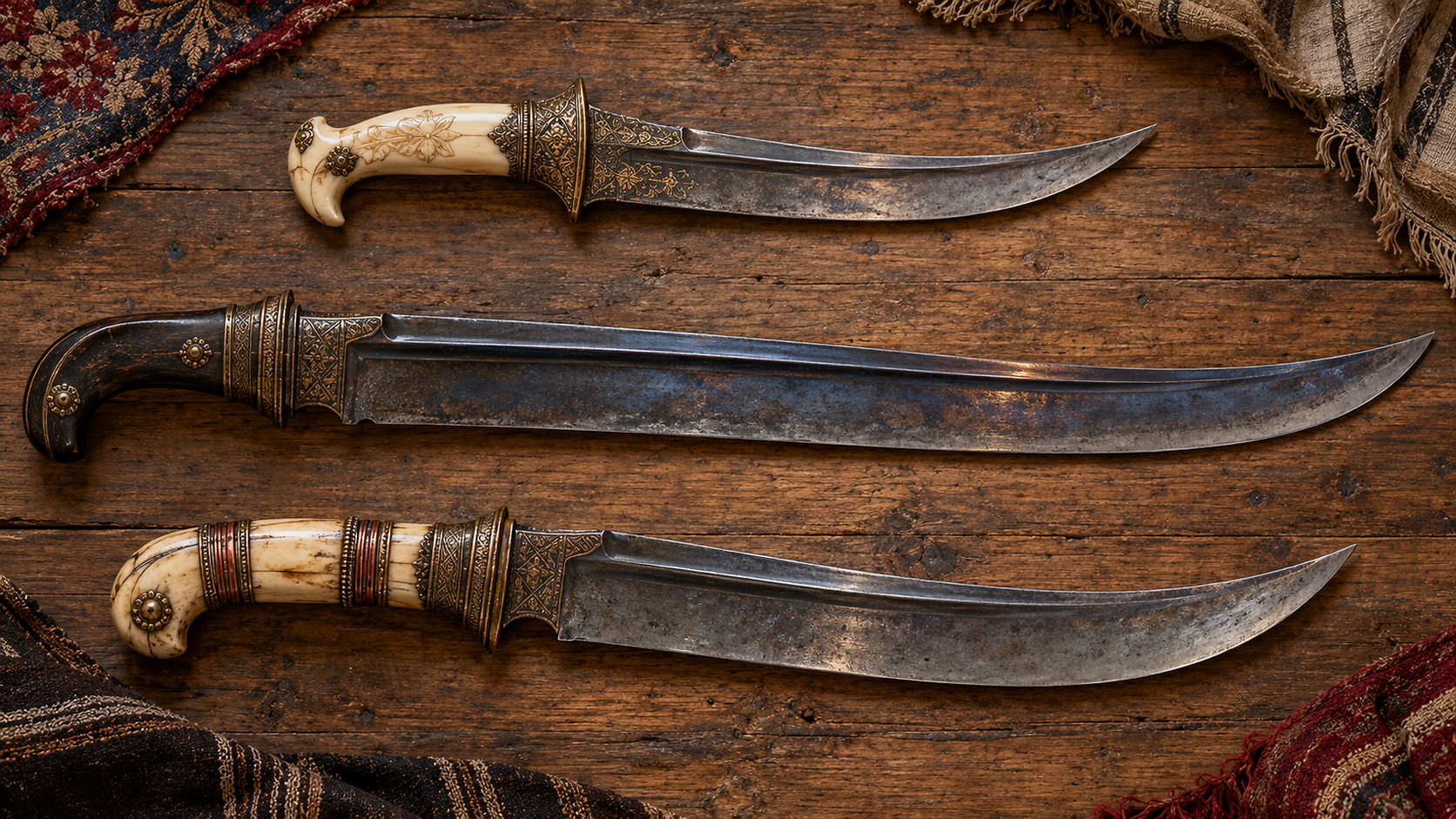
As firearms gradually diminished the dominance of heavy plate and mail on the battlefield throughout the eighteenth and nineteenth centuries, the mechanical logic of the reinforced T-spine spread and evolved across adjacent cultural regions. In the mountainous Afghan borderlands, Pashtun and Baluch tribesmen adapted the geometry into the massive salawar yatagan, commonly known to British colonial forces as the Khyber knife. Measuring up to thirty inches in length, this weapon took the T-spine of the pesh-kabz and expanded it to the proportions of a heavy short sword capable of both devastating chops and armor-piercing thrusts.
Simultaneously, the Mahsud and Afridi tribes of the Khyber Pass developed the chura, an angular, aggressive regional variant of the pesh-kabz featuring an exaggerated hooked pommel, bone scales banded with brass and copper wire, and an exceptionally thick, needle-straight T-spine. These later frontier weapons rarely utilized classical crucible wootz, instead employing imported British industrial shear steel or high-grade domestic pattern-welded iron, yet they preserved the identical physical cross-section that had proved its mechanical value over centuries of close-quarters combat.
The Pesh-Kabz in Modern Collections and Metallurgy
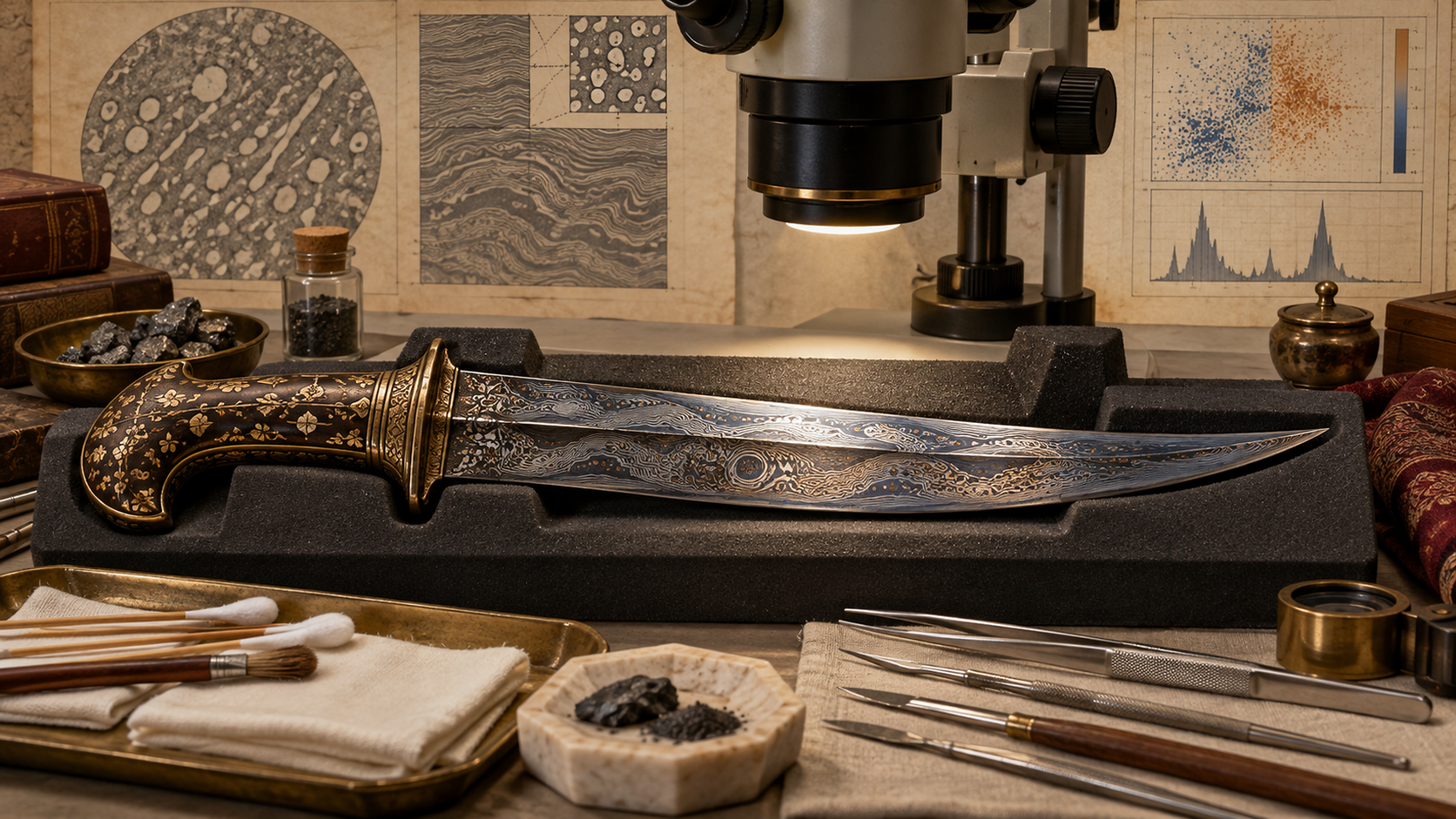
Today, surviving pesh-kabz occupy a critical place in museum collections, including the Wallace Collection in London, the Metropolitan Museum of Art in New York, and the National Museum in New Delhi. For modern materials scientists and arms historians, these daggers provide vital physical evidence for reconstructing the lost techniques of historical crucible steel production. Electron microscopy and metallographic analysis of authentic antique blades have helped researchers like J.D. Verhoeven and Al Pendray understand how micro-alloying elements such as vanadium and molybdenum guided the segregation of cementite during slow cooling.
When evaluating these daggers, conservators and collectors must carefully distinguish authentic crucible wootz from late nineteenth-century etched imitation steels, low-contrast mechanical damascus, or acid-corroded plain carbon forgings. In authentic examples, regional decorative tradition, extractive metallurgy, and structural geometry converge to overcome the mechanical limits of high-carbon crucible steel.
Further reading
Follow the sources to examine the object and its historical context.
Mani, V. Indo-Persian Edged Weapons. New Delhi: National Museum CatalogueExternal reference · Opens in a new tab Verhoeven, J.D., and Pendray, A.H. The Mystery of Damascus Blades. Scientific American, 2001External reference · Opens in a new tab