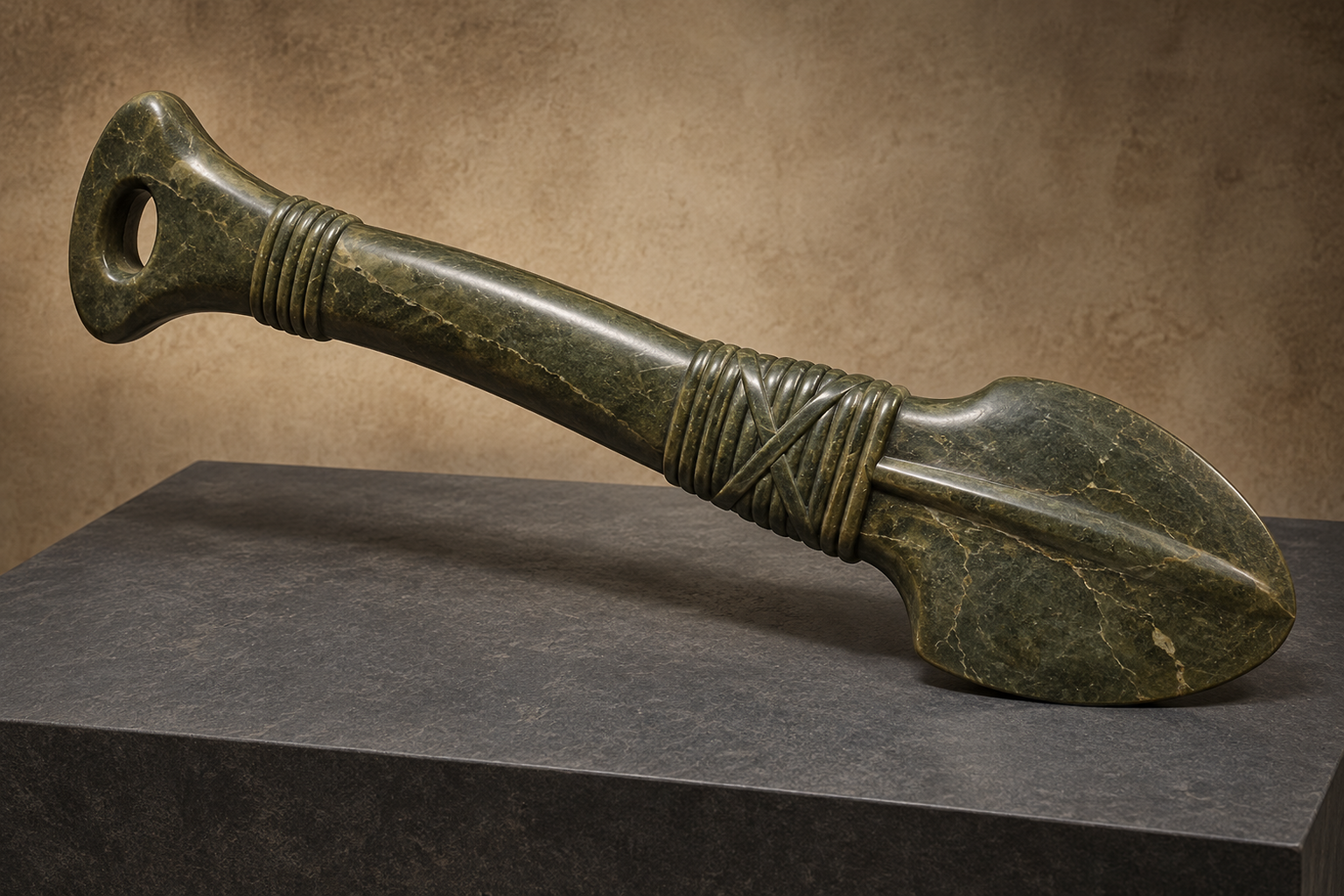
Among the most technically demanding stone carvings of the pre-Columbian American Southeast are weapons carved entirely from single blocks of stone, where the haft, celt blade, and binding cords are rendered as a continuous, unbroken object. Known to archaeologists as monolithic axes and spatulate clubs, these artifacts replicate the form of wooden-handled strike weapons as unbroken stone sculptures, trading the composite flexibility of wood and stone for brittle permanence. Recovered primarily from high-status burials at major mound centers like Moundville, Spiro, and Etowah, they occupy a contentious threshold between lethal war clubs and sacred insignia of rank.
The Monolithic Paradox: Stone Carved as Wood and Celt
To grasp the nature of a Mississippian monolithic axe, one must examine how late prehistoric warriors in eastern North America built standard impact weapons. A common Mississippian axe relied on a ground-stone celt—an ungrooved, petaloid axe head of polished metamorphic rock—inserted directly into a tapered mortise carved through the thick head of a hardwood haft. Under the kinetic shock of a strike, the tapered stone wedged tighter into the wood, though violent leverage risked splitting the haft along its grain.
The monolithic axe bypassed this structural partnership by carving both elements out of a single continuous block of stone. The sculptor shaped the handle, the swelled club head, the exposed celt blade, and even the protruding poll that projected through the back of the haft from one piece of rock. Some examples even include raised stone ridges mimicking the raw cord bindings or leather wrappings used to secure functional tools.
This design creates an engineering paradox. By transmuting a composite wooden tool into brittle stone, the craftsman created an object of extraordinary visual permanence that was far more vulnerable to catastrophic fracture than the wood-and-stone weapon it depicted. Striking an armored wooden shield or catching a hard blow on an unyielding edge could snap a stone handle across its neck. Yet surviving artifacts show ground edges capable of severing bone and crushing helmets woven of cane or raw hide.
Raw Stone and Geological Provenance
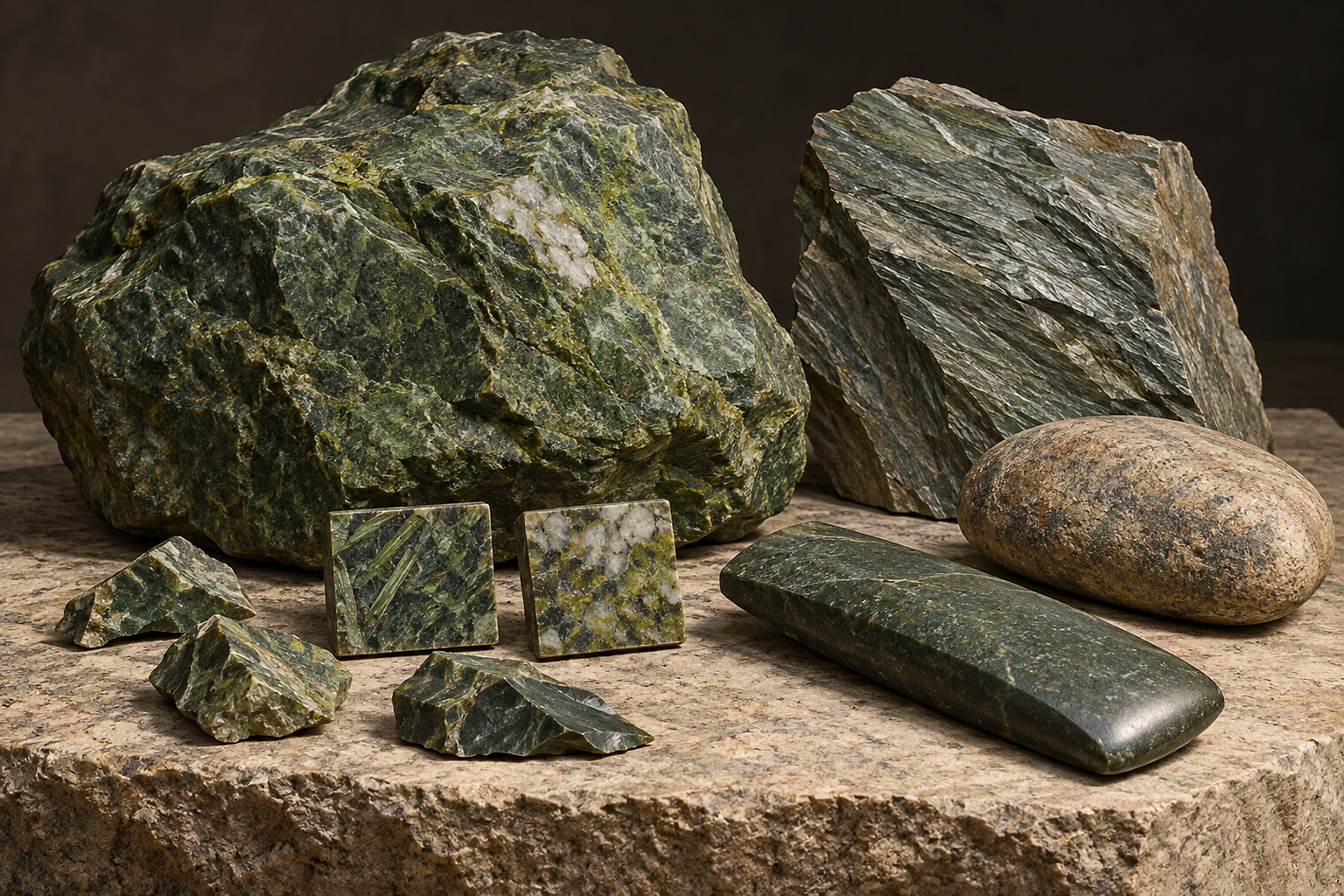
The manufacture of a monolithic club began with raw material acquisition. Late prehistoric artisans rarely used porous sedimentary rocks like soft sandstones for these prestigious items. Instead, they sought out dense, tough metamorphic formations that could sustain weeks of pecking without developing hidden shear planes or interior fracture lines.
The primary stone used across the central and southern reaches of the Mississippian world was greenstone, specifically actinolite-epidote-albite schists and metavolcanics quarried along the Piedmont province. Artisans operating within the influence of Moundville sourced stone from outcroppings along the Talladega slate belt in central Alabama. Chemical sourcing and petrographic thin-section analysis have shown that raw blanks and finished celts traveled hundreds of kilometers through established riverine exchange routes.
Further west, near the trans-Mississippi Caddoan center at Spiro, sculptors utilized fine-grained chlorite schists, siliceous limestones, and argillites. The physical properties of these stones were vital: they had to balance hardness, allowing the weapon to take a glass-smooth polish, with enough structural elasticity to survive repetitive abrasion without shattering during the manufacturing process.
Workshop Reductions: Pecking, Grinding, and Polishing
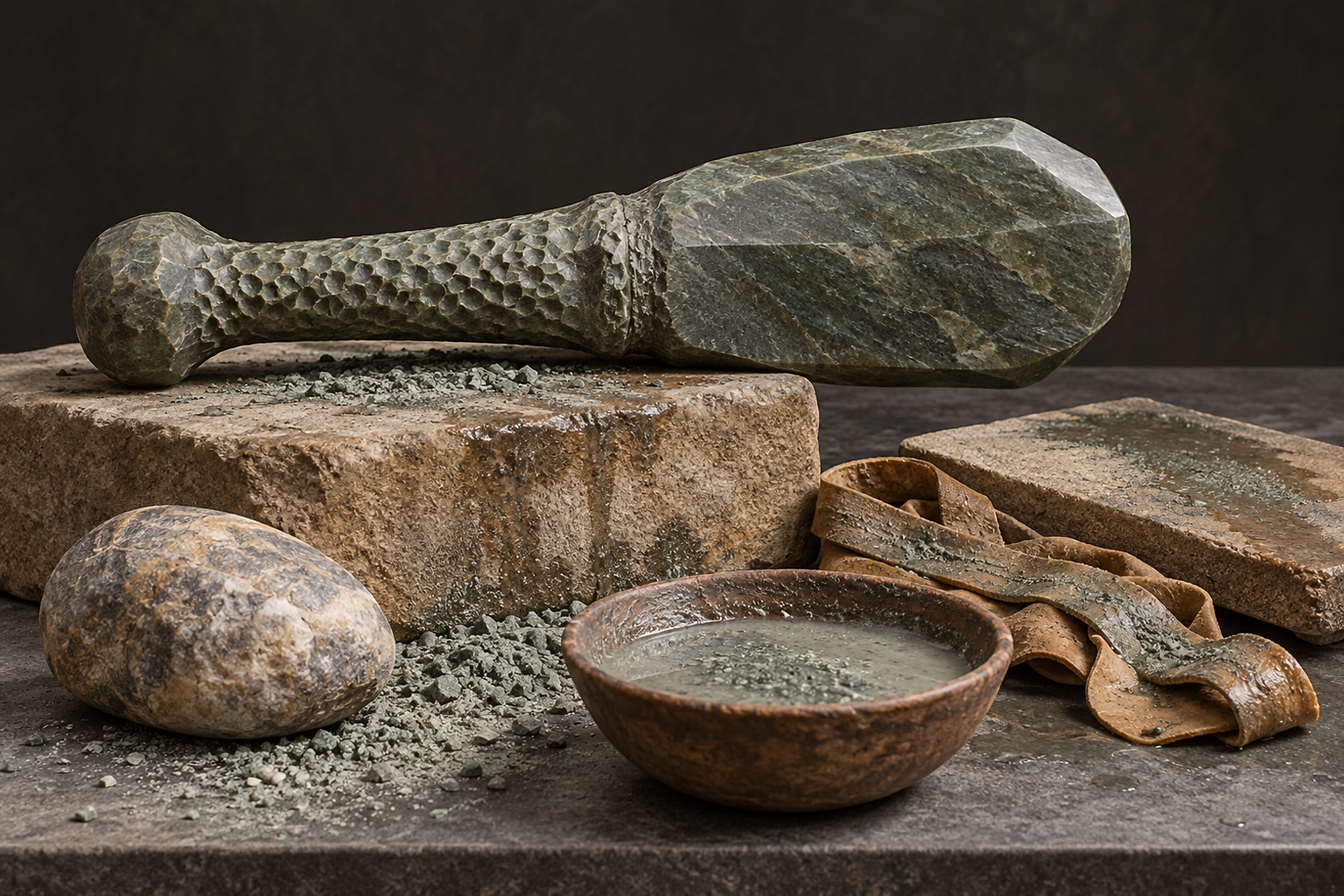
Transforming an irregular thirty-kilogram slab of raw metamorphic rock into a slender, perfectly balanced forty-centimeter monolithic axe required dozens, sometimes hundreds, of hours of manual reduction. Mississippian workshops lacked iron chisels or rotating saws; every contour had to be coaxed from the matrix through hammerstone pecking, abrasive sawn cuts, and wet grinding.
Artisans relied on tough quartzite or chert hammerstones to batter the blank, pulverizing tiny crumbs of stone with every controlled impact. By varying the angle and force of the strike, the maker narrowed the haft, rounded the grip, and established the profile of the axe head. Grooves along the margin between the simulated wooden haft and the exposed stone bit were often cut using thin sandstone slabs or cord coated with wet quartz slurry, acting as a flexible saw.
The final reduction stage shifted from impact to abrasion. Workers rubbed the contoured form against stationary sandstone grinding slabs, using water to flush away lithic dust. They gradually introduced finer abrasives—siltstones, pulverized hematite, and tanned hides—to polish away all traces of pecking scars. The resulting surface exhibited a deep, waxy sheen that caught the sunlight, highlighting natural mineral veins that ran uninterrupted through both haft and blade.
The Spatulate Profile: Geometry of the Flared Bit
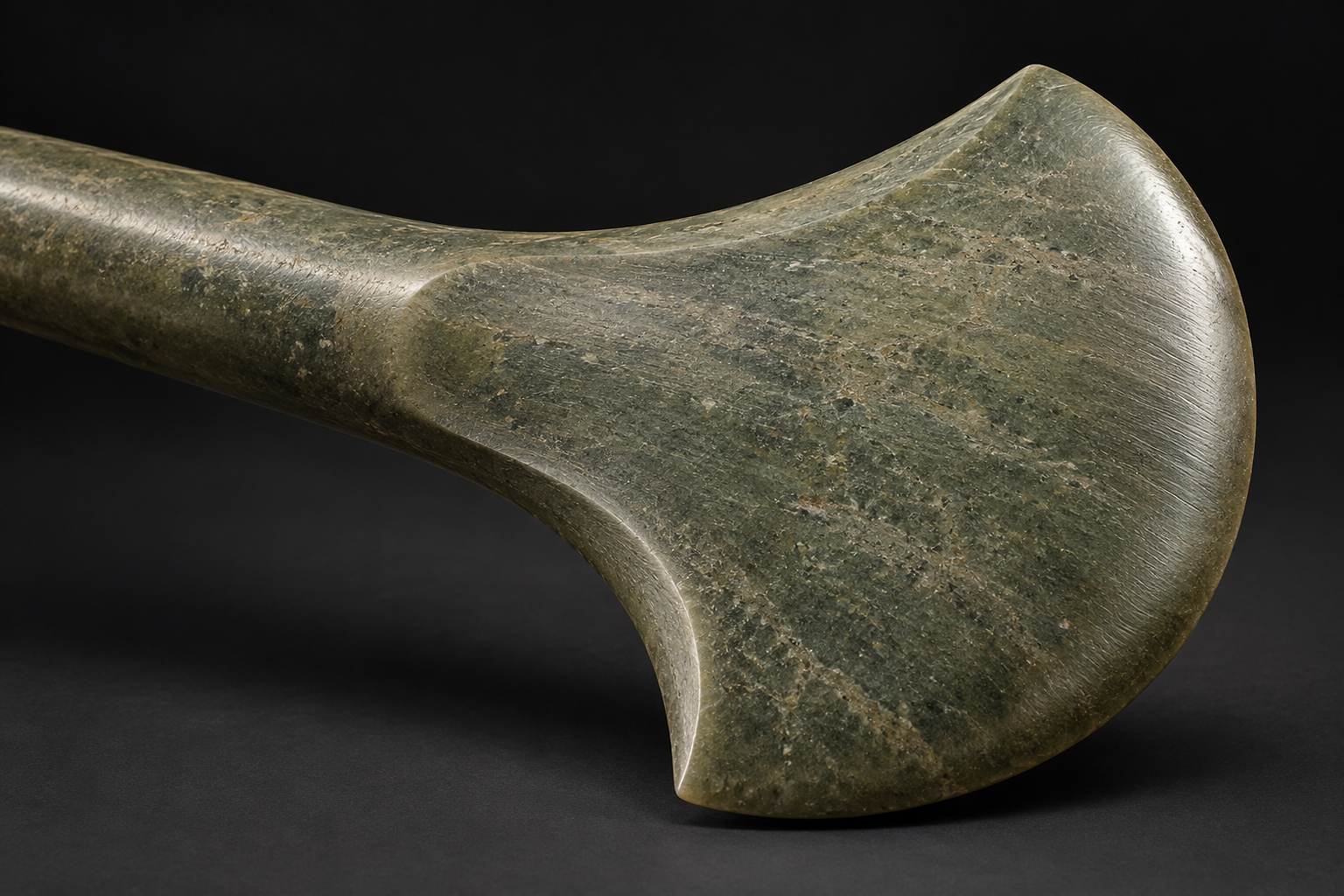
Beyond monolithic axes that strictly mirror hafted celts, archaeologists identify a related category termed spatulate clubs or spatulate celts. These objects display an elongated stem that expands into a broad, fan-shaped or spade-like blade. While some spatulates were fitted into wooden hafts like enormous broad chisels, monolithic versions incorporated both the paddle-like blade and the supporting shaft into one unified profile.
The working edge of a Mississippian monolithic celt rarely resembles the razor-thin bevel of a modern steel axe. Instead, it features a robust, convex cross-section known to toolmakers as an apple-seed bit. This blunt wedge concentrates enormous mass directly behind the cutting margin, allowing the stone to resist chipping upon impact while focusing devastating percussive force across a narrow line of contact.
On spatulate variants, the blade flares dramatically at the corners, creating distinct lateral spurs before sweeping into a semi-circular cutting edge. This wide geometry reduced the depth of penetration compared to a narrow wedge, functioning instead as a cleaving surface designed to impart concussive shock across a broader target zone.
Haft Architecture Carved in Monolith
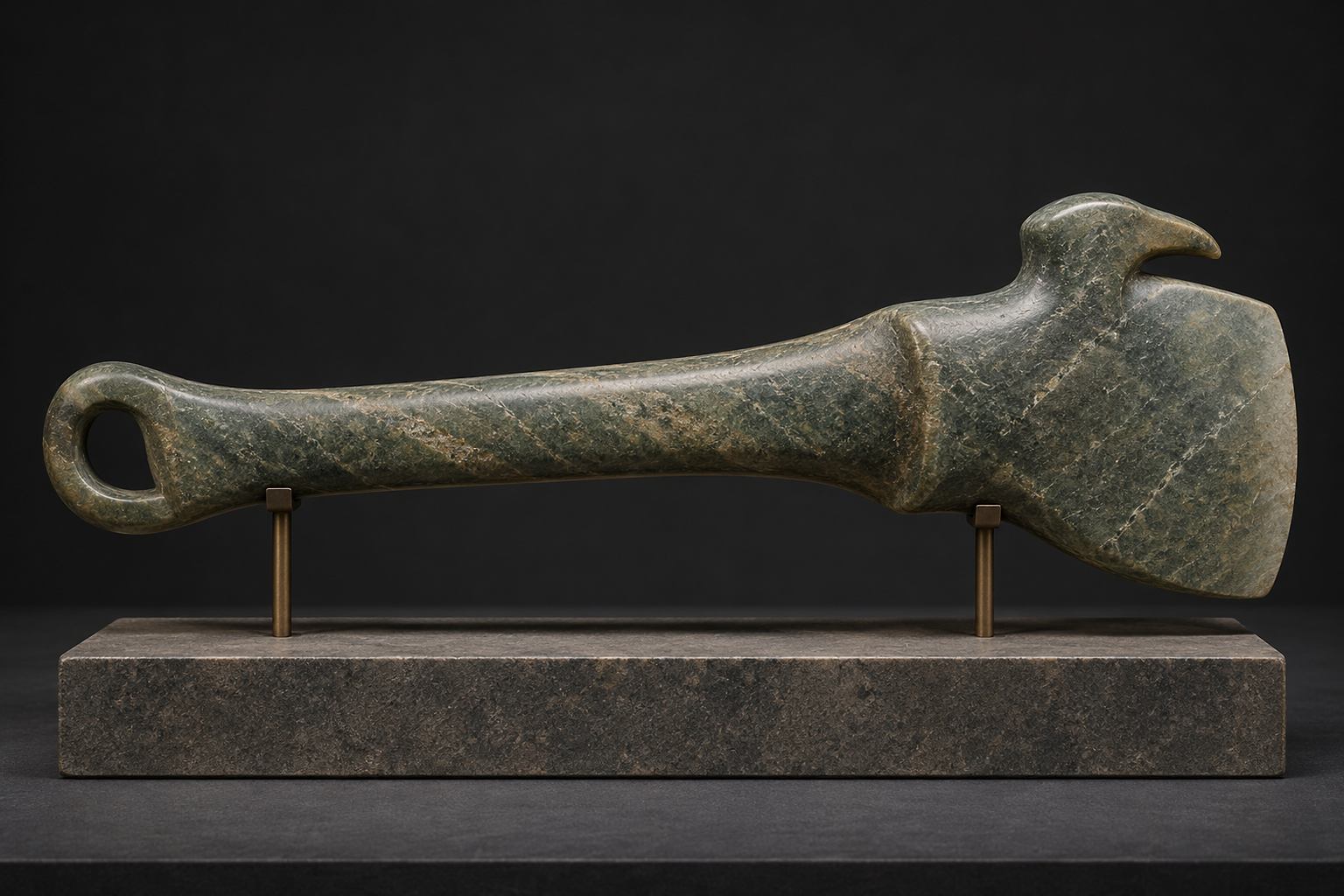
One of the most revealing aspects of monolithic axes is the meticulous detail with which they replicate the construction of wooden hafts. The handle does not resemble a simple straight stick; it faithfully captures the organic morphology of a tree branch chosen deliberately for shock resistance and ergonomic balance.
In living wood, Mississippian axe makers favored pieces where a stout side branch emerged from a thicker limb, providing natural flare and grain alignment around the mortise hole. Monolithic stone sculptors reproduced this asymmetry in stone. The haft tapers gently from a comfortable cylindrical grip toward an enlarged, swollen head that terminates in a stylized crest or curved avian crest.
Behind the axe bit, where a wooden club often split under wedging stress, monolithic examples frequently portray raised bands or bulbous swellings. At the butt of the handle, makers frequently carved perforated pommel loops or bulbous terminals. These features mirror the wrist lanyards that let a warrior retain his club through sweaty, hand-to-hand engagements on the ramparts of a palisaded town.
Bioarchaeological Evidence: Blunt Force Cranial Trauma
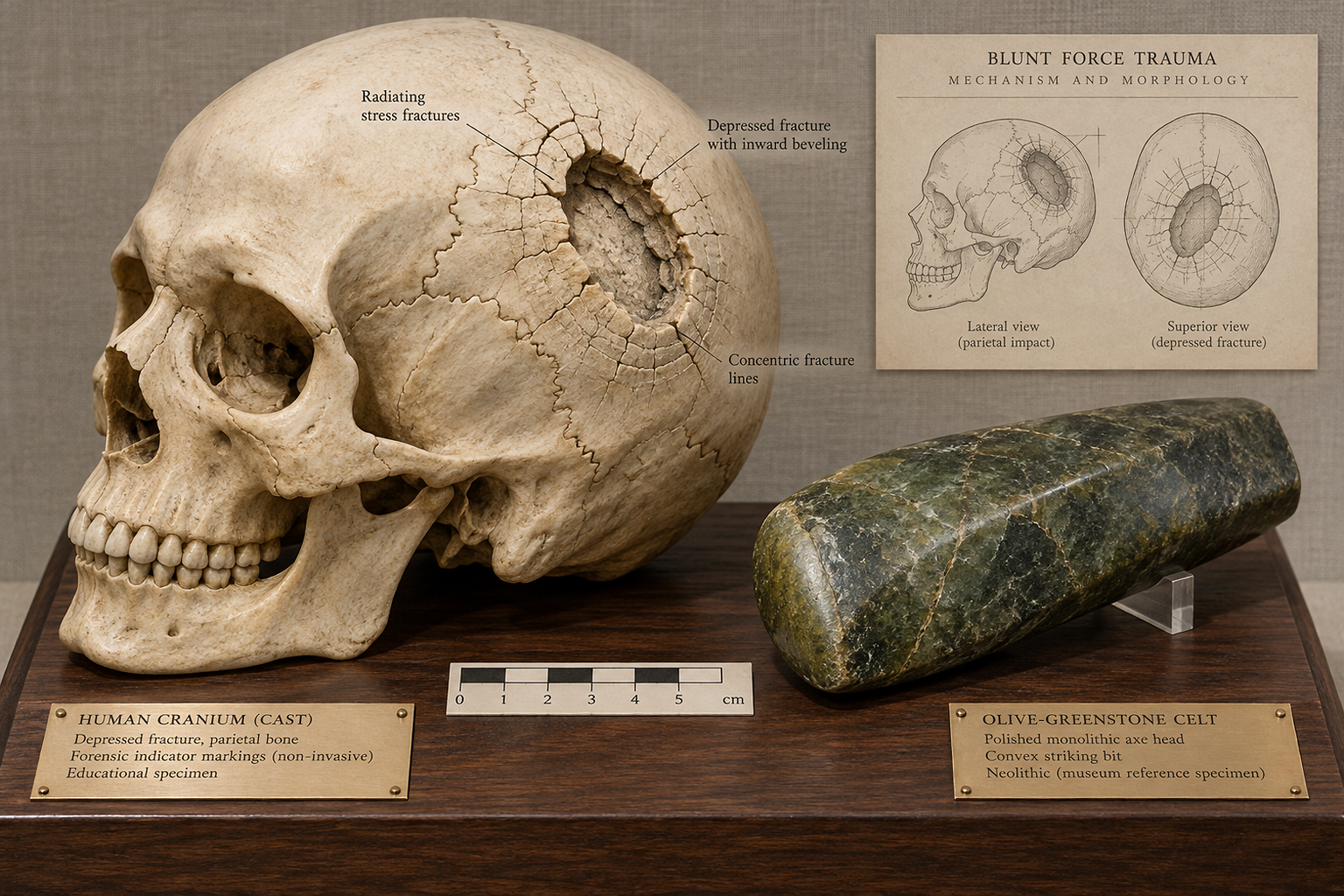
The functional reality of Mississippian shock weapons is documented extensively in the skeletal record of the American Bottom and Southeastern river valleys. Bioarchaeological excavations across late prehistoric cemetery populations reveal a grim catalog of percussive violence, characterized by circular, oval, and wedge-shaped depressed skull fractures.
When an ungrooved stone celt or monolithic axe strikes a human cranium, it produces distinct biomechanical signatures. A glancing or underpowered strike typically causes an oval depression where the outer table of bone caves into the spongy diploë, radiating concentric fracture lines outward. Full-force strikes deliver catastrophic shear failure, driving rectangular or wedge-shaped plugs of cortical bone directly into the vault of the braincase.
At sites such as the Larson site in Illinois and King Mound in Georgia, forensic examinations have documented individuals who survived moderate cranial crushing, evidenced by smooth bone remodeling along the edges of depressed fractures. Others display multiple unhealed impact wounds, showing that while monolithic specimens may have spent much of their lives wrapped in deer hide bundles for ceremonial display, the weapon class they represented dominated the physical reality of Mississippian warfare.
Fortified Towns and Mississippian Warfare
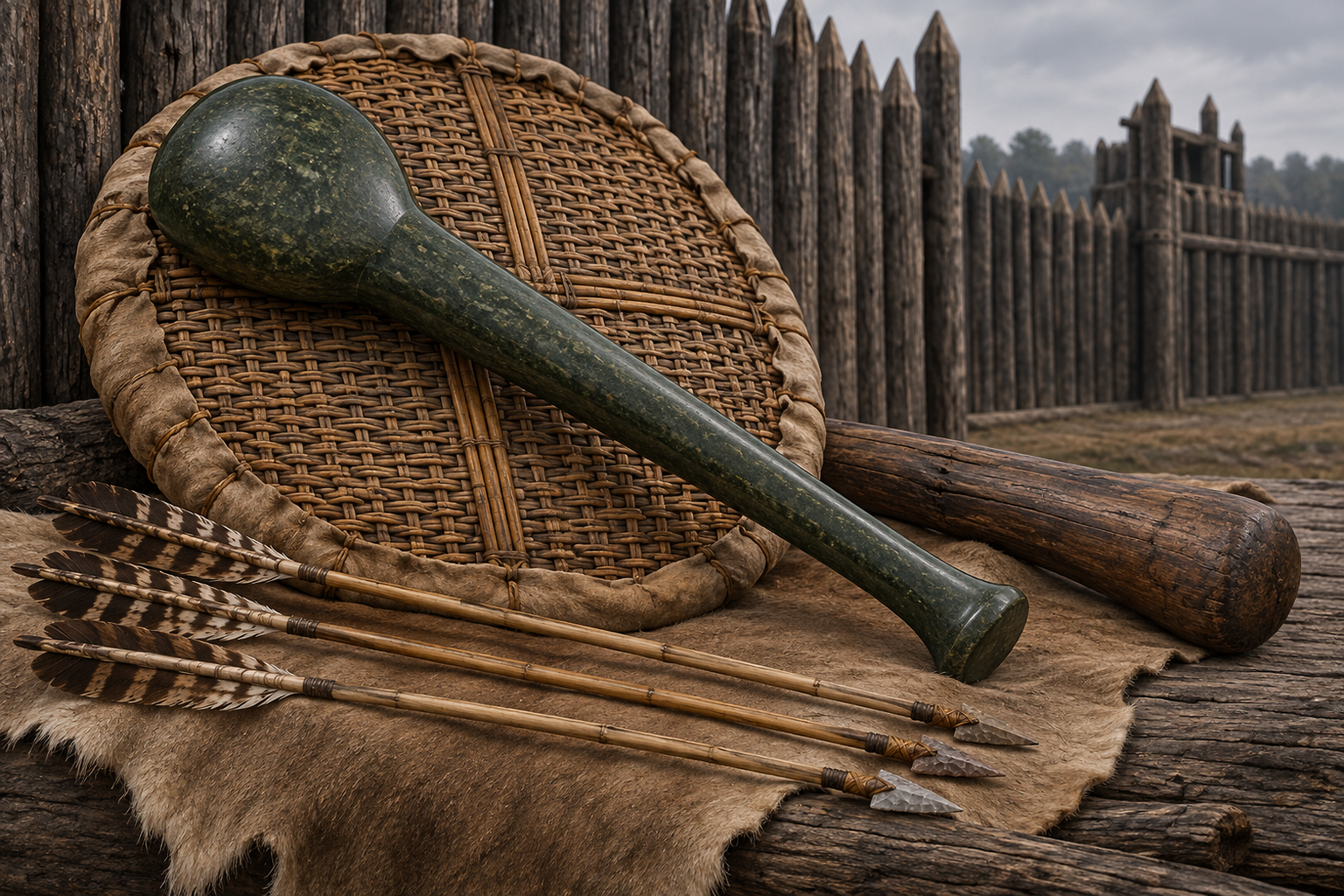
The Mississippian world was an interconnected landscape of nucleated chiefdoms, where defensive earthworks and bastioned timber palisades enclosed densely packed towns along fertile river terraces. Inter-polity warfare was deeply institutionalized, waged for regional tribute, elite captives, and political dominance.
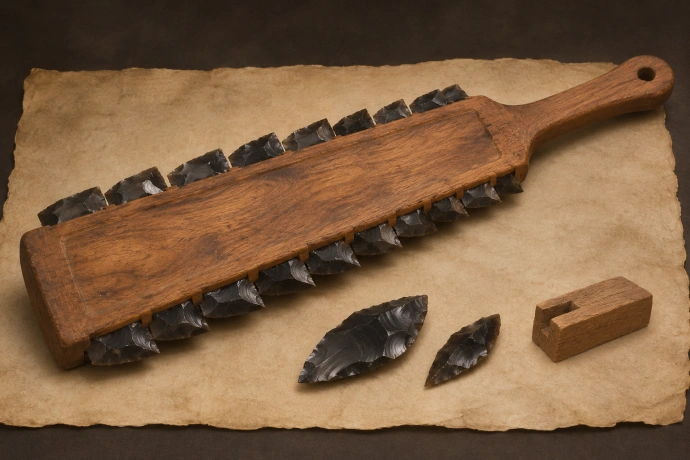
Combat in this era centered on decisive raids, ambushes, and assaults on fortified towns. While archery using cane arrows tipped with triangular chert points initiated engagements at distance, close-quarters combat inside the restricted gates and bastions demanded rigid percussive weapons. Wooden macanas studded with chert chips, heavy hardwood war clubs, and hafted greenstone axes formed the primary shock arsenal.
In this tactical environment, a commander or elite warrior carrying a monolithic club possessed a devastating weapon of intimidation. The weight distribution of a solid stone axe placed immense kinetic energy at the striking point, capable of crushing the defensive cane wickerwork shields and thick, quilted fiber tunics worn by Southeastern warriors.
The Southeastern Ceremonial Complex and Iconography
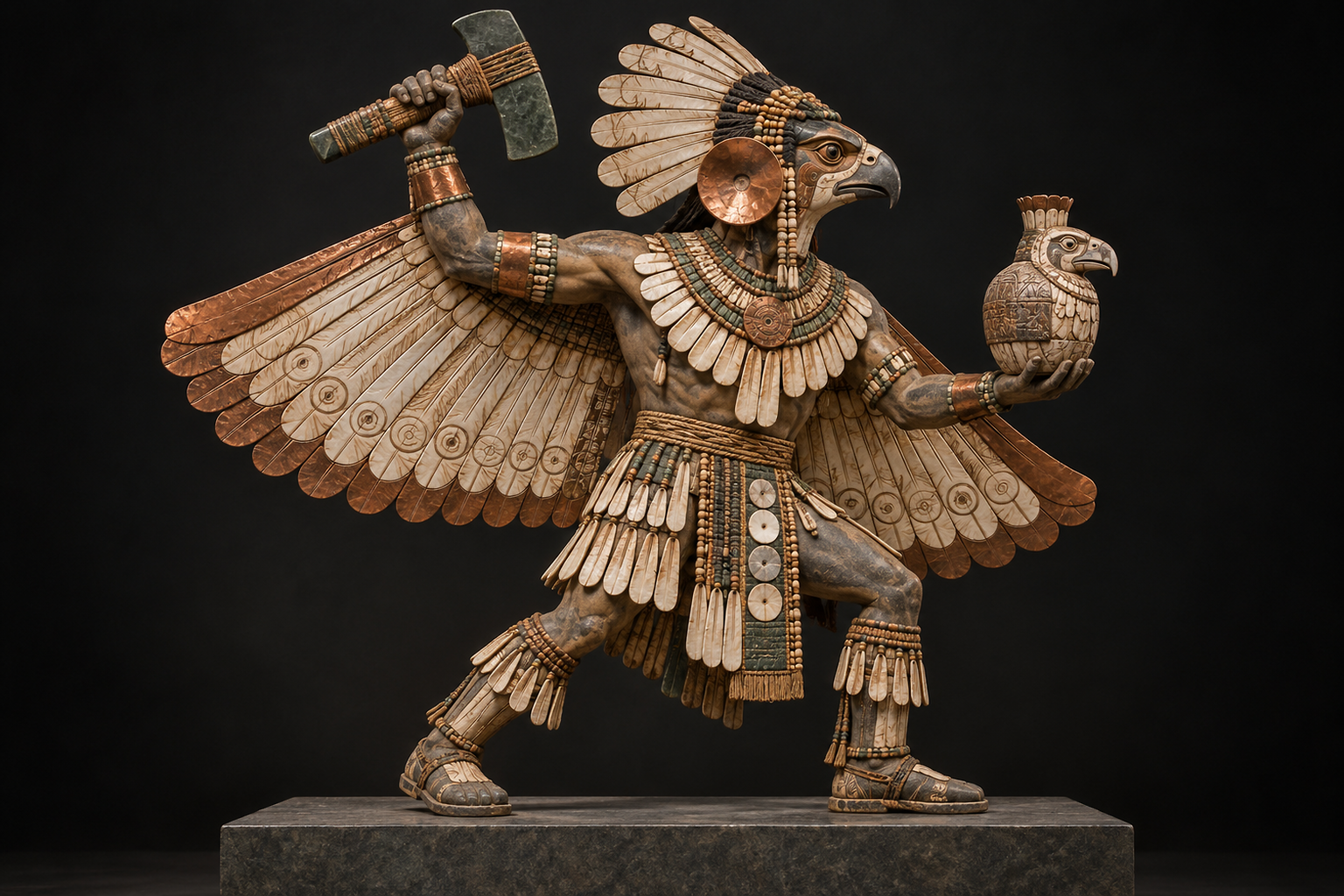
Monolithic axes and spatulate weapons do not exist in isolation; they are central motifs within the Mississippian Iconographic Interaction Sphere, historically designated as the Southeastern Ceremonial Complex. Across engraved marine shell gorgets, repoussé copper plates, and incised pottery, supernatural beings and sanctified rulers wield these exact implements.
The most ubiquitous figure associated with the stone axe is the Falcon Dancer or Birdman. Portrayed on cold-hammered copper plates found at Etowah and Spiro, this composite supernatural entity displays avian raptorial markings, wings of falcon feathers, and elite copper earspools. In his right hand, the dancer invariably brandishes either a severed human head or a monolithic stone axe held at the mid-shaft, poised to strike.
Iconographers suggest the axe represented the celestial lightning bolt—a sudden, vertical strike of fracturing power linked to upper-world raptors and thunder deities. By carrying a monolithic axe, a Mississippian chief linked battlefield command with the mythological authority of divine retribution, connecting judicial violence with cosmic order.
Moundville: Elite Regalia in Mortuary Contexts
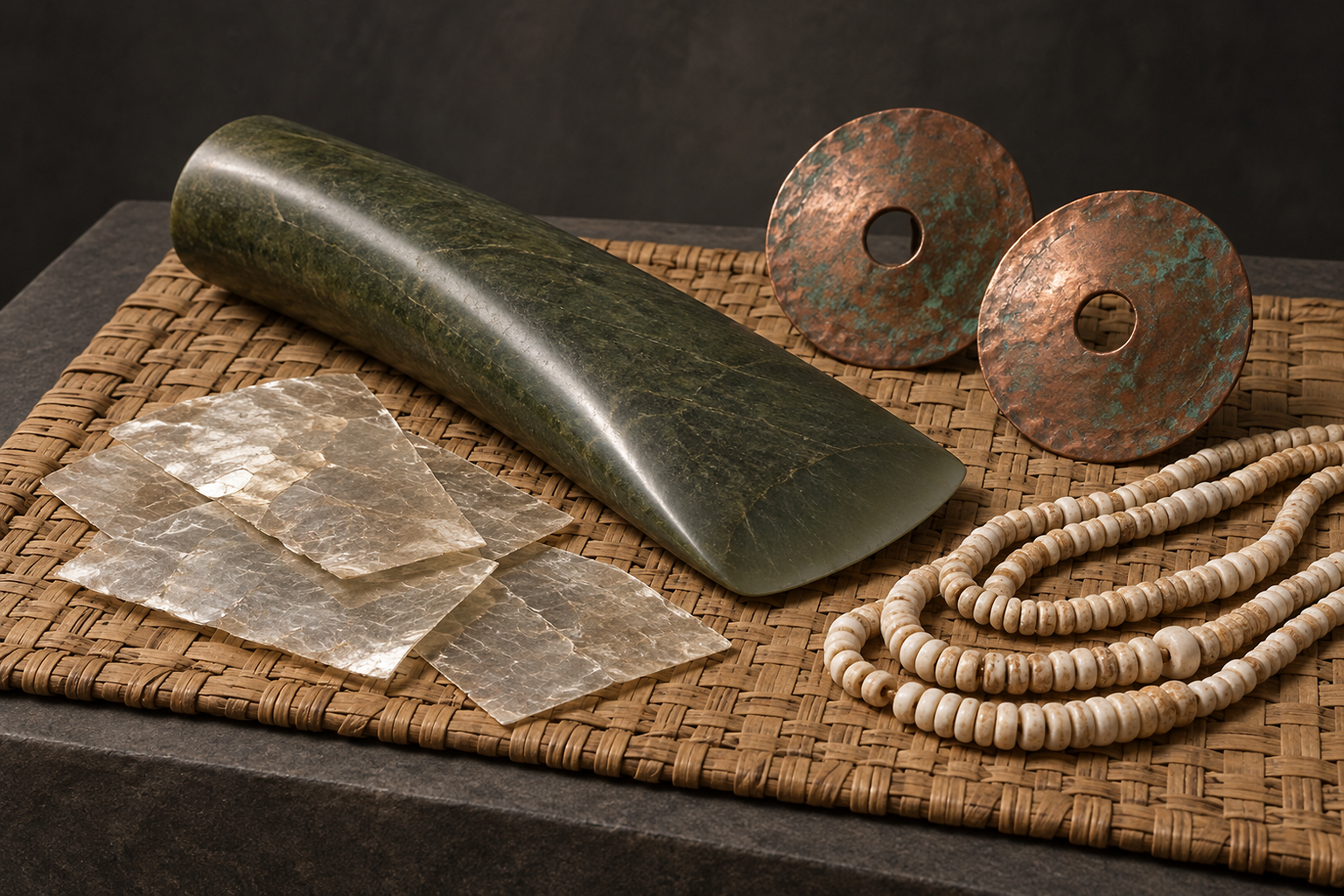
At Moundville, situated along the Black Warrior River in central Alabama, archaeological excavations during the nineteenth and twentieth centuries recovered some of the most celebrated monolithic axes ever identified. Here, twenty-nine massive earthen mounds formed a rigid political and spatial hierarchy, serving as residences, administrative centers, and mortuary platforms for paramount lineages.
The Moundville monolithic axes were not scattered among general cemetery populations. They were recovered almost exclusively from high-status adult male burials clustered near the bases or summits of primary civic-ceremonial mounds. Laid alongside copper ear ornaments, marine shell beads, and sheets of hammered mica, the axes were positioned deliberately along the forearm or resting near the shoulder of the deceased.
The contextual associations at Moundville indicate that these objects were inalienable heirlooms of high office. Their immaculate surface preservation, devoid of battered poll edges or impact chips along the bit, suggests they were shielded from everyday agrarian labor. If they were swung in anger, it was during controlled, highly ritualized actions such as the sacrifice of captives or state executions, where the risk of the blade deflecting off armor was minimal.
Spiro Mounds and the Great Mortuary Cache
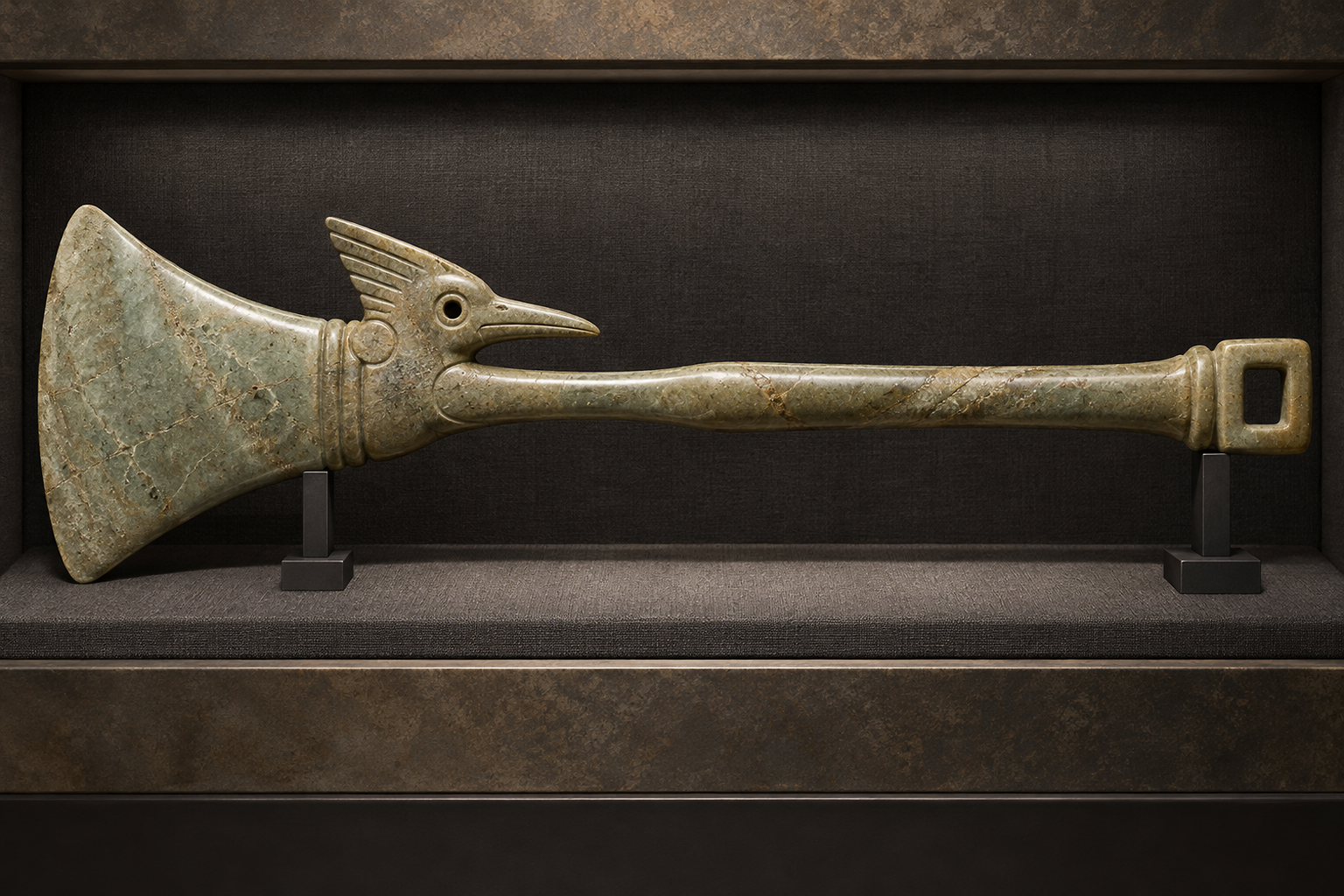
The western frontier of the Mississippian cultural orbit, centered at Spiro Mounds in eastern Oklahoma, produced the most spectacular assembly of pre-Columbian ritual equipment in North America. Within the central chamber of the Craig Mound—often referred to as the Great Mortuary—depositors sealed thousands of shell cups, copper plates, textile fragments, and dozens of polished stone weapons.
Among the Spiro assemblages were several masterfully executed monolithic axes, including specimens carved from soft, fine-grained greenish-gray stone. Unlike the robust, heavy specimens of Alabama, some Spiro examples possess extremely slender hafts, pierced terminals, and stylized effigy finials depicting the heads of birds or canids emerging from the poll of the axe.
Tragically, the discovery of the Great Mortuary in 1933 by a commercial mining consortium known as the Pocola Mining Company resulted in catastrophic destruction. Miners used dynamite and crude picks to loot the mound, tossing stone clubs, textiles, and skeletal remains into spoil heaps for roadside sale. Only through decades of retrospective archaeological sleuthing have researchers reconstructed the contextual provenance of Spiro’s monolithic weaponry.
Etowah and the Shell Gorget Depictions
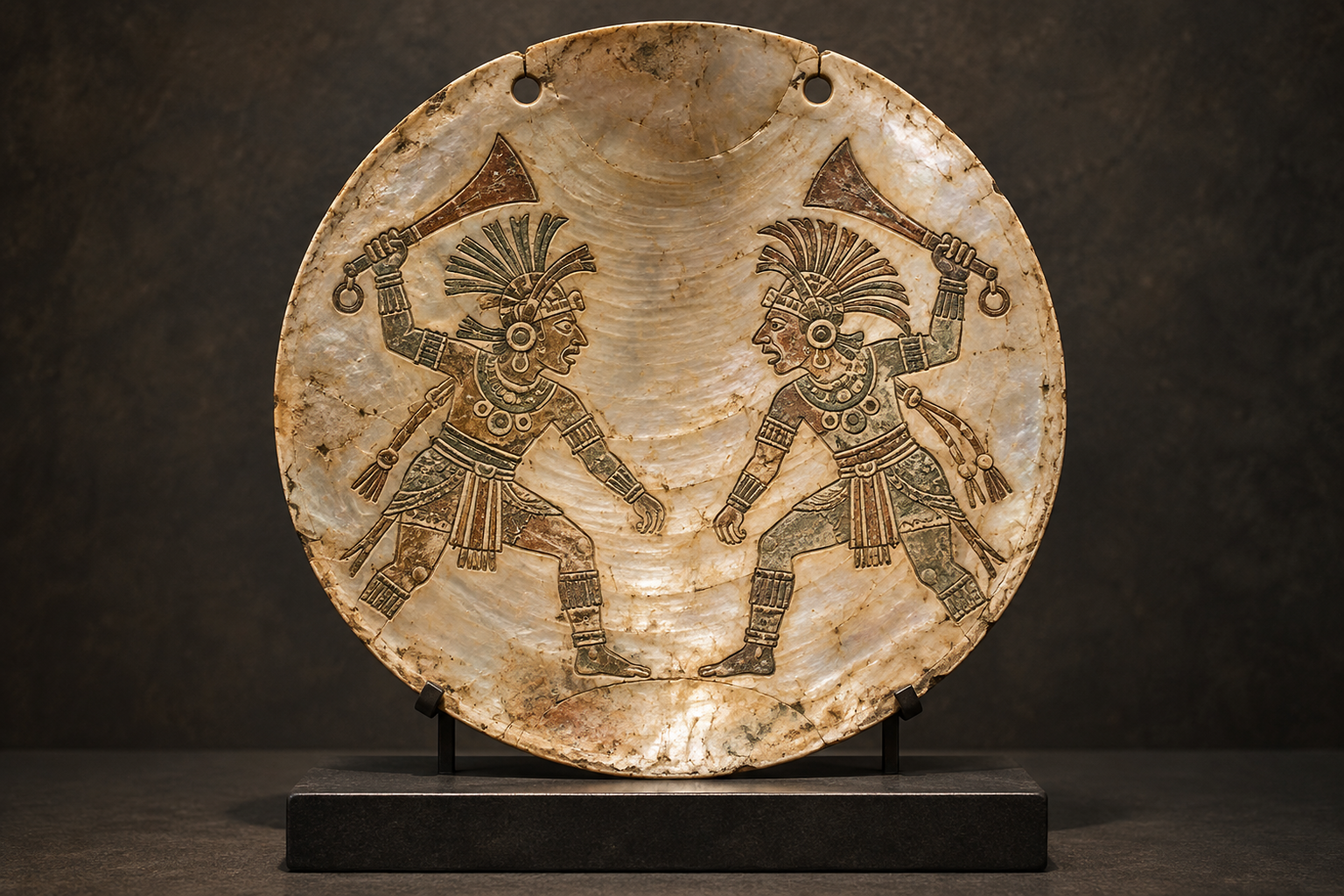
At the Etowah site in northwestern Georgia, Mound C yielded a remarkable series of intact burials associated with the Wilbanks phase of the late thirteenth and early fourteenth centuries. Excavations directed by Lewis Larson uncovered not only physical stone axes but also engraved marine shell gorgets illustrating their exact operational posture.
The shell gorgets portray paired warriors engaged in combat or ritual choreography. Each warrior holds a monolithic-style celt aloft in his primary hand while clutching a severed head or a rectangular cane shield in the other. The stone axes shown in these dynamic engravings feature clearly delineated haft loops, crested polls, and flaring bits that precisely match physical artifacts recovered from adjacent graves.
The Etowah discoveries confirmed that the morphology of monolithic stone clubs was standardized across hundreds of kilometers. Craftsmen hundreds of leagues apart worked within rigid canonized proportions, suggesting that stone carvers adhered to strict ritual specifications overseen by regional priests and paramount lineage leaders.
Functional Weapon versus Inviolable Insignia
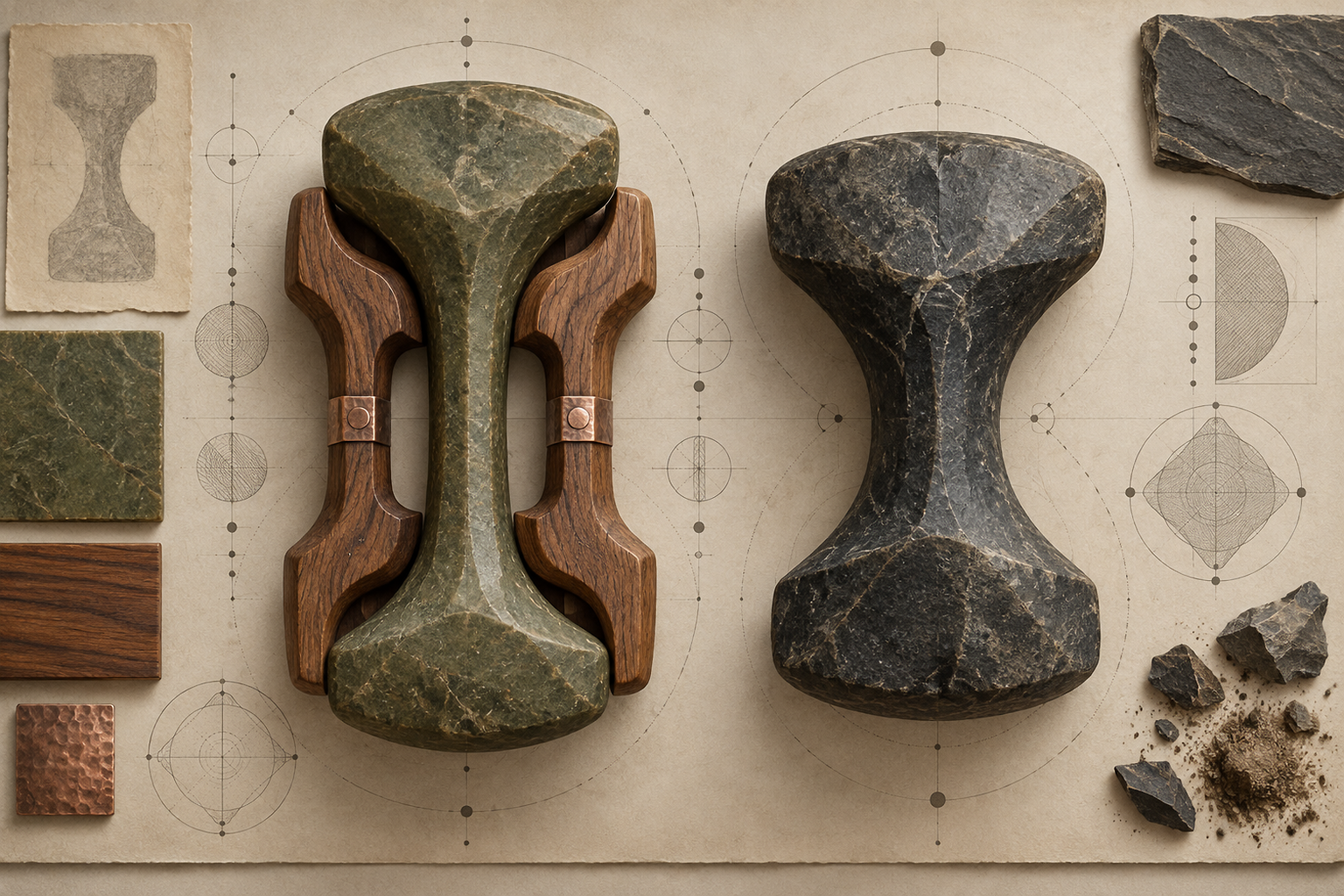
The debate regarding whether monolithic axes were wielded as practical combat clubs or held solely as non-functional regalia remains active among archaeologists and experimental replication specialists. Several distinct physical characteristics help differentiate their mechanical capabilities from ordinary utility axes:
First, consider the balance: a functional hafted celt features a lightweight wooden handle that acts as a lever, accelerating the heavy stone head through an arc. A monolithic axe, by contrast, distributes weight evenly down the entire length of the stone handle, moving the center of mass closer to the wielder’s hand. This makes the weapon slower to swing, though it grants exceptional control in close, confined scuffles.
Second, the vulnerability to shock cannot be ignored. While greenstone has high compressive strength, its tensile strength is limited. Striking another stone weapon or an oak war club would generate immense bending stress along the neck of the haft, courting catastrophic failure. Archaeologists generally treat them as functional weapons of display: capable of delivering fatal blunt force to an unarmored opponent or captive, but too fragile and socially valuable to risk in general skirmishing.
Sixteenth-Century Encounters: Spanish Chroniclers and Shock Weapons
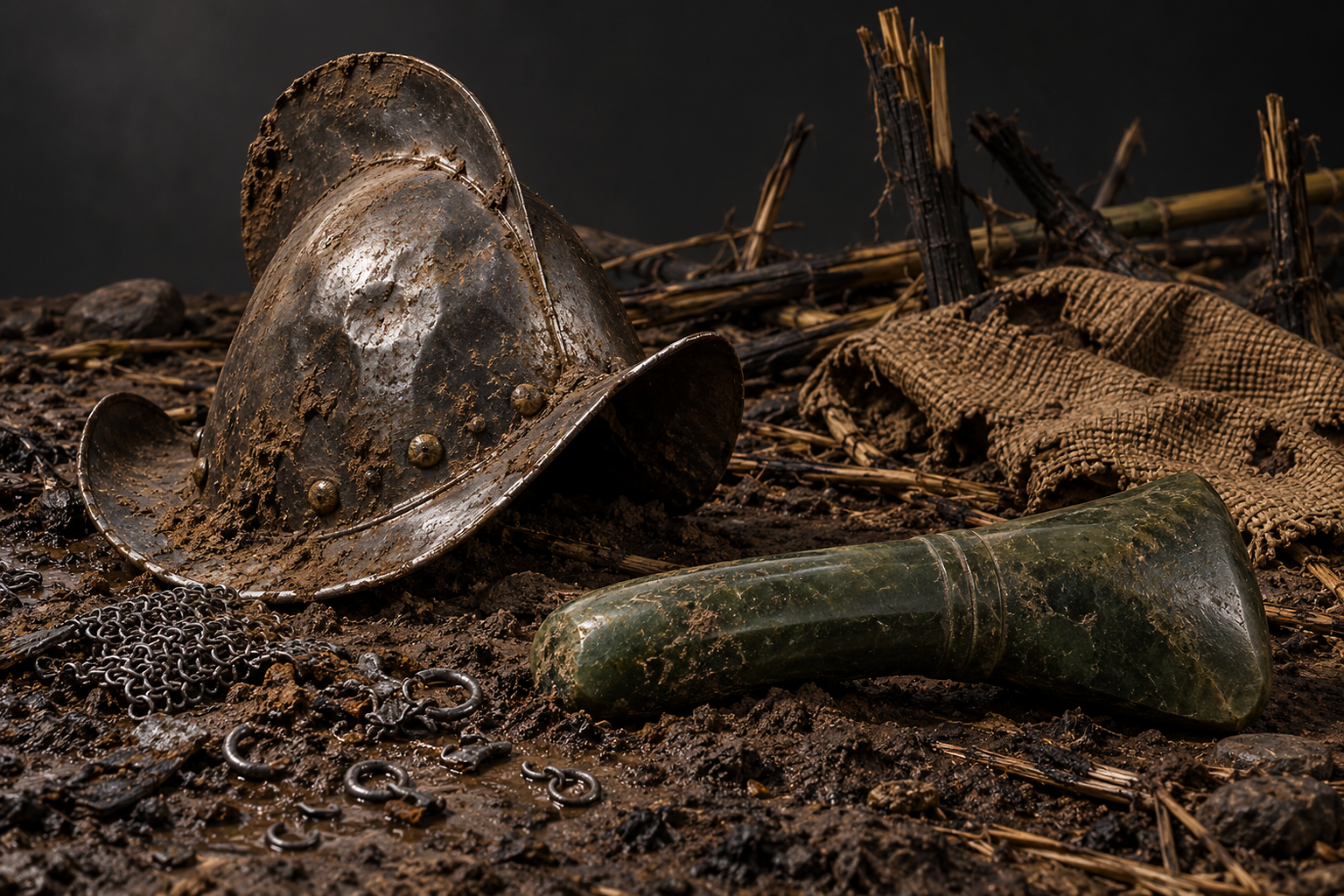
When Hernando de Soto’s expedition traversed the Southeastern interior between 1539 and 1543, Spanish chroniclers recorded detailed eyewitness descriptions of the weaponry wielded by Mississippian armies. The narratives of the Gentleman of Elvas, Garcilaso de la Vega, and Rodrigo Rangel describe a sophisticated, aggressive martial culture that inflicted heavy casualties on the invaders.
The chroniclers consistently noted the devastating power of Native shock weapons in close combat. While Spanish steel armor turned many cane arrows, jointed strikes from hardwood macanas and stone-headed axes broke Spanish limbs, crushed iron helmets, and crippled horses. Garcilaso described clubs fashioned with such skill that they could cleave a man through the shoulder or smash an iron-clad skull in a single blow.
While the Spanish accounts do not explicitly distinguish between wooden-hafted celts and monolithic stone axes, they frequently mention caciques and war captains carrying clubs of polished, gleaming stone as badges of command. In the desperate urban battle of Mabila in 1540, close-quarters fighting within the enclosed town square saw Native warriors using every available impact weapon to batter down Spanish swordsmen separated from their lances.
Museum Histories, Antiquarian Looting, and Repatriation
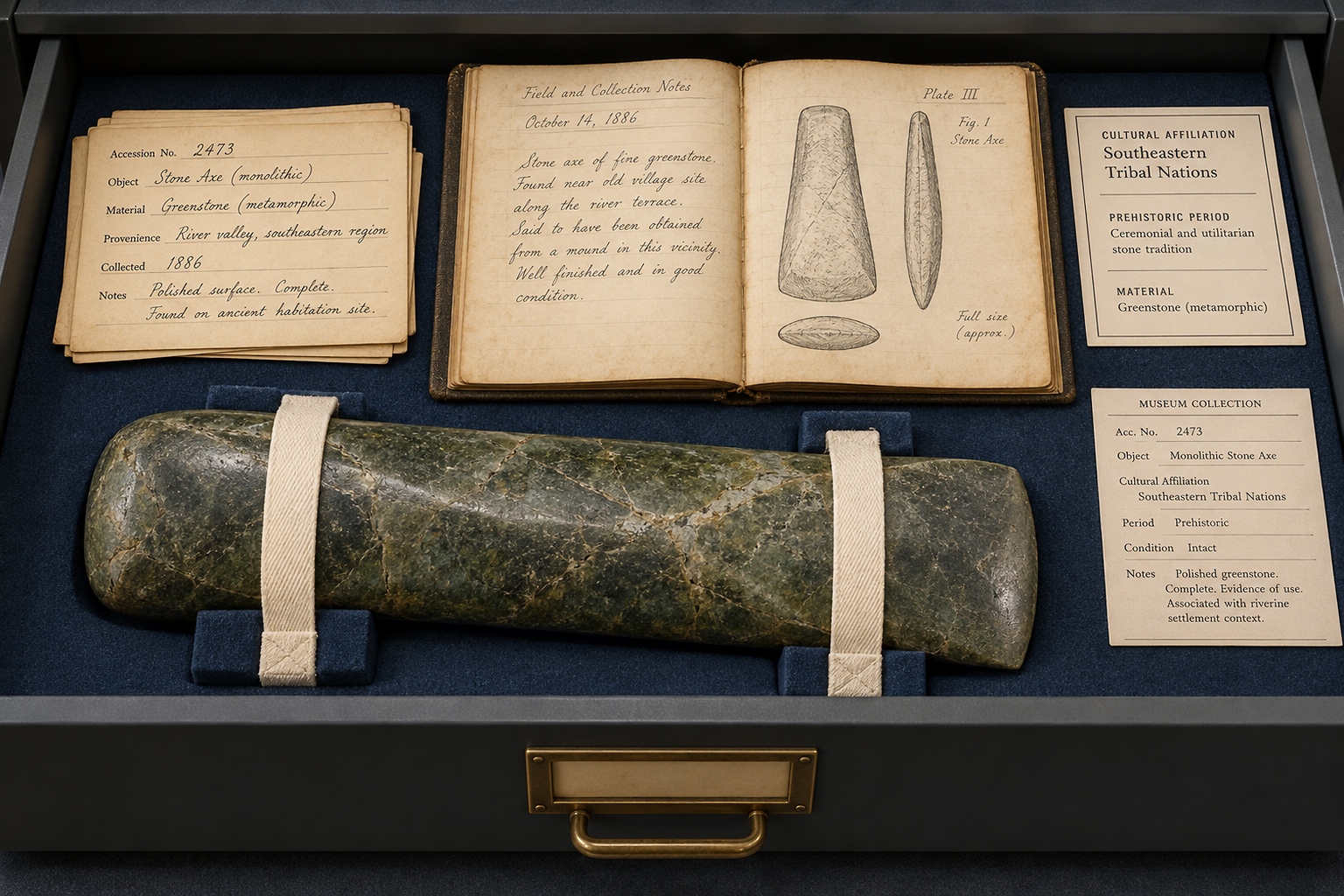
During the late nineteenth and early twentieth centuries, monolithic stone clubs became prime trophies for antiquarians and elite collectors. The immaculate symmetry, exotic forms, and high polish of these artifacts commanded exorbitant sums on the private antiquities market, driving extensive illicit looting of mounds across Tennessee, Alabama, and Arkansas.
Notable early specimens entered the collections of the Smithsonian Institution, the National Museum of the American Indian, and European ethnographic museums, often stripped of their precise burial contexts. Without stratigraphy, early scholars frequently misidentified them as Mesoamerican imports, failing to recognize that local Southeastern cultures possessed indigenous stone-carving traditions equal to any in the Americas.
In recent decades, the legal and ethical landscape surrounding these sacred weapons has shifted dramatically. Under the Native American Graves Protection and Repatriation Act (NAGPRA), federally recognized tribes—including the Muscogee Nation, the Choctaw Nation, the Cherokee Nation, and the Caddo Nation—have asserted cultural affiliation over mortuary objects excavated from mound centers. As a result, several monolithic axes have been returned to tribal custody, recognized not merely as ancient archaeological specimens, but as sacred ancestral regalia.
The Stone Club in the Balance of Pre-Columbian Armory
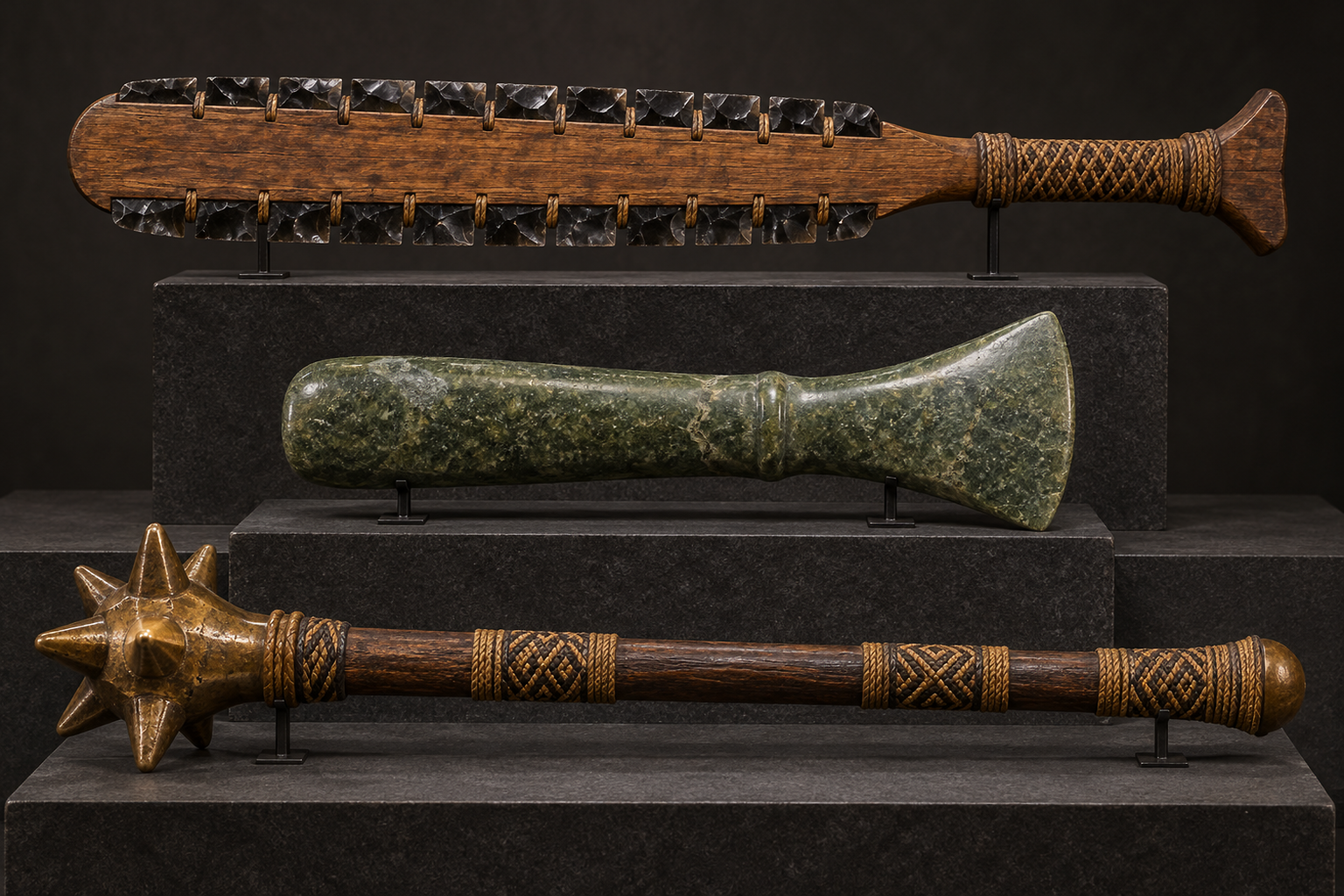
Viewed alongside the obsidian-edged macuahuitl of central Mexico or the cast-bronze star-headed maces of the Inka Andes, the Mississippian monolithic axe represents a distinct North American approach to martial regalia, combining raw lithic craft with the symbolic weight of political authority.
Rather than relying on metallurgy or composite modularity, Mississippian craftsmen elevated the humble ground stone celt into a singular work of sculptural devotion. By freezing a dynamic assembly of wood, sinew, and stone into an unyielding monolith of greenstone, they created an object that denied the impermanence of organic materials.
These clubs demonstrate that prehistoric weapon design was not governed solely by mechanical efficiency or shock resistance. In the palisaded towns of the pre-Columbian South, power was reinforced through visual display and cosmological lineage. A single polished axe of greenstone communicated the bearer's elite rank and the violent authority underpinning chiefdom politics.
Further reading
Follow the sources to examine the object and its historical context.
Brown, James A. The Spiro Ceremonial Center: The Archaeology of Arkansas Valley Caddoan Culture in Eastern Oklahoma. Memoirs of the Museum of Anthropology, University of Michigan, 1996.External reference · Opens in a new tab Milner, George R. The Cahokia Chiefdom: The Archaeology of a Mississippian Society. Smithsonian Institution Press, 1998.External reference · Opens in a new tab Knight, Vernon J., and Vincas P. Steponaitis, eds. Archaeology of the Moundville Chiefdom. Smithsonian Institution Press, 1998.External reference · Opens in a new tab Larson, Lewis H. Piercing the Past: The Mortuary Complex of Mound C, Etowah. University of Georgia Press, 1989.External reference · Opens in a new tab