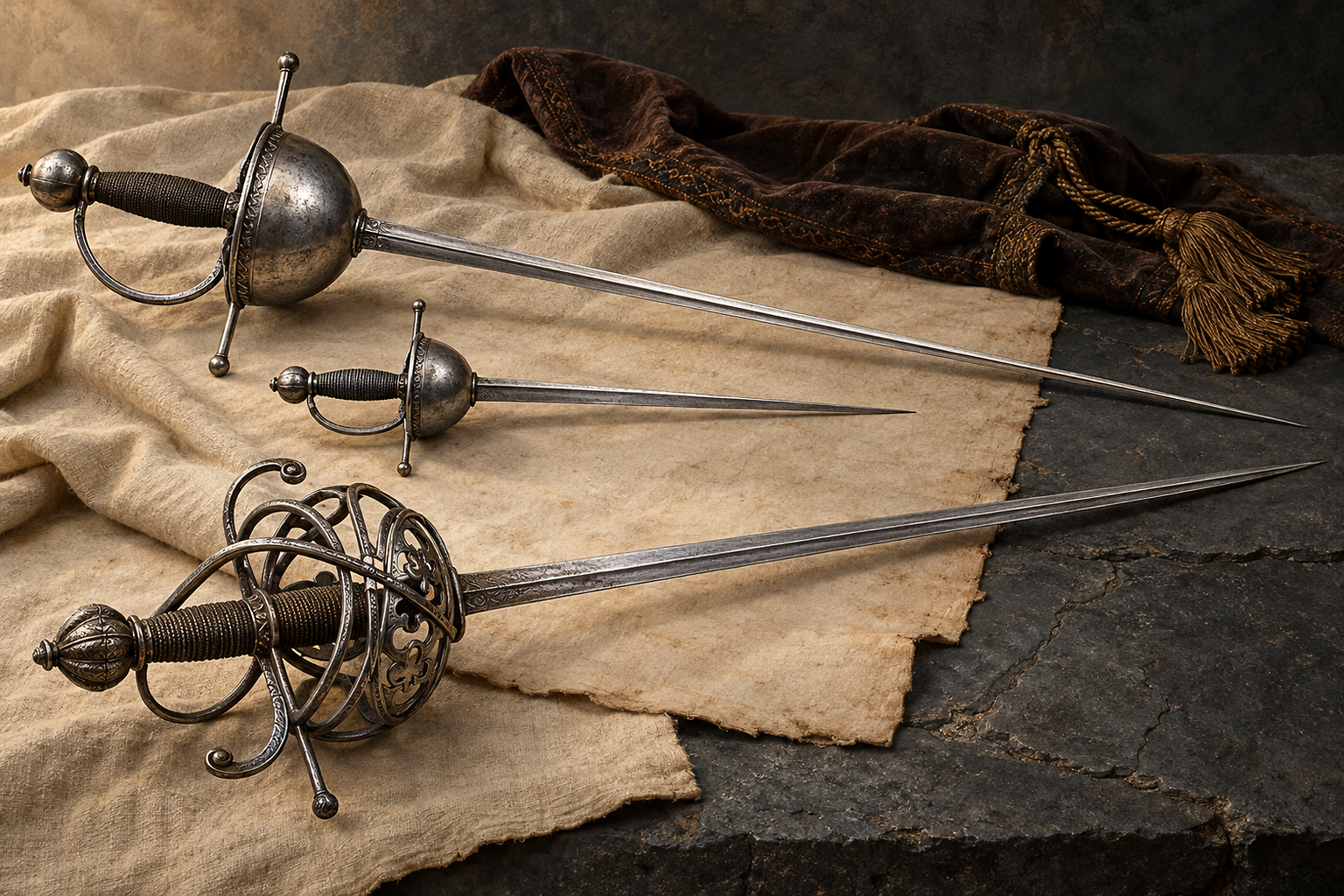
In the mid-seventeenth century, Iberian arms makers simplified the intricate cage of sweeping bars that had shielded the rapier hand for decades. In place of complex branches, rings, and pas d'âne loops, they installed a deep hemispherical steel bowl known as the cup, or taza. Paired with a matching sail dagger held in the left hand, this weapon system answered the rigorous mathematical demands of Spanish fencing philosophy, creating an impenetrable defensive enclosure around the fingers while projecting an extraordinarily long, stiff point along calculated lines of engagement.
The Evolution from Swept Hilts to the Solid Steel Cup
Sixteenth-century rapiers relied on complex swept hilts formed from interlocking steel bars. While visually striking and effective at deflecting wide cuts, these open cages suffered from a dangerous structural vulnerability. A narrow, well-aligned thrust could slip between the outer rings and pierce the fingers wrapped around the ricasso. As thrust-oriented fencing became faster and more precise across Western Europe, armorers sought a guard that offered seamless physical coverage without adding excessive weight to the pommel balance.
The solution developed across the Iberian peninsula and southern Italian territories under the Spanish crown was the cup hilt, or guarnición de taza. Armorers formed a thin, spherical bowl of iron or mild steel, securing it over the quillon block directly beneath the crossguard. This bowl completely enveloped the hand, enclosing the knuckles, thumb, and forefinger within a continuous dome of metal. Hostile points could no longer find seams between bars, giving the lead hand continuous coverage against straight thrusts.
The earliest true cup-hilts appeared in the opening decades of the seventeenth century and rapidly achieved dominance by the 1640s. While northern European fashion began turning toward lighter smallswords with dish hilts by the late seventeenth century, Spain and its overseas viceroyalties retained the full-sized cup-hilt rapier well into the eighteenth century. The design suited both civilian honor duels and colonial frontier defense, where long reach and solid hand protection remained paramount.
Anatomy of the Cup: Taza, Rompepuntas, and Guardapolvo
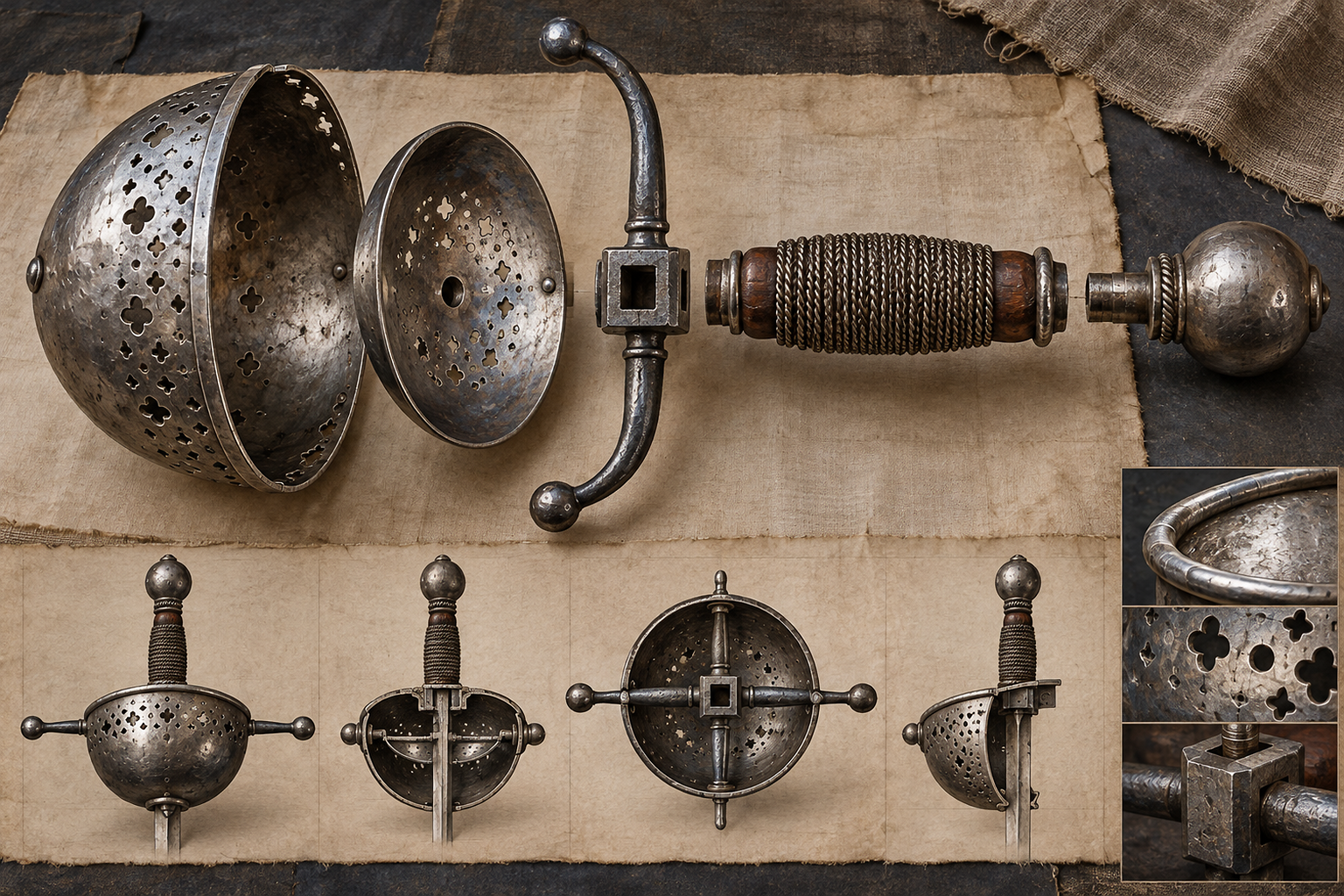
A standard Iberian cup hilt appears deceptively simple from a distance, but its internal assembly incorporates several specialized components engineered for defense. The outer shell, the taza, was hammered from sheet iron or steel, either kept smooth and mirror-polished or pierced with intricate scrolling foliage and chiseled grotesque masks. High-end examples achieved remarkable visual delicacy through openwork chasing without sacrificing structural stiffness.
Inside the bowl sat a secondary plate known as the guardapolvo, literally the dust-guard. This inner liner prevented hostile blade tips from catching against the internal quillon arms or penetrating the decorative pierced openings of the outer cup. It also acted as a mechanical brace, dampening the vibration of heavy impacts that might otherwise loosen the pommel peen or deform the thin exterior shell.
Around the outer rim of the bowl, makers typically rolled the metal outward or riveted a heavy circular wire flange called the rompepuntas, or point-breaker. When an opposing thrust struck the exterior of the cup, the sloping spherical surface deflected the enemy tip outward toward the rim. The rolled edge caught the sliding point, arresting its travel and preventing it from skidding off the cup into the defender's forearm, face, or throat.
Blade Geometry and Toledo Metallurgy
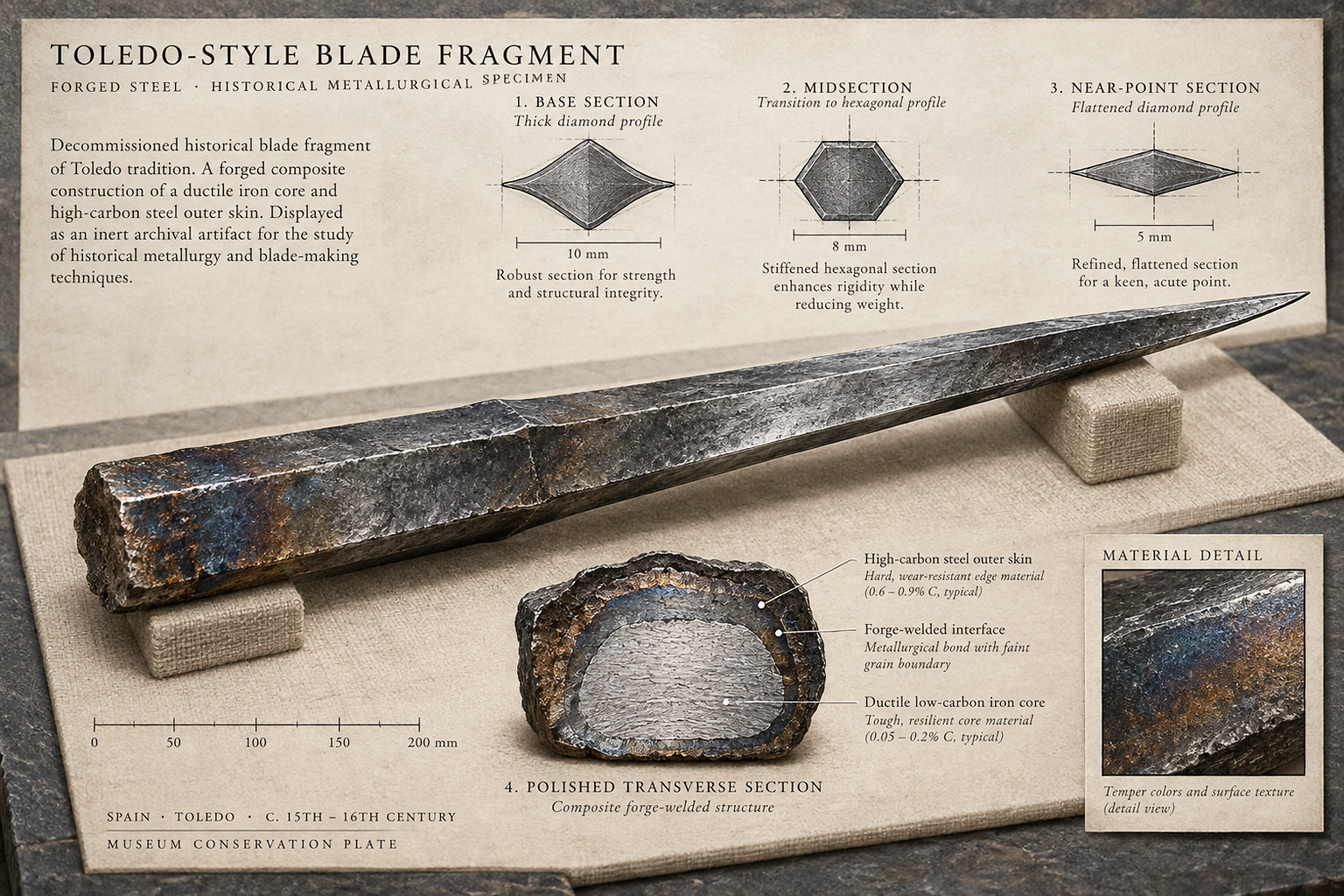
The blades mounted in Spanish cup-hilts were long, exceptionally rigid, and tapered with extreme care. Averaging between 100 and 115 centimeters in length, they maintained a thick diamond or hexagonal cross-section through the strong half of the blade before transitioning to a flattened diamond profile toward the point. This distal tapering allowed the blade to retain enough stiffness to deliver lethal linear thrusts through heavy wool doublets while keeping the overall weapon maneuverable in single-handed play.
Toledo maintained an international reputation as the premier blade-making center of the Spanish Empire. The metallurgical prowess of Toledo workshops stemmed from skilled manipulation of local iron ores and carefully controlled heat treatment. Rather than using homogenous modern steel alloys, master smiths forge-welded high-carbon steel envelopes around soft, ductile iron cores. This composite structure prevented the long, slender blades from shattering upon impact while allowing the edges and thrusting tip to take a razor-sharp, wear-resistant temper.
Quenching practices contributed significantly to the blade's functional properties. Toledo smiths quenched their normalized blades in water baths conditioned with organic materials, tempering them slowly over charcoal fires until the metal achieved a resilient spring temper. The resulting blade could flex substantially under stress and immediately spring back true, a vital quality for a weapon subjected to violent parries and thrusting shocks.
Makers, Guild Regulations, and Counterfeit Marks
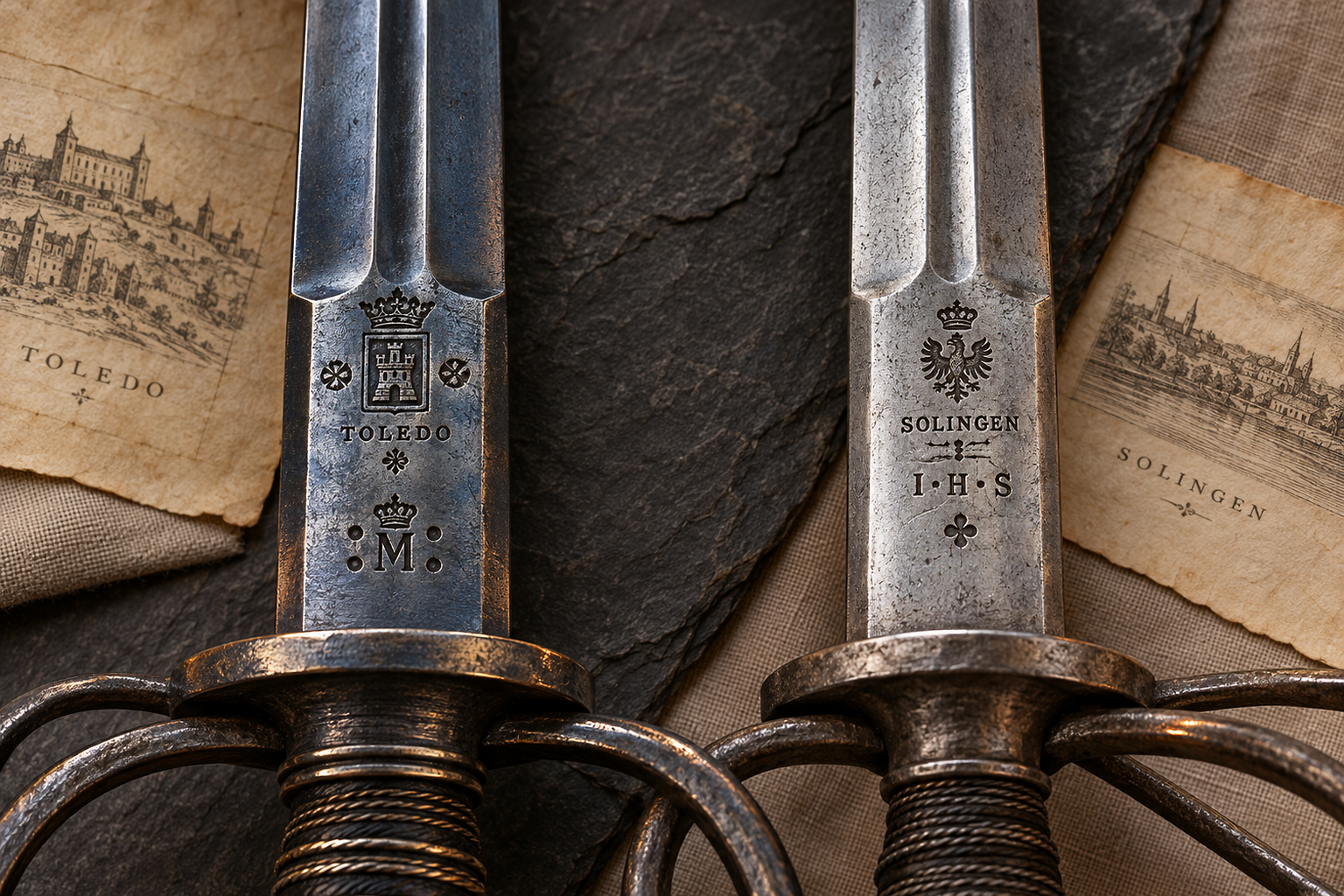
The sword makers of Toledo operated under strict guild oversight administered by the city council and royal inspectors. Master smiths were required by law to strike their registered maker's marks and full names into the ricasso or down the deep central fuller of the blade. Celebrated names such as Tomás de Ayala, Sebastián Hernández, and the Sahagún family became synonymous with supreme balance and reliability across European courts.
The commercial success of Toledo blades spawned an aggressive counterfeit industry. Cutlers in Solingen, Germany, and northern Italy routinely stamped forged Toledo marks, including the famous crowned letter stamps and misspelled versions of Spanish masters' names, onto their own export blades. These German blades were imported across Europe and fitted with local hilts, creating a complex trail for modern arms historians.
To discern an authentic Iberian blade from a German export specimen, scholars examine the cross-sectional geometry, fuller execution, and the consistency of the metallographic grain. Genuine Toledo work typically exhibits meticulous fuller channelling and cleaner transitions along the ricasso, where the metal met the internal quillons of the cup.
The Philosophy of La Verdadera Destreza
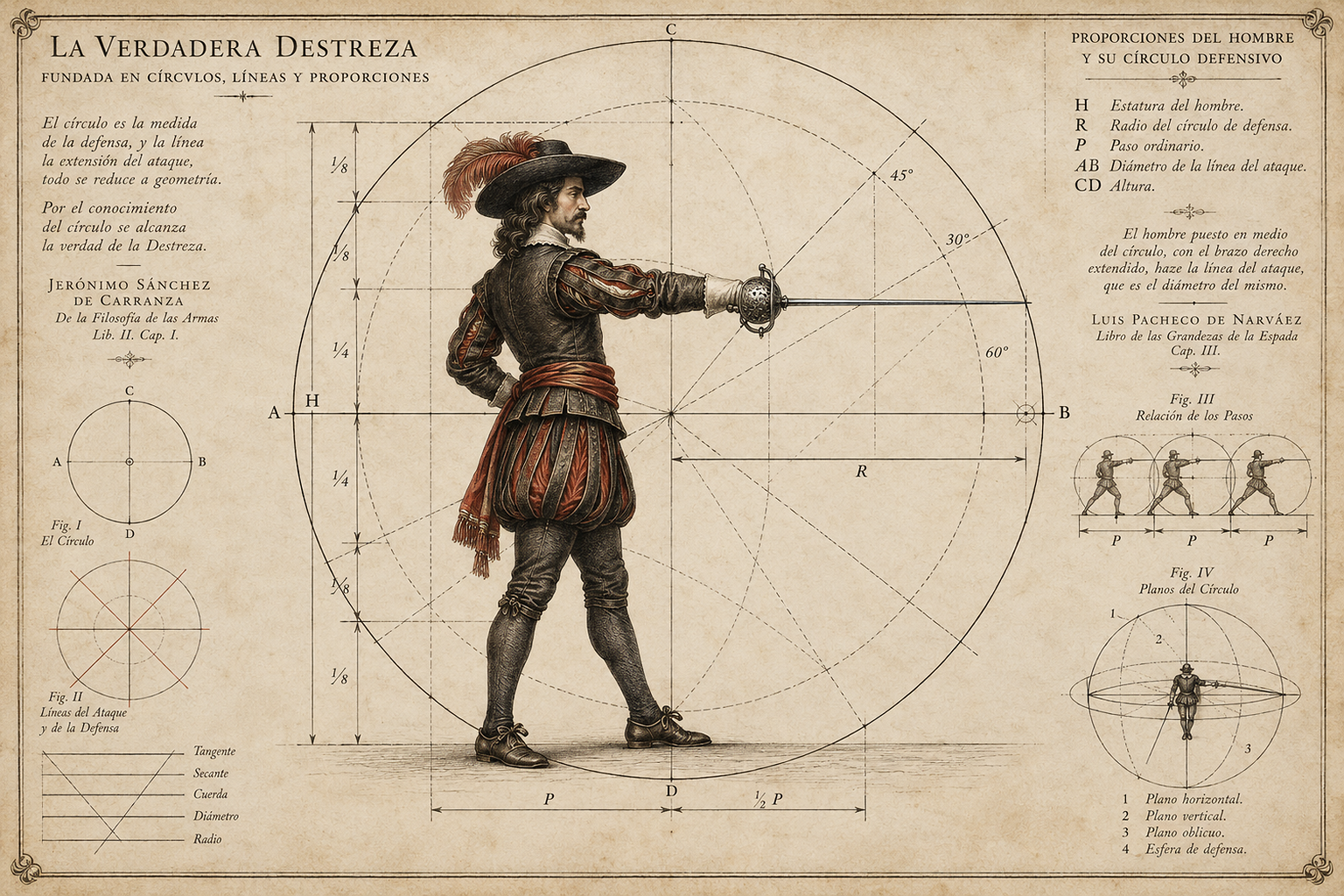
The technical employment of the cup-hilt rapier was inextricably bound to La Verdadera Destreza, the "True Art" of Spanish fencing founded by Jerónimo Sánchez de Carranza in his 1582 treatise and expanded by Luis Pacheco de Narváez throughout the seventeenth century. Unlike the pragmatic, cut-and-thrust traditions of contemporary Italian and English masters, Destreza was an intellectual discipline grounded in Aristotelian natural philosophy, geometry, and Christian humanism.
Destreza treated the combat space as a dynamic geometric plane governed by Euclidean principles. Masters mapped the duel onto a conceptual circle drawn upon the ground, known as the círculo común or common circle. Combatants stood upright with erect posture and slightly flexed knees, extending their weapon arms straight toward the opponent along the center diameter.
The system explicitly rejected linear lunging, which Carranza and Pacheco considered reckless and physically destabilizing. Instead, practitioners moved along concentric circular paths and tangential chords, maintaining an unyielding defensive sphere while shifting their body angles to gain control of the opponent's steel.
The Right Angle and the Sphere of Defense
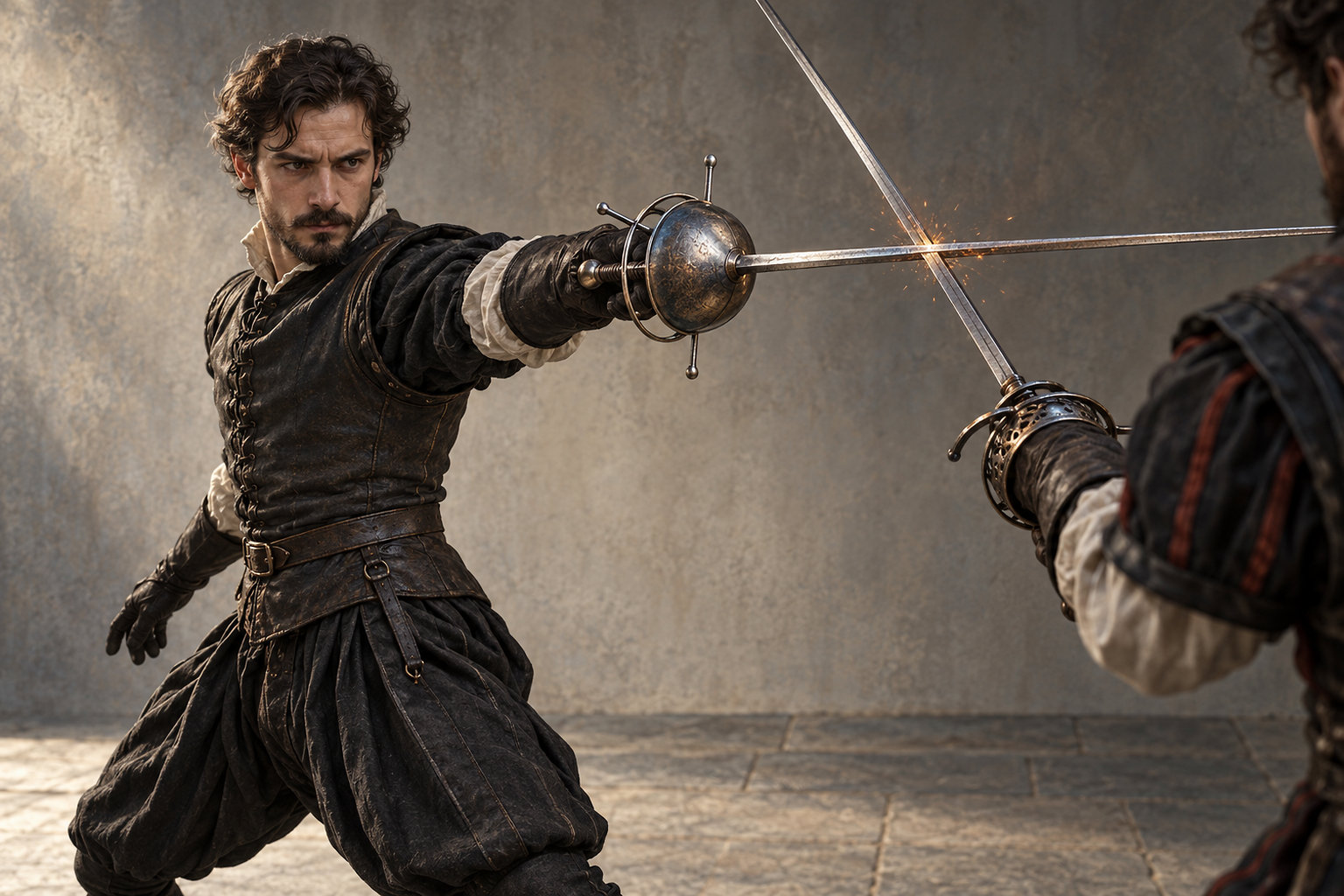
At the foundation of Destreza tactical theory lay the ángulo recto, the right-angle posture. The diestro held the rapier straight forward at shoulder height, forming a ninety-degree angle with the torso. The cup hilt rested forward, acting as a physical shield that covered the forearm and chest while presenting the point directly at the opponent's eyes or throat.
This forward posture fundamentally altered the geometry of the encounter. Because the cup was held far out from the chest, it intercepted incoming lines of attack early, long before an enemy blade could approach the torso. Any cut or thrust aimed at the body was caught on the broad exterior of the bowl, allowing the defender to make minimal, economical deflections using subtle turns of the wrist.
From this position, the diestro practiced the atajo, the mechanical subjugation of the opposing blade. By placing the strong portion of their blade over the weak portion of the adversary's weapon, the fencer bound the enemy steel downward and outward. The solid cup protected the hand during these tight, binding engagements, where bare fingers or open bar guards would have been vulnerable to close-range counter-cuts.
Thibault's Geometric Synthesis
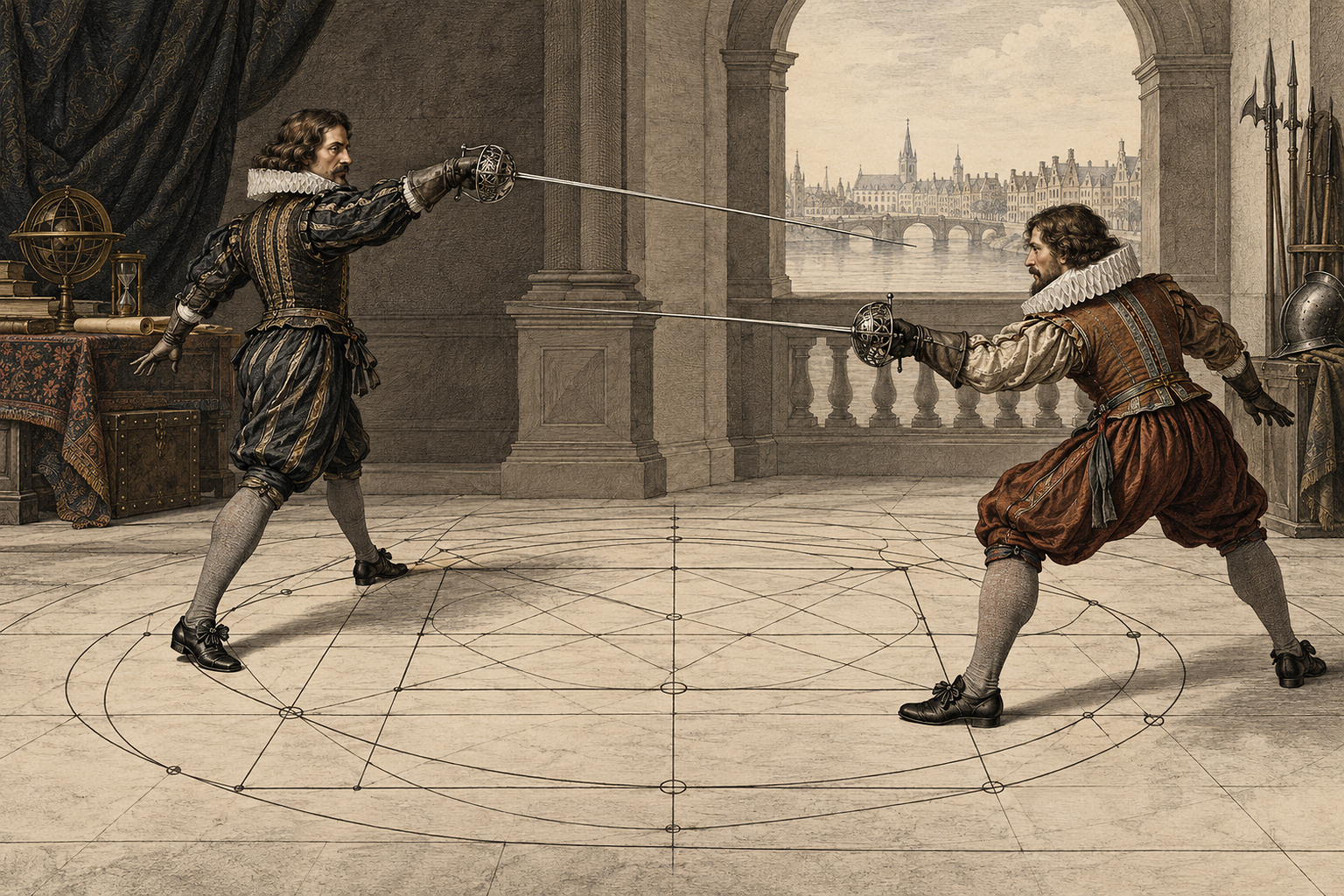
The most visually exhaustive documentation of Spanish rapier principles appears in the monumental 1628 treatise Académie de l'Espée by the Flemish master Gérard Thibault d'Anvers. Although published in Leiden, Thibault had studied fencing in Spain and synthesized Destreza theory with stunning oversized copperplate engravings executed by leading Dutch artists.
Thibault's plates illustrate combatants moving through intricate webs of numbered circles, intersecting chords, and radial tangents. He analyzed the exact physical dimensions of the combatants, deriving the dimensions of the fencing circle directly from the human body's proportions, measured from the sole of the foot to the navel and the crown of the head.
The illustrations clearly demonstrate the function of the long, straight rapier within this mathematical framework. In Thibault's plates, the straight arm and cup-level guard allow the fencer to pivot around an opponent's aggressive thrust, stepping along circular lines to strike over or around the adversary's guard without ever retreating in a direct line.
The Sail Dagger: Daga de Vela Architecture
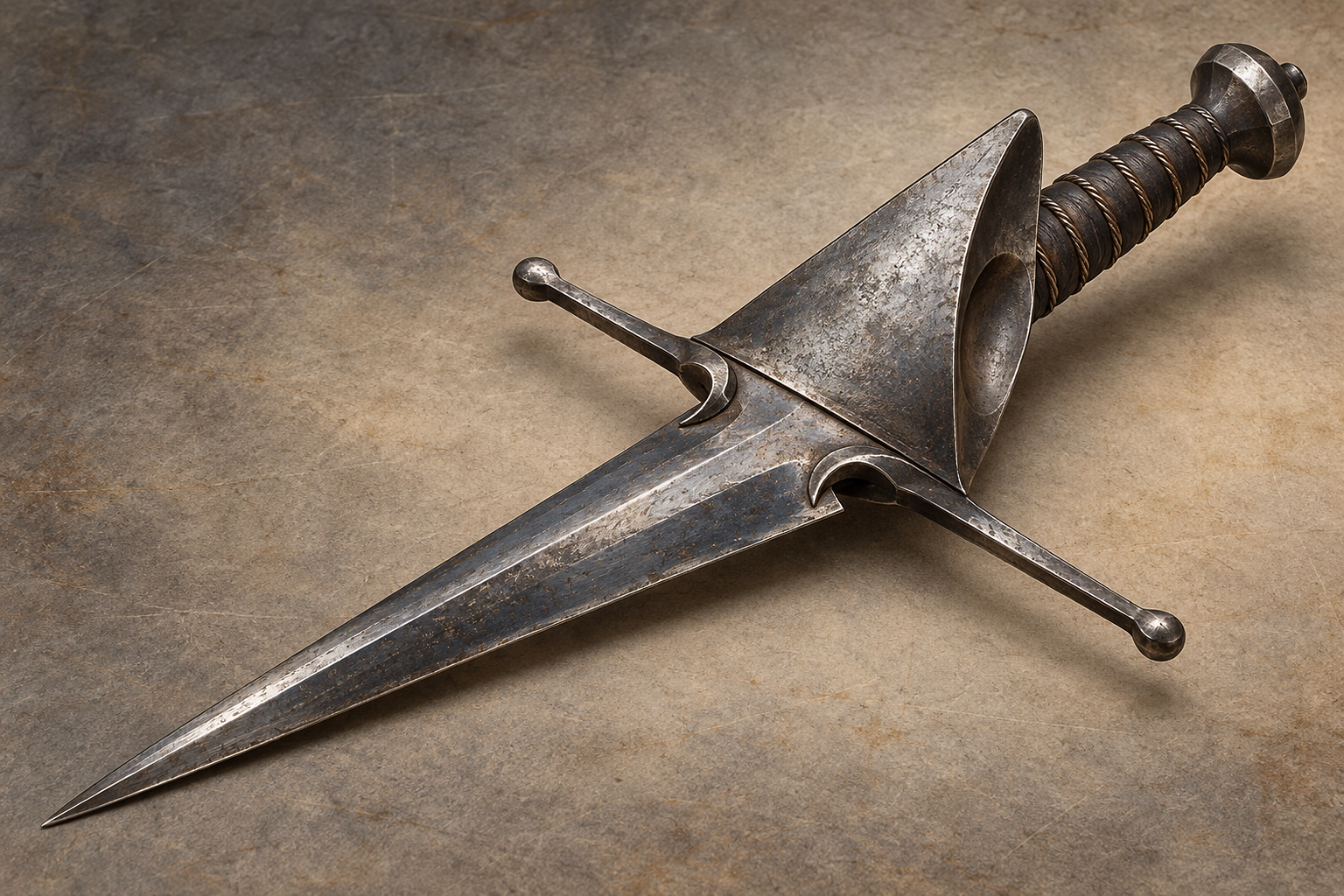
While the cup-hilt rapier could be used alone with a cloak or buckler, its definitive companion in civilian combat was the sail dagger, known in Spanish as the daga de vela. This left-hand parrying weapon took its name from the distinctive triangular plate of steel that swept back from the crossguard toward the pommel, resembling the triangular lateen sail of a Mediterranean vessel.
The sail plate mirrored the protective function of the rapier's cup. It formed a rigid barrier over the knuckles of the left hand, allowing the fencer to intercept high-velocity thrusts and cuts without risking severed tendons. The crossguard of the sail dagger featured remarkably long, straight quillons, often measuring over twenty-five centimeters from tip to tip, which caught and guided incoming blades away from the torso.
Internally, the sail dagger incorporated specialized catching mechanisms. Many surviving examples possess two curved retaining lugs forged into the base of the blade just above the quillon block. These small steel hooks, combined with deep grooved thumb depressions on the inner face of the sail, allowed the fencer to wedge their left thumb firmly against the guard, exerting tremendous downward leverage against an enemy blade.
Two-Handed Coordination in Dual-Weapon Combat
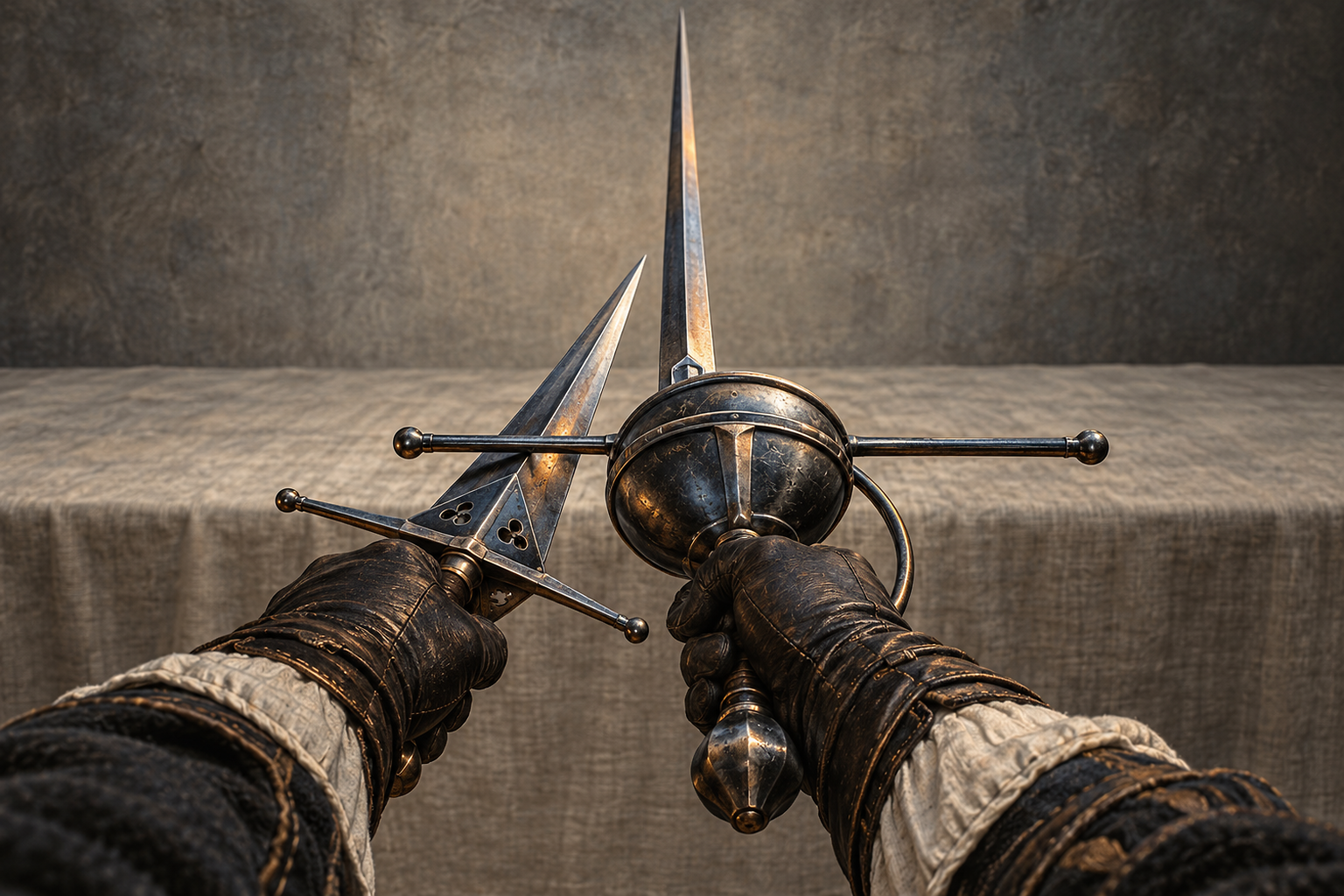
Fighting with rapier and dagger required intricate motor coordination, turning the combatant into a mobile defensive redoubt. In the Spanish style, the sail dagger was not held low near the waist as in some early Italian traditions. Instead, it was brought forward, operating just beneath or alongside the rapier's cup to form an interlocking wall of steel.
The primary defensive sequence relied on crossed guards. When an opponent unleashed a powerful linear thrust, the diestro stepped obliquely off the line of attack, parrying the thrust outward with the sail dagger while maintaining the rapier point on the opponent's center line. The sail plate absorbed the impact of the blow, while the long quillons trapped the opposing steel, leaving the attacker fully exposed to a direct counter-thrust.
In close-quarter scuffles where distance collapsed inside the reach of the long rapier, the sail dagger became a lethal primary weapon. The stout, diamond-section dagger blade, typically thirty to forty centimeters in length, could penetrate thick buff coats and heavy leather that might resist a compromised cut from the sword.
The Daga de Vela Blade: Pierced Fullers and Serrated Catchers
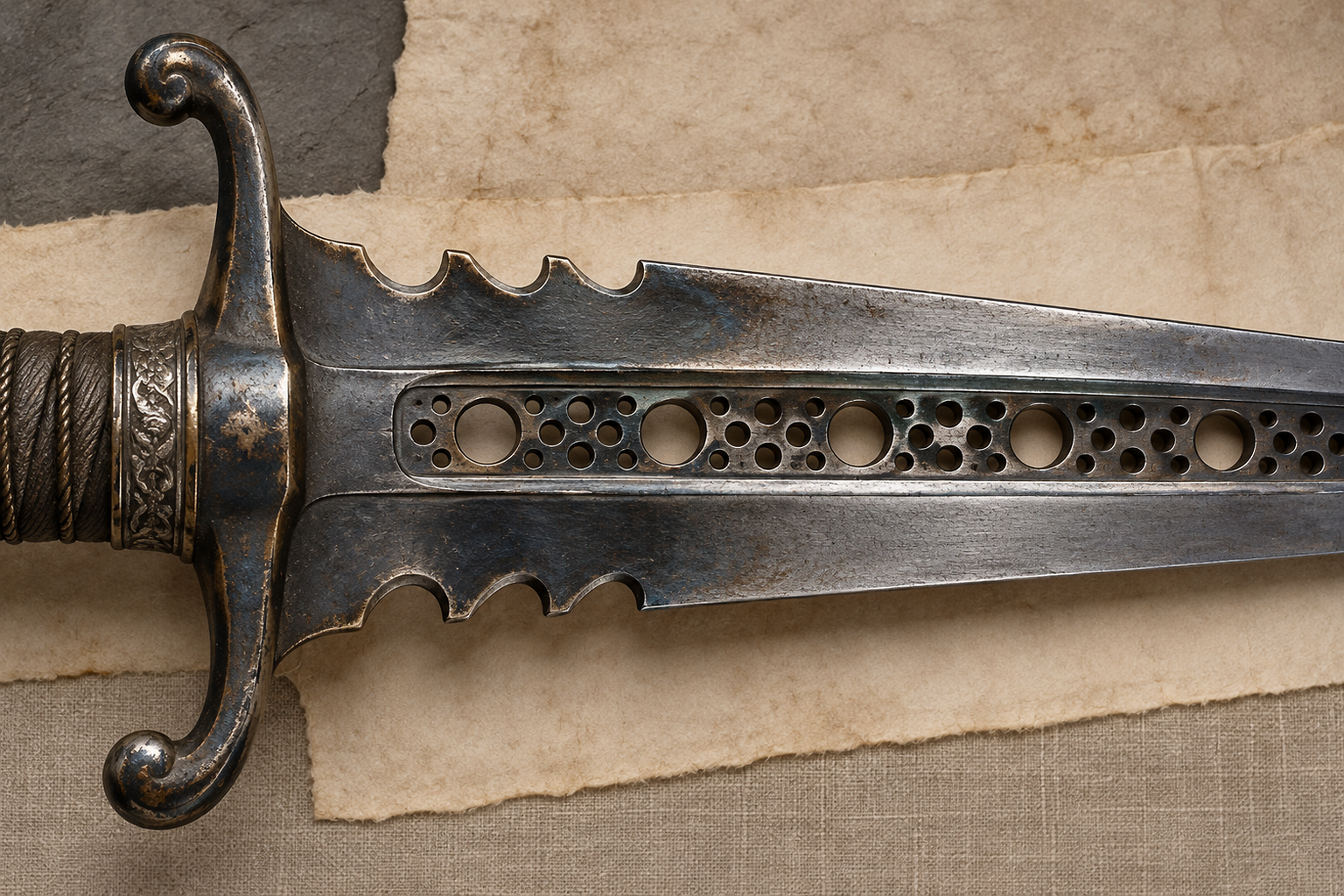
The blades of sail daggers exhibit remarkable variety, reflecting both functional ingenuity and regional metalworking traditions. While many were simple, stiff diamond-ground thrusting spikes, others were engineered specifically to disrupt an opponent's weapon play through textured surfaces and blade traps.
A common feature found in high-grade Iberian sail daggers is the pierced fuller. The strong half of the dagger blade often features a broad, deep central channel filled with hundreds of tiny, decorative drilled holes and filed scrollwork. While modern observers sometimes mistake these for poison channels, historical metallurgists recognize their real purpose: lightening the broad blade without reducing its spine thickness, while providing an abrasive, textured surface that generated friction against opposing steel.
Other examples incorporated scalloped or serrated sections along the unsharpened forte. These teeth were not meant to physically snap an opponent's rapier blade—a rare occurrence given the high ductility of quality sword steel—but rather to firmly arrest sliding blades, preventing the adversary from slipping free of a parry during the decisive instant of counter-attack.
Colonial Service and the Frontier Legacy
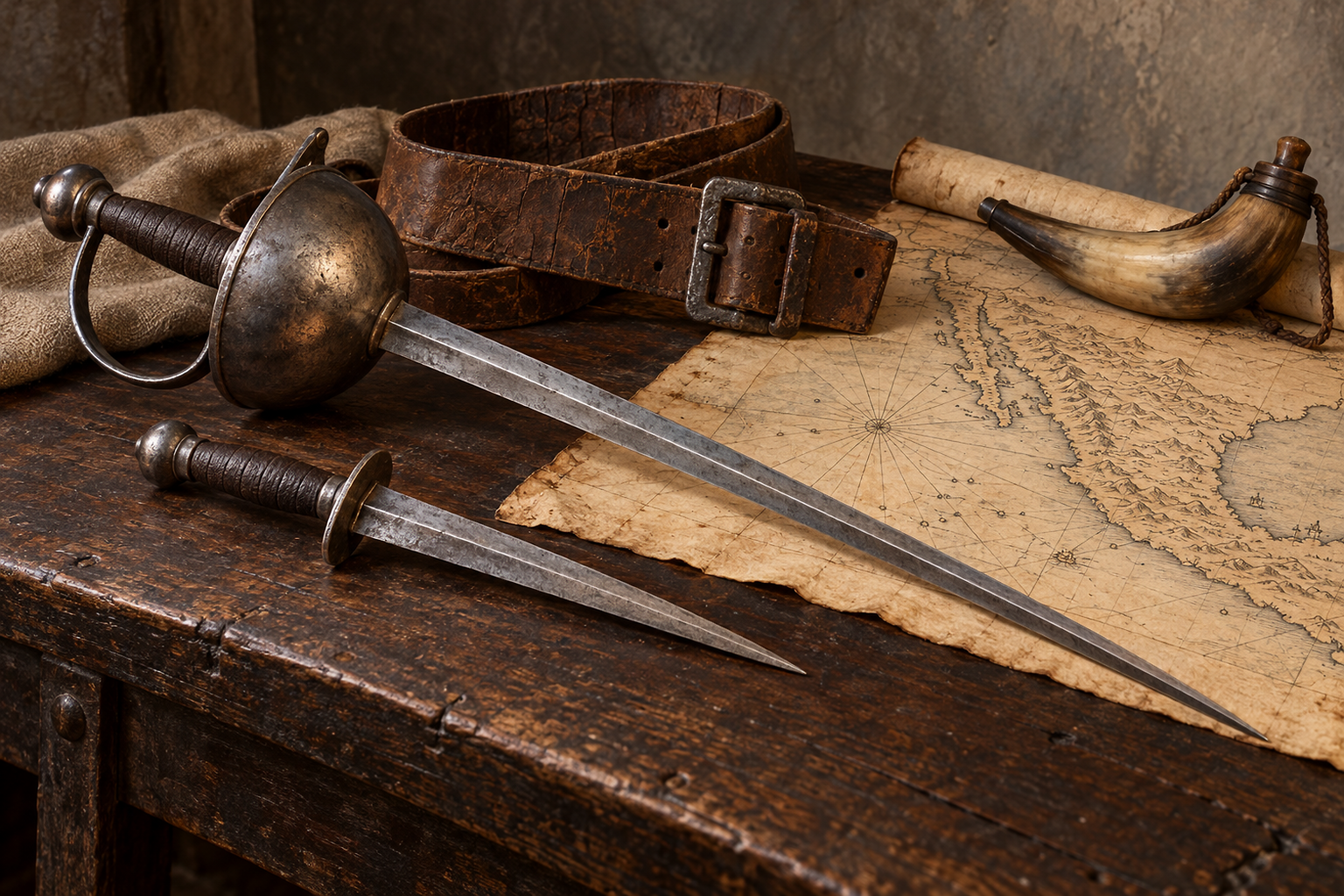
The cup-hilt rapier and sail dagger were not confined to European fencing salons and urban streets. They traveled aboard galleons across the Atlantic and Pacific, serving as the standard civilian and officer sidearms throughout the Spanish Empire, from the viceroyalties of New Spain and Peru to the captaincies of the Philippines.
In the Americas, the robust nature of the cup hilt proved far superior to fragile swept-hilt designs. Frontier environments, shipboard dampness, and rough transport took a heavy toll on complex wire wrappings and slender open bars. A solid, unpierced steel cup required minimal maintenance beyond a coat of oil and offered dependable protection against unarmored opponents armed with polearms, machetes, or traditional indigenous weapons.
Archaeological excavations at colonial garrison sites, such as the Castillo de San Marcos in St. Augustine, Florida, have yielded fragments of rapier cups, long straight quillons, and sail dagger plates dating from the mid-seventeenth to the early eighteenth century. These finds confirm that while Madrid courtiers were adopting the French smallsword, imperial soldiers in the borderlands retained the proven mechanical reach of the cup-hilt rapier.
Decline, Transition, and Modern Historical Fencing
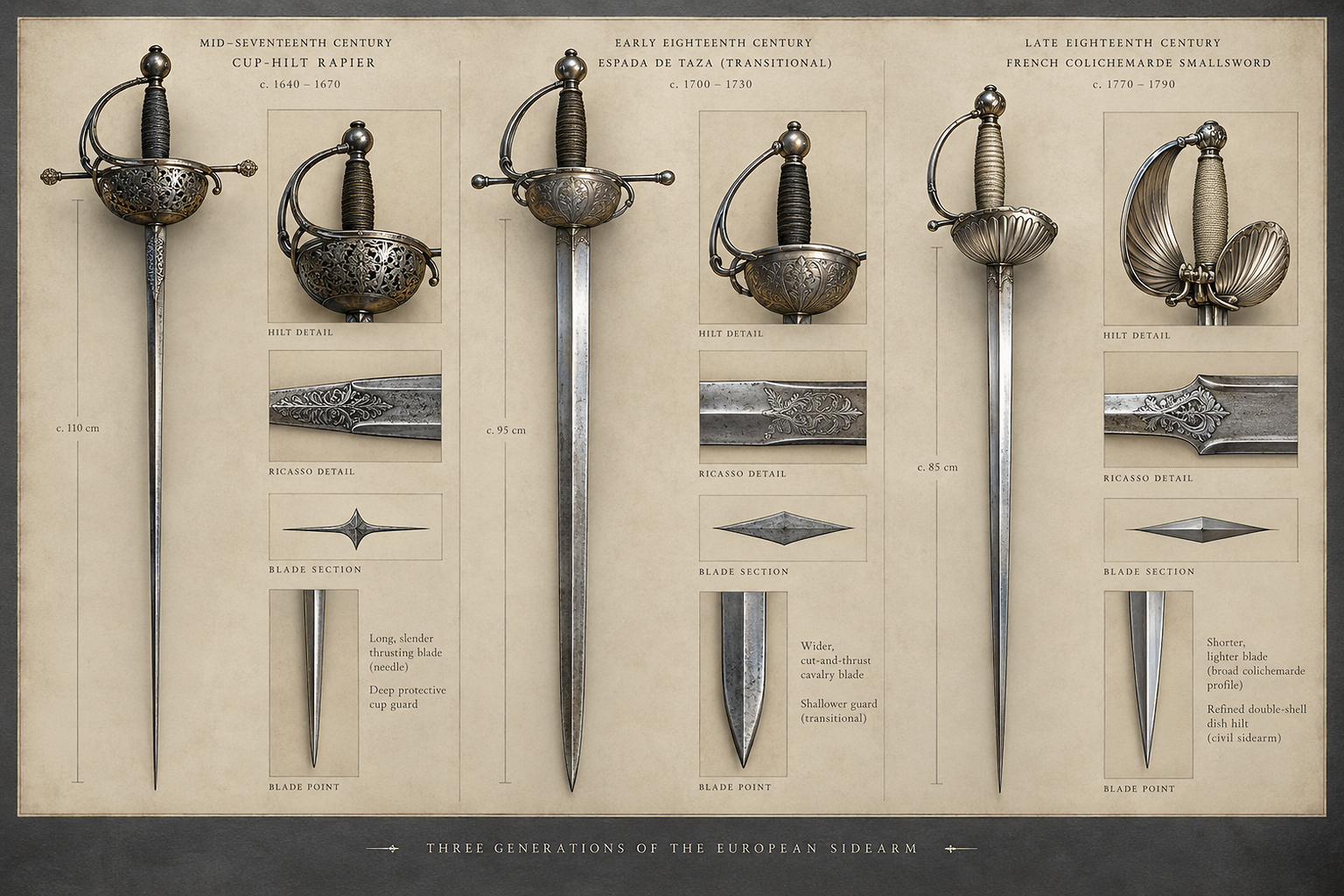
By the first decades of the eighteenth century, the dominance of the cup-hilt rapier was steadily eroded by French fencing doctrine and the rise of the colichemarde and smallsword. The French system favored speed, compact circular parries, and lightning-fast disengagements, rendering the massive 110-centimeter rapier cumbersome in fashionable urban dueling contexts. Spain's accession to the Bourbon monarchy in 1700 accelerated this cultural shift, introducing French military fashions to the Madrid court.
Despite this shift, the cup hilt refused to vanish entirely. Spanish cavalry units, municipal night guards, and traditionalists in Andalusia continued carrying broadsword-bladed weapons fitted into deep cup guards well into the mid-1700s, producing transitional sidearms known as espadas de taza with shorter, broader cutting blades.
Today, the cup-hilt rapier and sail dagger occupy a central place in the modern study of Historical European Martial Arts (HEMA). Practitioners reconstruct Carranza, Pacheco, and Thibault's treatises using flexible steel training replicas, rediscovering the subtle geometric efficiency of the right angle guard and the formidable hand security afforded by the steel cup.
Further reading
Follow the sources to examine the object and its historical context.
Real Armería de Madrid: Catálogo histórico-descriptivoExternal reference · Opens in a new tab Wallace Collection European Edged Weapons CatalogueExternal reference · Opens in a new tab Castillo de San Marcos National Monument Historical Arms ArchiveExternal reference · Opens in a new tab